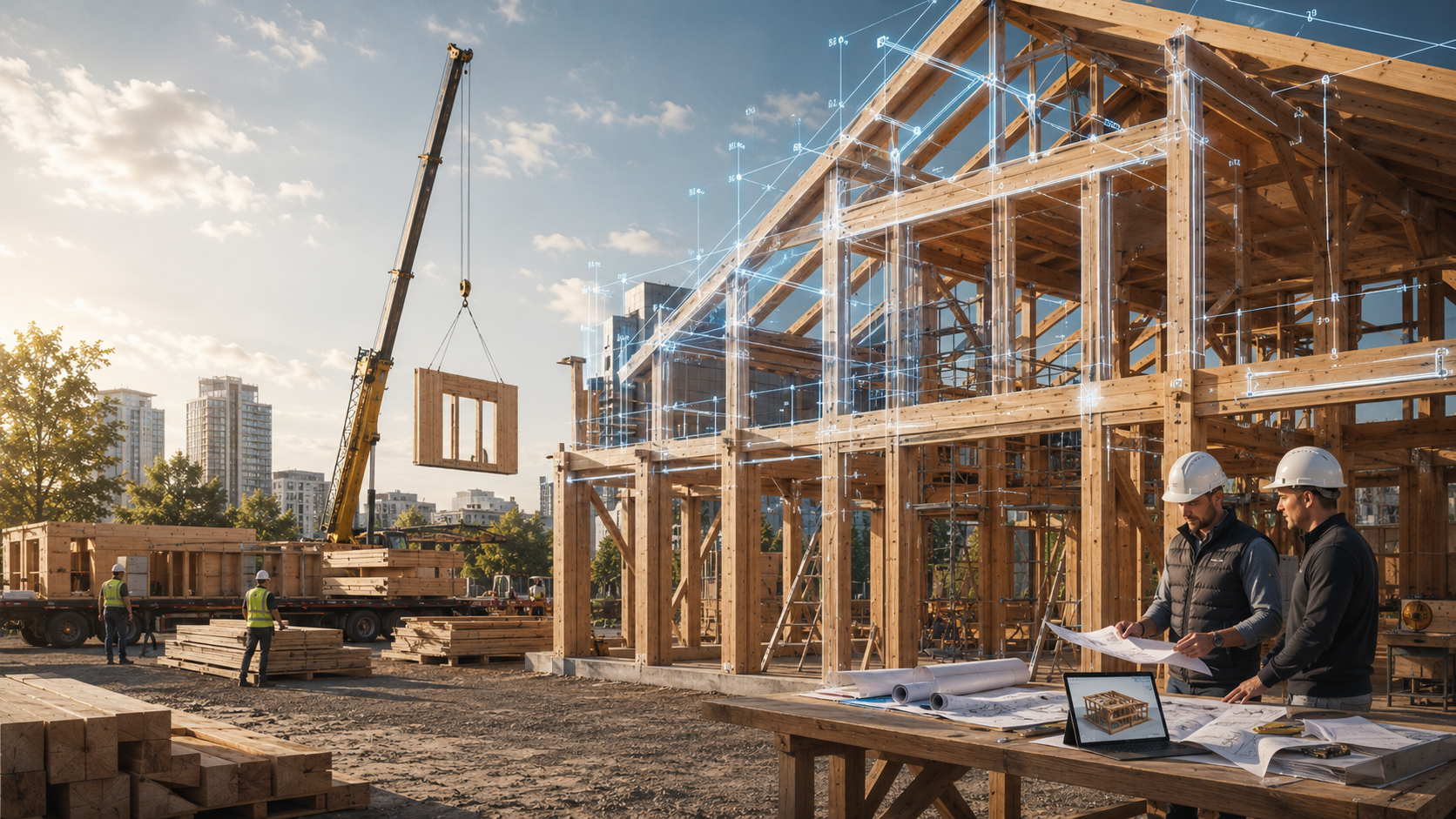
Why AI Still Struggles With Real Timber-Frame Design — And Why That Matters
AI can generate a beautiful timber house in seconds. But can it place the posts correctly, align the plates, respect structural logic, and produce something a builder can actually cut? That is where things get interesting.
AI is very good at making timber-frame houses look amazing.
Give it a prompt like:
“Modern timber-frame cabin in a forest, golden light, exposed beams, cozy interior, cinematic, award-winning architecture.”
And boom.
You get a house that looks like it belongs in a Scandinavian design magazine owned by a very rich raccoon.
The beams glow.
The windows are huge.
The fireplace is perfect.
There is probably a misty mountain in the background and a cup of coffee nobody will ever drink.
But here is the uncomfortable question:
Can you actually build it?
That is where AI still starts sweating.
Because timber-frame design is not just about making wood look pretty. It is about geometry, structure, load paths, sequencing, tolerances, connections, material lengths, code requirements, and all the boring details that decide whether your dream cabin becomes a real building or an expensive pile of firewood.
And in 2026, this gap is becoming more obvious.
AI can imagine.
But construction needs more than imagination.
The Problem: Buildings Are Not Just Pictures
Most people first experience AI design through images.
They type a prompt, get a beautiful render, and think:
“Great. Now I have a house design.”
Not really.
What they usually have is a mood board with confidence issues.
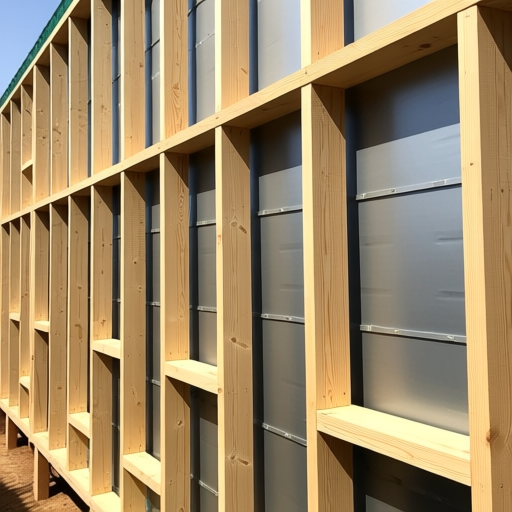
A timber-frame image can look realistic while being completely impossible. Posts may not align. Beams may float. Braces may connect to nothing. Roof loads may disappear into architectural optimism. Windows may cut through structural members like the AI has a personal problem with gravity.
And gravity, unfortunately, is not impressed by vibes.
This is the difference between visual realism and physical validity.
A picture can be beautiful.
A frame has to stand.
That distinction is now becoming a serious research topic. In 2026, researchers introduced DreamHouse, a benchmark focused on physical generative reasoning using residential timber-frame construction. The benchmark includes more than 26,000 verified timber-frame structures across 13 architectural styles and tests whether models satisfy geometric, structural, constructability, and code-compliance constraints — not just whether the output looks nice.
That is a big deal.
Because it confirms something builders already know:
Pretty is not the same as buildable.
Timber Frame Is a Brutal Test for AI
Timber-frame construction is a perfect stress test for AI because it looks simple from far away and becomes very unforgiving up close.
At first glance, it is just wood.
Posts. Beams. Plates. Rafters. Studs. Braces.
Easy, right?
Not exactly.
A real timber-frame system has rules everywhere:
Posts need to land on supports.
Beams need bearing.
Wall plates need continuity.
Openings need headers.
Rafters need proper spacing and support.
Braces need useful angles and real connection points.
Loads need a path down to the foundation.
Material lengths matter.
Cut lists matter.
Waste matters.
Assembly order matters.
Moisture and tolerances matter.
And then, just to keep things spicy, every country, region, and building type may have different rules.
AI models are often trained to recognize what buildings look like. But construction requires understanding what buildings do.
That is a very different problem.
A model may know that a brace “belongs somewhere diagonal.”
But does it know whether that brace actually helps?
Does it know whether the joint can be cut?
Does it know whether two members collide?
Does it know if a 6 m beam can be bought locally?
Does it know if the frame can be assembled by two people, or whether you just designed a wooden puzzle that requires a crane, a priest, and three divorces?
Usually, no.
The Hidden Enemy: Plausible Nonsense
The most dangerous AI output is not obvious nonsense.
Obvious nonsense is easy to reject.
If an AI gives you a timber house with three roofs, eleven chimneys, and a staircase leading into the sky, fine. Everyone knows something went wrong.
The real problem is plausible nonsense.
That is when the design looks almost right.
A post is only slightly misplaced.
A plate line is almost continuous.
A roof shape is mostly believable.
A brace looks structural but does nothing useful.
A wall opening cuts into a member that should not be cut.
A beam is shown, but its connection is undefined.
This kind of error is dangerous because it feels professional at first glance.
For a beginner, it can look like a real plan.
For a builder, it creates extra checking work.
For a software tool, it becomes a trust problem.
And for a project, it can become expensive very quickly.
In timber construction, small geometry mistakes cascade. Move one wall. Now the roof changes. Change the roof. Now rafters change. Move the rafters. Now the cut list changes. Change the cut list. Now your material order is wrong. Order wrong material, and suddenly your “AI-assisted design workflow” becomes a very elegant way to buy the wrong lumber faster.
Not ideal.
Why Construction AI Needs Rules, Not Just Prompts
The future of AI in timber-frame design is not just better prompts.
It is constraint-aware design.
That means AI should not simply generate something that looks like a timber frame. It should generate within rules:
Structural rules.
Geometric rules.
Material rules.
Connection rules.
Manufacturing rules.
Code rules.
Assembly rules.
This is exactly the direction serious research is moving. The University of Stuttgart’s IntCDC, for example, describes AI co-design work for timber buildings that integrates computational design, structural analysis, and generative AI methods, with constraints formalised so generated systems can be physically consistent and buildable.
That is the key phrase:
Physically consistent and buildable.
Not “cool.”
Not “inspired.”
Buildable.
Because in construction, buildable beats beautiful every single time.
Ideally, AI should behave less like a fantasy artist and more like a very fast assistant who understands the rules and asks annoying but useful questions:
“Where does this beam bear?”
“What is the stud spacing?”
“Do you want metric or imperial?”
“Can this member be purchased in that length?”
“Should I generate the cut list?”
“Are you sure this opening does not remove the only thing holding up the roof?”
That is the AI we need.
Slightly less magical.
Much more useful.
Where AI Can Help Right Now
To be fair, AI is not useless for timber-frame work.
It can already help a lot in the early stages.
AI can generate concept directions.
It can help compare styles.
It can explain construction terms.
It can summarize code concepts.
It can create checklists.
It can help write project documentation.
It can assist with estimating logic.
It can generate blog posts, marketing content, product descriptions, and client-friendly explanations.
It can even help review a design if the underlying geometry is already clear.
But the important phrase is:
“if the underlying geometry is already clear.”
AI works best when it is connected to structured data.
A prompt is vague.
A model is not.
A proper design file knows where every wall, plate, post, roof plane, and opening actually is.
That is why browser-based timber design tools matter.
The goal is not to replace the framer with a chatbot.
The goal is to create a system where the design is already structured, measurable, and checkable — and then AI can assist intelligently on top of that.
In other words:
AI should sit on top of real geometry.
Not hallucinate the geometry from a pretty picture.
What This Means for Builders and DIYers
For builders, the lesson is simple:
Use AI for ideas, not blind instructions.
Let it inspire you.
Let it help you communicate.
Let it draft explanations and compare options.
But do not trust a timber-frame image as a construction plan.
For DIYers, this is even more important.
A beautiful AI-generated cabin can give confidence very quickly. Sometimes too quickly. The render looks finished, so the project feels solved.
But the real questions are still waiting:
What size are the posts?
What spacing are the studs?
How is the roof supported?
Where are the openings?
What is the cut list?
What happens at the corners?
How is everything fixed together?
Can this be built safely?
If the answer is “the AI picture looks fine,” stop.
That is not a plan.
That is a screensaver with ambition.
The Real Future: Human + Tool + AI
The strongest future is not AI replacing builders.
It is builders using better tools.
A good timber-frame design workflow should combine:
Human judgment.
Accurate geometry.
Simple editing.
Smart snapping.
Automatic material data.
Cut lists.
Rule checks.
And, eventually, AI assistance that understands the project instead of just describing it.
That is where construction software can become genuinely useful.
Not by pretending to be smarter than the craft.
But by respecting the craft enough to encode its rules.
Because timber framing is not just a style.
It is a logic.
And once software understands that logic, AI becomes much more powerful.
Final Thought
AI will absolutely change timber-frame design.
But not because it can generate pretty wooden houses.
We already have plenty of pretty wooden houses.
The real breakthrough will happen when AI can help create frames that are not only beautiful, but buildable, checkable, measurable, and ready for real materials.
Until then, use AI with enthusiasm.
Just keep a tape measure nearby.
And maybe a builder.
Final silly note: if an AI ever tells you “the beam is supported by the atmosphere,” politely close the laptop and go sharpen a pencil.