Mallets, Adzes, and Marking Knives: The Quiet Power Tools You’re Underestimating
Power tools scream, but traditional hand tools whisper—and still deliver joinery accuracy down to fractions of a millimeter. Meet the mallet, adze, and marking knife: three timeless tools that shape timber with precision, control, and zero battery anxiety.
Why the loudest tool isn’t always the best—and how three silent heroes shape joints with soul (and zero battery anxiety)
🪵 Power tools scream. These tools whisper… and still drop a perfectly fitted tenon.
Walk into any modern workshop and you’ll hear the usual soundtrack: drills buzzing, saws growling, routers whining like they’re on a deadline. It’s fast, it’s efficient… and honestly, it’s a little exhausting.
But step into a traditional timber frame shop—or the quiet corner of any serious joiner’s workspace—and the atmosphere changes completely. No fans. No sparks. Just the soft thunk of a mallet, the clean shhhhk of a blade slicing grain, and the calm confidence of someone shaping wood the way it’s been shaped for centuries.
These tools don’t plug in.
They don’t overheat.
They don’t beep angrily when the battery hits 3%.
And yet, for precision joinery, they are undeniably superior.
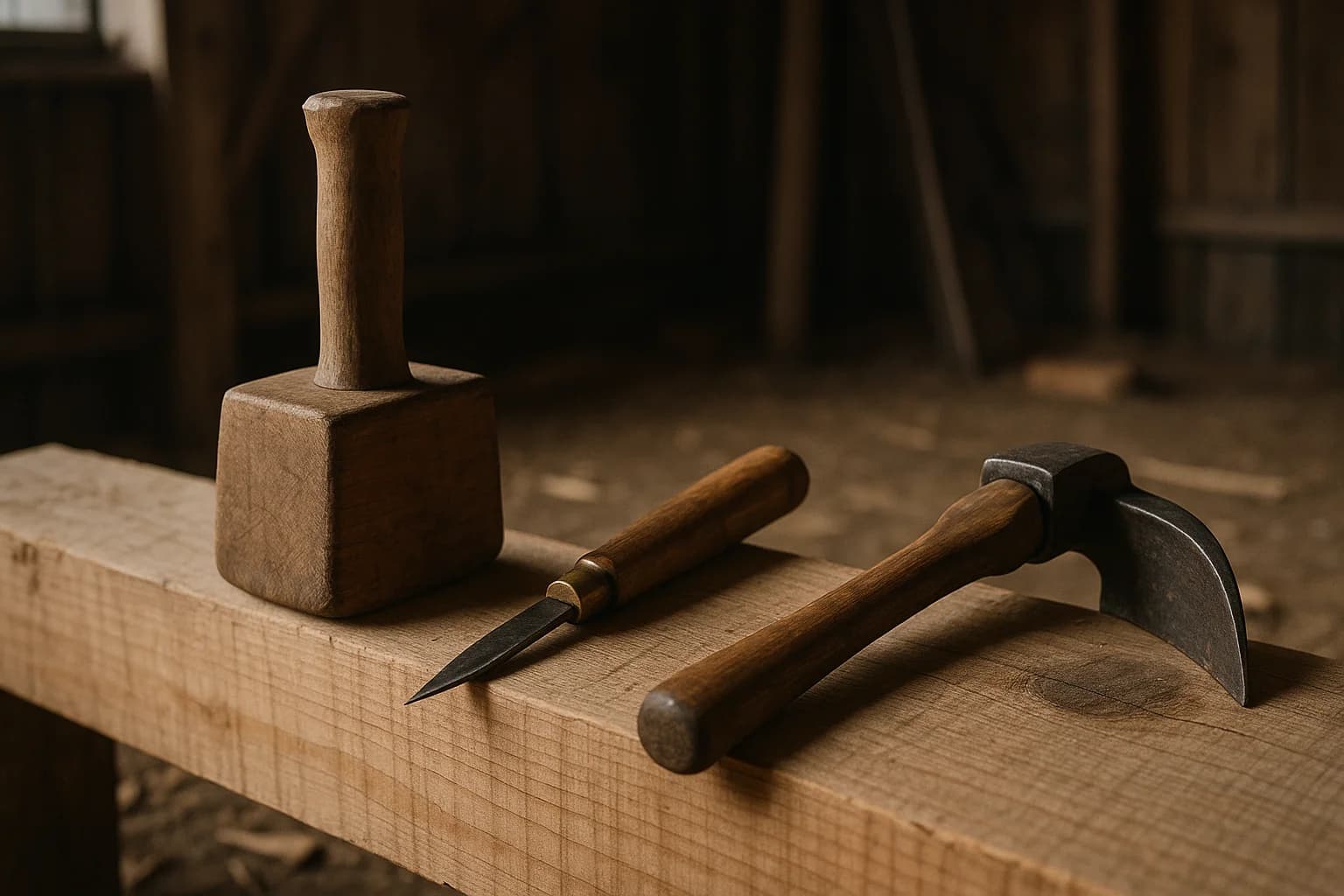
Meet the Quiet Power Trio:
- The Mallet
- The Marking Knife
- The Adze
Three tools that cost less than a premium drill battery… and consistently outperform it in accuracy.
🪓 1. The Mallet — Not a Hammer. Never a Hammer.
A timber framing mallet is designed for controlled force. Usually made from hickory, beech, or lignum vitae, it’s engineered to guide a chisel through wood fibers without bruising your beautifully prepared tenon shoulders.
Why not use a steel hammer?
- No dents — wood-on-wood is gentle but firm
- Better feedback — you feel resistance instantly
- Natural rhythm — thunk… thunk… thunk… like a focused woodpecker on an important project
Many high-quality mallets include metal rings to prevent the head from splitting. Think of them as seatbelts: not flashy, but life-saving for the tool.
A steel hammer smashes.
A mallet persuades.
✍️ 2. The Marking Knife — More Honest Than a Pencil
A pencil line is… vague. Wide. Smudgeable. Subject to humidity and wishful thinking.
A marking knife, especially a Japanese single-bevel knife, creates a precise incised line—a shallow kerf that defines exactly where the cut must go.
Try marking a shoulder line ±0.5 mm:
- Pencil → “somewhere around here”
- Knife → “this exact micron—or else”
The knife + square combination is unbeatable for layout accuracy. The blade rides against the reference edge, locking your measurement in place whether the board is 10°C or 30°C (50–86°F).
Bonus uses:
- Light paring
- Cleaning fuzz around mortises
- Opening packages (emotionally satisfying)
A pencil suggests.
A knife commits.
⚒️ 3. The Adze — The Original Surface Planer (With More Personality)
Looking like a hatchet with a philosophical bent, the adze was the dominant beam-shaping tool for thousands of years. And for good reason.
Unlike a power planer—which removes material uniformly whether the wood likes it or not—the adze responds to grain. You adjust your swing to the wood, giving surfaces a subtle hand-hewn texture that modern machines simply can’t replicate.
Why use one today?
- Aesthetic finishes — the scalloped surface catches light beautifully
- Historic accuracy — many restoration projects require adze-shaped beams
- Mindfulness — each swing is intentional, controlled, and deeply satisfying
- Strength training — accidental, but welcome
Modern adzes (from makers like Barr Tools or Ray Iles) use refined geometry and high-carbon steel, balancing tradition with performance.
Safety rule:
Always swing away from your body.
Preferably also away from your dog.
🔇 Why Quiet Tools Still Win the Precision Game
Hand tools aren’t faster than power tools for bulk removal—but when tolerances are tight and joints matter, quiet tools outperform noisy ones every time.
- Zero vibration → better accuracy
- Total control → you feel the wood in real time
- No battery anxiety → your mallet doesn’t need charging
- Extreme longevity → these tools last generations
- Better ergonomics → your elbows will thank you
A quality mallet ($70–$120), marking knife ($30–$70), and adze ($150–$250) cost less than a modern drill/driver kit—yet contribute more to joinery accuracy than almost any powered tool.
A perfect mortise and tenon should need only a gentle tap to close—
and a firm handshake to stay put.
🎁 Starter Kit Suggestions (text-only, translation friendly)
Mallet: 900–1100 g (2–2.5 lb) hardwood mallet with reinforced rings
Marking Knife: Single-bevel Japanese or Veritas-style knife
Adze: Carpenter’s adze with 180–200 mm (7–8") edge, properly sharpened
Sharpening Tools: 1000/6000 grit stones + strop
Square: 300 mm / 12" combination square for layout
🌲 Final Thought — Silence Is Part of the Craft
Quiet tools slow you down in the best possible way. They make you present. They help you feel grain direction, wood density, tiny variations—details you can’t sense when a motor is vibrating in your hand.
When your drill jams or your battery dies at 6%, pick up your mallet. Trace a line with your marking knife. Take a shaving with the adze.
Make something that lasts—not because it was fast,
but because it was true.
And if the timber gods clap again?
Just nod. They know craftsmanship when they see it.