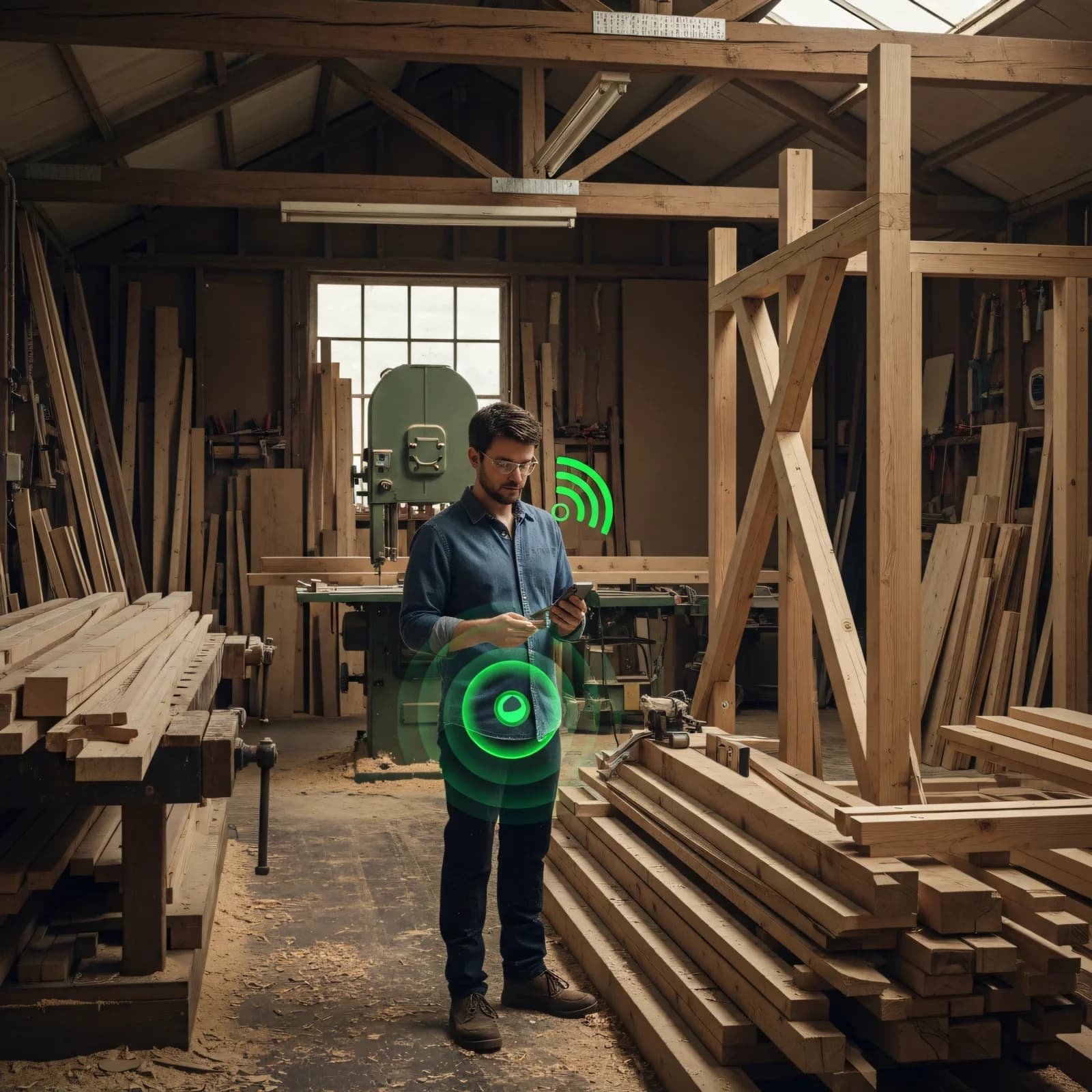
Tool Tracking for Timber Teams: Why Bluetooth Tags Are the New “Where’s the Framing Square?” Fix
Timber framing crews lose up to 7% of weekly productivity searching for tools. Bluetooth trackers are the simplest, funniest, and most effective way to stop the disappearing-square epidemic forever.
Let’s be honest: if your framing square had legs, it would’ve walked out of the shop three days ago—and taken your favorite marking knife with it.
You’re not forgetful.
You’re a timber framer, which means tools disappear faster than biscuits at crew lunch. One minute your 12-inch (300 mm) combination square is checking a tenon shoulder; the next… poof. It’s borrowed, buried, or acting as someone’s emergency drink coaster.
Lost tools aren’t just annoying—they’re expensive. Small construction teams lose up to 7% of weekly productive time just searching for equipment. That’s nearly four full workdays per year spent doing laps around the shop like a confused pigeon.
Enter the quiet hero of modern timber framing: Bluetooth tool trackers.
Yes, the same tiny disc that finds your car keys can find your slick, your drill, your 1½" (38 mm) chisel, and even the sacred carpenter’s pencil with the perfect 45-degree edge.
🔍 The Great Tool Disappearance Act (And Why It’s Not Your Fault)
Timber framing is chaos by design:
- You’re on ladders.
- Under beams.
- On scaffolding.
- Jumping between layout → cutting → raising → fitting.
Tools get passed around, placed down "for two seconds," and inevitably end up:
- Taped to the inside of a toolbox lid (no one knows why)
- Sitting on top of a timber lifted 12 ft (3.6 m) into the air
- Buried under 3 in (75 mm) of sawdust from yesterday’s cleanup pile
A Vermont timber shop tracked lost-tool incidents for 30 days. Results:
1️⃣ Framing square — vanished 8 times (found once in a client’s truck 40 miles away)
2️⃣ Carpenter’s pencil — 14 missing, 2 "eaten by the shop dog"
3️⃣ 1½" (38 mm) chisel — borrowed for “one quick cut,” returned never
Sound familiar?
📡 How Bluetooth Tags Actually Work (Without Tech Headaches)
Picture a rugged little disc—about the size of a poker chip—stuck to your drill or tucked into your chisel handle.
It pairs with your phone.
If the tool wanders beyond Bluetooth range (typically 30–100 ft / 9–30 m), the app saves the last known location.
When panic strikes (“Where’s the mortise gauge?!”), you tap Play Sound.
A happy little beep echoes from under a tarp, inside a drawer, or inside the coffee mug someone forgot to empty.
Some trackers—like Apple AirTag or Chipolo ONE Spot—even use crowdsourced networks. If your tagged slick leaves the site, any passing phone quietly updates the location.
A tiny GPS whisper from your tools:
“Hey. I’m under the shavings pile. Again.”
🛠️ Tagging the Untaggable: Timber Framing’s Trickiest Tools
Some tools are grumpy, weirdly shaped, or allergic to adhesives. Here’s how framers have hacked the system:
✔ Framing squares
Use a thin flat tracker on the backside—won’t affect layout lines.
✔ Chisels & slicks
Secure a small round tracker with heat-shrink tubing around the ferrule. Bonus: better grip.
✔ Drills & impact drivers
Most 18–20V (or 5–6 Ah) batteries have a recessed underside—perfect for a thin tracker.
✔ Layout bars & story poles
Drill a ½" (12 mm) cavity, drop in a waterproof tracker, plug with a wood dowel.
Pro tip: Color-code tags by category.
Red = layout tools, blue = cutting tools, green = measuring tools.
📉 Real Shop Results: From Chaos to Calm
A timber crew in Oregon tested Bluetooth trackers for six months. Their stats:
- Search time reduced by 82% (11 minutes → under 2 minutes)
- Tool replacement costs dropped by $1,400 per quarter
- Crew morale: up significantly
(“I stopped accusing the apprentice every time the slick vanished.”)
The biggest win?
Accountability without blame.
No more awkward staring contests.
Just a phone ping and a peaceful stroll to wherever the framing square decided to take a nap.
🎯 Choosing the Right Tracker (Because Not All Beeps Are Equal)
Forget cheap no-brand trackers. Several have been flagged for overheating. Stick to reputable models that survive jobsite abuse.
Here’s what actually matters:
1. Water & dust resistance
Sawdust + humidity = electronics graveyard.
Look for IP67 (30 minutes in 1 m of water).
2. Replaceable batteries
A CR2032 you can swap beats a sealed device you have to throw away.
3. Loud enough to hear over a planer
Aim for 90+ dB.
AirTag hits ~85 dB, Tile Pro ~94 dB.
4. Range
Bluetooth: 100 ft / 30 m (ideal conditions).
Metal shop? More like 30 ft (9 m).
UWB trackers give directional precision.
⚙️ Setup: The 10-Minute Solution
- Stick the tag on.
- Open app → name it (“Slick – DO NOT LEND”).
- Enable Lost Mode.
- Share with crew (multi-device tracking).
- Hide tool → practice finding it → celebrate.
You've now added a digital insurance layer to your timber craft.
🔮 The Future: Smarter Than a Beeping Square
New features under testing:
- Temperature alerts (don’t leave glue chisels in hot trucks)
- Usage timers (auto-maintenance reminders)
- Geofencing (alerts if a tool leaves the site)
But honestly?
Right now, the simple beep is revolutionary.
🌲 Final Thought: Tools Have Feelings (Probably)
Imagine you’re a $120 precision square.
You help build beams that last centuries…
Yet you spend half your life under a tarp.
A Bluetooth tag is more than convenience.
It’s respect.
So the next time someone shouts:
“Has anyone seen the combination square?!”
Just smile, check your phone, and reply:
“Relax. It’s beeping from inside the biscuit tin.”
Because in timber framing, the strongest joints aren’t just wood and pegs.
They’re trust, precision, and always knowing where your tools are.