Expo Osaka 2025: How Sou Fujimoto Built the World’s Largest Wooden Structure
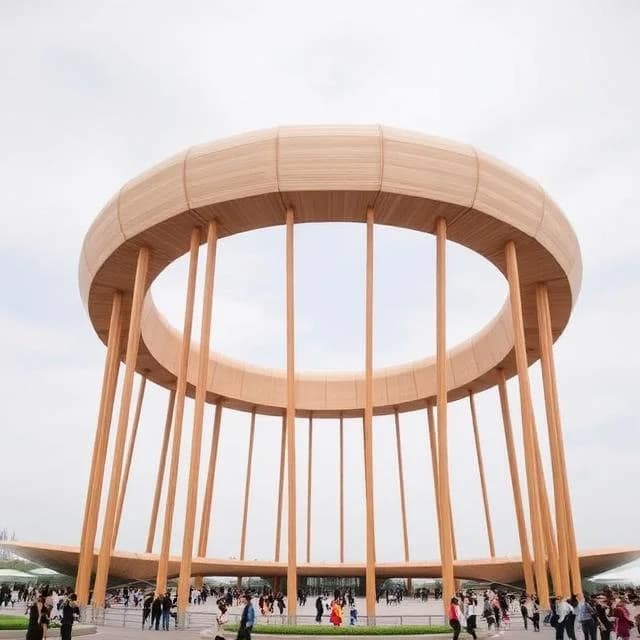
At Expo Osaka 2025, architect Sou Fujimoto unveiled the Grand Ring — a record-breaking 60-meter tall circular timber megastructure. Here’s how ancient Japanese joinery, digital design and mass timber engineering made it possible.
When Expo 2025 opens in Osaka, one structure will dominate not just the skyline — but the global architectural conversation itself.
That structure is the Grand Ring:
a breathtaking 60-meter (197 ft) tall, 690-meter (2,263 ft) circumference circular timber megastructure designed by world-renowned architect Sou Fujimoto.
This is not a pavilion.
This is not a sculpture.
This is a manifesto in wood — the largest free-standing wooden structure ever built.
And it’s doing something even more ambitious than breaking records:
It’s proving that timber can shape the future of monumental architecture.
🌍 A Global Symbol for a Post-Carbon Future
The theme of Expo 2025 is “Designing Future Society for Our Lives.”
The Grand Ring doesn’t just support this message.
👉 It is the message.
Its perfect circular form represents:
- the cycle of nature
- the regeneration of resources
- the continuity of human culture
Instead of concrete dominance and steel excess, Fujimoto chose a material that grows, breathes and stores carbon:
Wood.
🏯 A Vision Rooted in Ancient Craft — Built with Digital Precision
At first glance, the Grand Ring feels timeless.
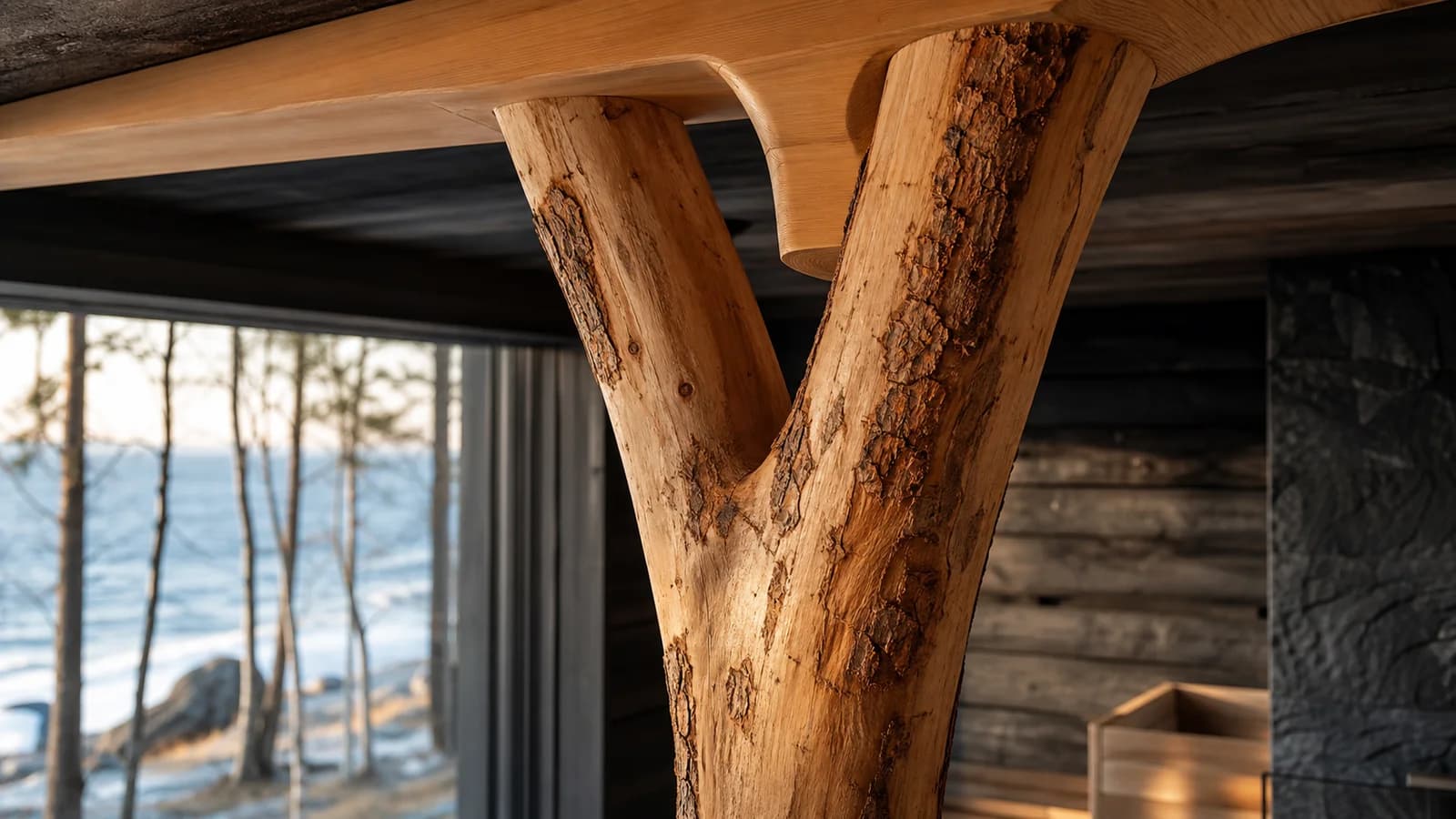
Its elevated timber columns echo the post-and-beam systems of Japanese temples and farmhouses (minka), where structures are held together through interlocking wooden joints, not brute-force fasteners.
But here’s the twist:
This ancient logic was rebuilt using fully digital design and fabrication.
Instead of hand-cut mortises, Fujimoto’s team used:
- 3D timber modeling
- parametric node design
- CNC-fabricated joinery components
Every single connection was:
- digitally modeled
- structurally optimized
- fabricated with millimeter-level precision
The entire coordination process ran through timber-specific CAD/CAM workflows, enabling seamless alignment between architect, engineer and fabricator.
🪵 The Timber Arsenal: Glulam, CLT & 4,500 m³ of Wood
The Grand Ring is built primarily from:
- Glulam beams → primary structural ribs
- CLT panels → decking and diaphragm stabilization
Total timber volume:
Over 4,500 cubic meters of wood
Equivalent to ~1,800 mature trees
All timber was sustainably sourced Japanese:
- Sugi (Japanese cedar)
- Hinoki (Japanese cypress)
certified through national forest stewardship programs.
This wasn’t just construction.
👉 It was a national forestry statement.
🧠 Engineering the Impossible: How a 690-Meter Wooden Ring Stays Standing
By all normal logic, a 690-meter timber loop should collapse.
Gravity.
Wind.
Seismic forces.
Buckling.
So why doesn’t it?
Because the Grand Ring uses a three-layered structural strategy:
✅ 1. Double-Curved Glulam Lattice
The ring is not a flat circle.
Its section is subtly vaulted and double-curved, forming:
- a horizontal arch
- and a vertical shell
This dramatically increases:
- stiffness
- load redistribution
- buckling resistance
It’s a shell structure — executed entirely in wood.
✅ 2. Hidden Steel Tension System
Discreetly embedded inside the wood:
- high-tensile steel tension cables
These act like:
- tendons in a muscle
- restraining outward thrust
- absorbing seismic energy
👉 No steel is visible.
The purity of the timber expression remains untouched.
✅ 3. Modular Segmented Assembly
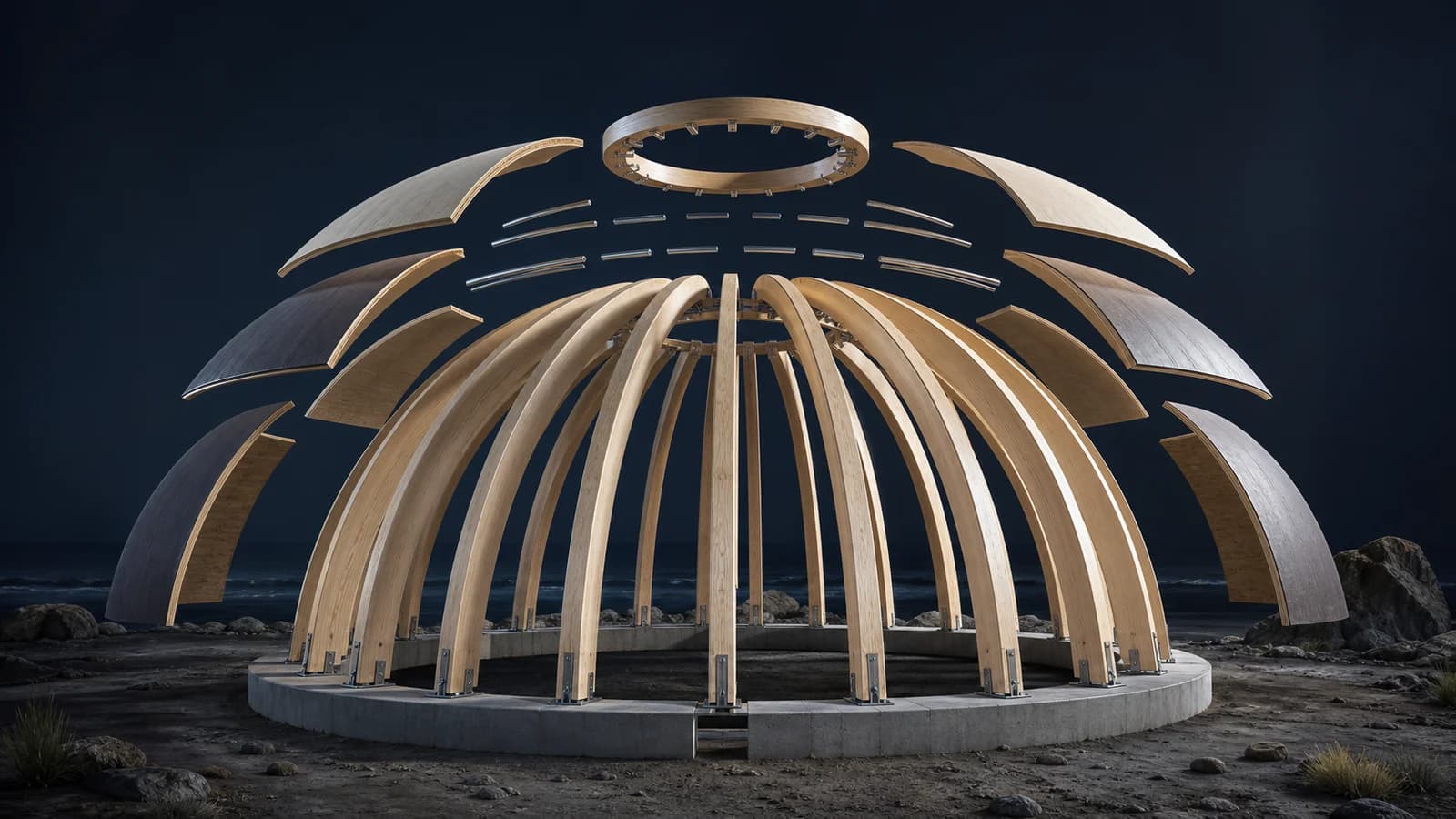
The structure was fabricated as:
- 24 massive timber segments
- each approx. 28.75 m (94 ft) long
Assembled nearby off-site.
Then lifted into position over:
Just 72 hours.
This was a logistical ballet in wood and cranes — proving that mass timber scales not just in size, but in speed.
📡 A Living Digital Twin
Sensors are embedded directly into the structure, tracking:
- moisture levels
- structural stress
- deformation
- thermal movement
All of this feeds into a real-time digital twin, allowing engineers to:
- monitor long-term behavior
- optimize maintenance
- validate mass-timber performance at megastructure scale
This is timber engineering in the age of live data.
🔁 The World’s First Truly Circular Expo Megastructure
Here’s the most revolutionary part:
The Grand Ring was never meant to die with the Expo.
After Expo 2025 closes, the structure will be:
- carefully disassembled
- transported to Nara Prefecture
- rebuilt as a permanent eco-cultural retreat and forest education center
Its components were designed for deconstruction from day one:
- columns become new pavilions
- CLT panels form floors and walls
- foundation materials are locally recycled
This is a closed-loop lifecycle, not demolition theater.
Expo → Forest → Education → Second Life.
🏆 Why the Grand Ring Changes Everything
The Grand Ring has already been long-listed for:
- Dezeen Awards 2025
- Japan Institute of Architects Award
But awards are not the real story.
The real proof is this:
✅ Timber can now reach monumental scale
✅ Tradition and technology are no longer opposites
✅ Sustainability is not a trend — it’s an engineering discipline
✅ Buildings can be designed for their second life before the first ends
🌀 Final Thought: The Future Is Circular
As visitors walk beneath the Grand Ring at Expo Osaka 2025, they won’t just see architecture.
They will experience:
- a forest that became a building
- a building that will become a forest again
- a structure that proves one truth:
The future of architecture isn’t vertical steel.
It’s circular wood.
Built with algorithms.
Connected by joints.
Designed to live more than once.
And that future?
It’s already standing in Osaka.