From Historic Restoration to Contemporary Vision: 5 Wooden Structures That Shape the Future
Five extraordinary wooden projects prove that timber can preserve history, protect ruins, empower communities, and build the future—without losing its soul. Sven and Olaf approve.
From Historic Restoration to Contemporary Vision: 5 Wooden Structures That Shape the Future
Or: How Wood Time-Travels Better Than Any Sci-Fi Machine
Wood isn’t just a building material.
Wood is a storyteller.
Every beam remembers storms.
Every joint remembers hands.
Every structure remembers why it was built.
And today—when sustainability, memory, and identity matter more than ever—architects are doing something beautiful:
👉 They’re using timber to save the past and build the future at the same time.
Sven calls it “respect for the forest.”
Olaf calls it “advanced tree reincarnation.”
Both are correct.
Here are five wooden projects that prove the future of architecture still grows from roots.
🐟 1. Feskekôrka, Gothenburg
A Fish Market That Refused to Retire
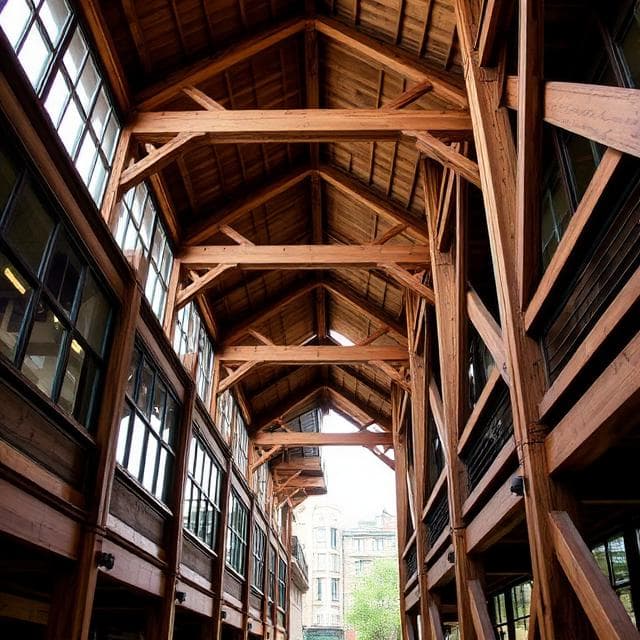
Built in 1874, this legendary fish market is nicknamed “The Fish Church”—and yes, it absolutely looks like someone tried to worship salmon.
Originally all-timber, its dark spruce trusses survived 150 years of smoke, salt, winters, and fish drama. When modern architects stepped in, their mission was simple:
- ❌ No fake historic copies
- ❌ No cosmetic nostalgia
- ✅ Stabilize the original wood
- ✅ Add glass, light, and modern life around it
The result?
A living marketplace where fresh seafood meets century-old joinery.
Sven approves:
“This beam survived two world wars and at least a million herring.”
🌋 2. Stöng Shelter, Iceland
Wood Protecting What No Longer Exists
This Viking farm vanished in 1104, buried under volcanic ash.
Nothing stood.
Only fragile ruins remained.
So architects built a timber guardian above it:
- Raised on slender steel legs
- Wrapped in naturally weathering larch
- Shaped like a ghost of a Norse longhouse
- Floating above memory instead of replacing it
This isn’t reconstruction.
This is architectural humility.
Olaf whispered:
“The building is bowing to the past.”
🌀 3. Sky Under the Trees Pavilion, Expo Osaka 2025
Ancient Joinery Goes Full Sci-Fi
This 32-meter circular pavilion looks futuristic—but it’s actually built from centuries-old Japanese timber logic:
- No nails
- No glue
- CNC-cut joints inspired by earthquake-proof temples
- Fully demountable and reusable after the Expo
It’s heritage encoded into digital files.
Sven calls it “timber with firmware.”
And honestly… yeah.
🧺 4. Bidi Bidi Performing Arts Centre, Uganda
When Wood Becomes a Tool of Dignity
Built by and for South Sudanese refugees, this project used:
- Local Afara timber
- Hand tools
- Community knowledge
- Zero imported steel
Its timber lattice copies traditional basket-weaving patterns—turned into architecture.
This isn’t low-tech.
This is perfectly adapted tech.
Where some see “temporary shelter,” wood delivered:
- Identity
- Strength
- Permanence
- Hope
Even Sven went silent here. That’s rare.
⚓ 5. Katajanokan Laituri, Helsinki
Mass Timber Finally Goes Urban-Hero Mode
This mixed-use monster uses:
- CLT + glulam
- Exposed timber interiors
- Biophilic design everywhere
- Over 60% lower embodied carbon
It mirrors Helsinki’s old dock warehouses—but without cosplay.
Here, wood isn’t decoration. It’s the structure.
Olaf summed it up:
“This is where logs go after architecture school.”
🌲 What All Five Projects Share
These buildings prove that wood is a mediator:
✅ Between past and future
Old beams and new structures don’t compete—they coexist.
✅ Between craft and computation
Hand traditions now live inside CNC files and parametric design.
✅ Between local and global
Each project uses native species—but speaks a universal language.
And most importantly…
👉 They all reject the lie that heritage and innovation are enemies.
🔥 Why This Matters Right Now
Concrete alone produces nearly 8% of global CO₂.
Meanwhile, timber:
- Stores carbon
- Requires less energy to process
- Creates healthier interiors
- Ages with dignity instead of decay
A tree records climate in rings.
A timber building records culture in structure.
🏁 Final Thought — The Forest Was Here First
The future of architecture will not be built against nature.
It will be built in partnership with it.
The past speaks in timber.
The future is being written in the same grain.
Sven nods.
Olaf already wants to move into one of these.