Can Timber Help Europe’s Housing Crisis? EU Projects Target the Skills Gap
Two EU LIFE projects are building the training, local supply chains and practical knowledge needed to use more wood in affordable and social housing.
Europe’s housing shortage cannot be solved by changing materials alone. But two EU-supported projects argue that timber can contribute—if the industry first addresses skills, local supply chains and practical delivery.
The LIFE WOOD for Future and LIFE BE-WoodEN programmes are working on the less visible barriers behind timber construction: education for architects and engineers, training for site workers, support for small companies and better use of regional wood resources.
Training the entire project chain
LIFE WOOD for Future is developing curricula for architects, engineers, technicians, workers and local SMEs. In Granada, the programme also includes work on a certification manual for poplar nurseries, connecting forest resources to future construction demand.
LIFE BE-WoodEN focuses on social and residential housing, professional training and applied research. According to the European Climate, Infrastructure and Environment Executive Agency, its activities have generated almost 9,880 professional training credits.
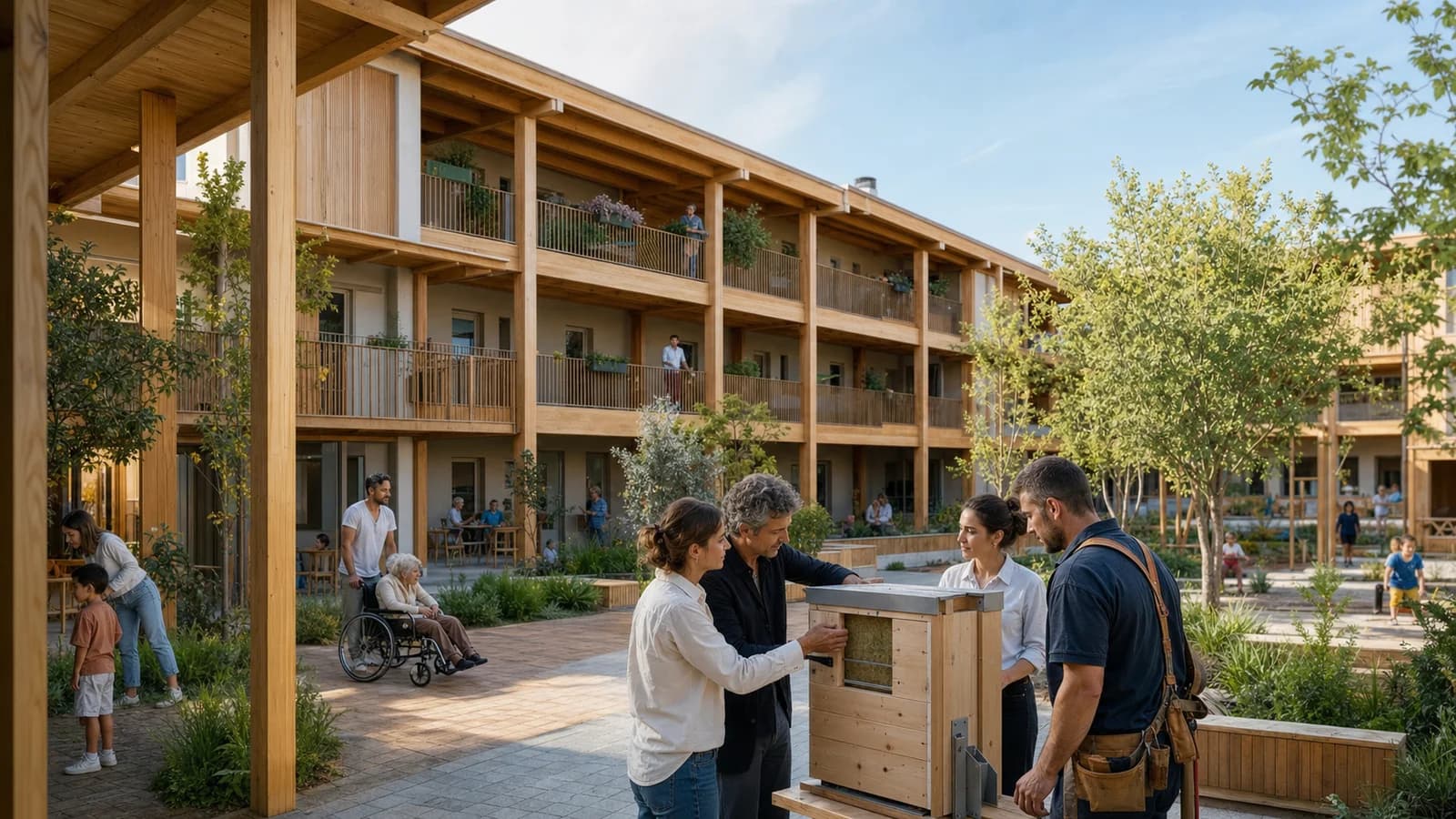
The programme has also contributed to redesigned shared spaces in a 19-apartment social-housing complex for older residents in Liguria, Italy.
Why skills may be the real bottleneck
Timber buildings require coordination across architecture, structural engineering, fire safety, acoustics, moisture management, fabrication and assembly. A shortage of experienced professionals can increase risk and cost even when the material itself is available.
That is why workforce development belongs in the housing discussion. Standardized training and repeatable digital workflows can help teams make decisions earlier, reduce redesign and give local manufacturers more confidence to invest.
For software providers, this creates another opportunity: guidance, validated assemblies, quantities and manufacturing information can be integrated into the design process. The goal is not merely to draw a timber building, but to make it buildable by the available supply chain.
Timber is not automatically cheaper, and the LIFE projects do not prove that it can solve Europe’s housing crisis by itself. Land, finance, planning and infrastructure remain decisive.
Their lesson is nevertheless important. A scalable timber-housing market needs people, standards and local industrial capacity as much as it needs ambitious architecture.
Source: European Climate, Infrastructure and Environment Executive Agency, “LIFE projects champion wood for greener, more beautiful and affordable homes”, 16 February 2026: https://cinea.ec.europa.eu/news-events/news/life-projects-champion-wood-greener-more-beautiful-and-affordable-homes-2026-02-16_en