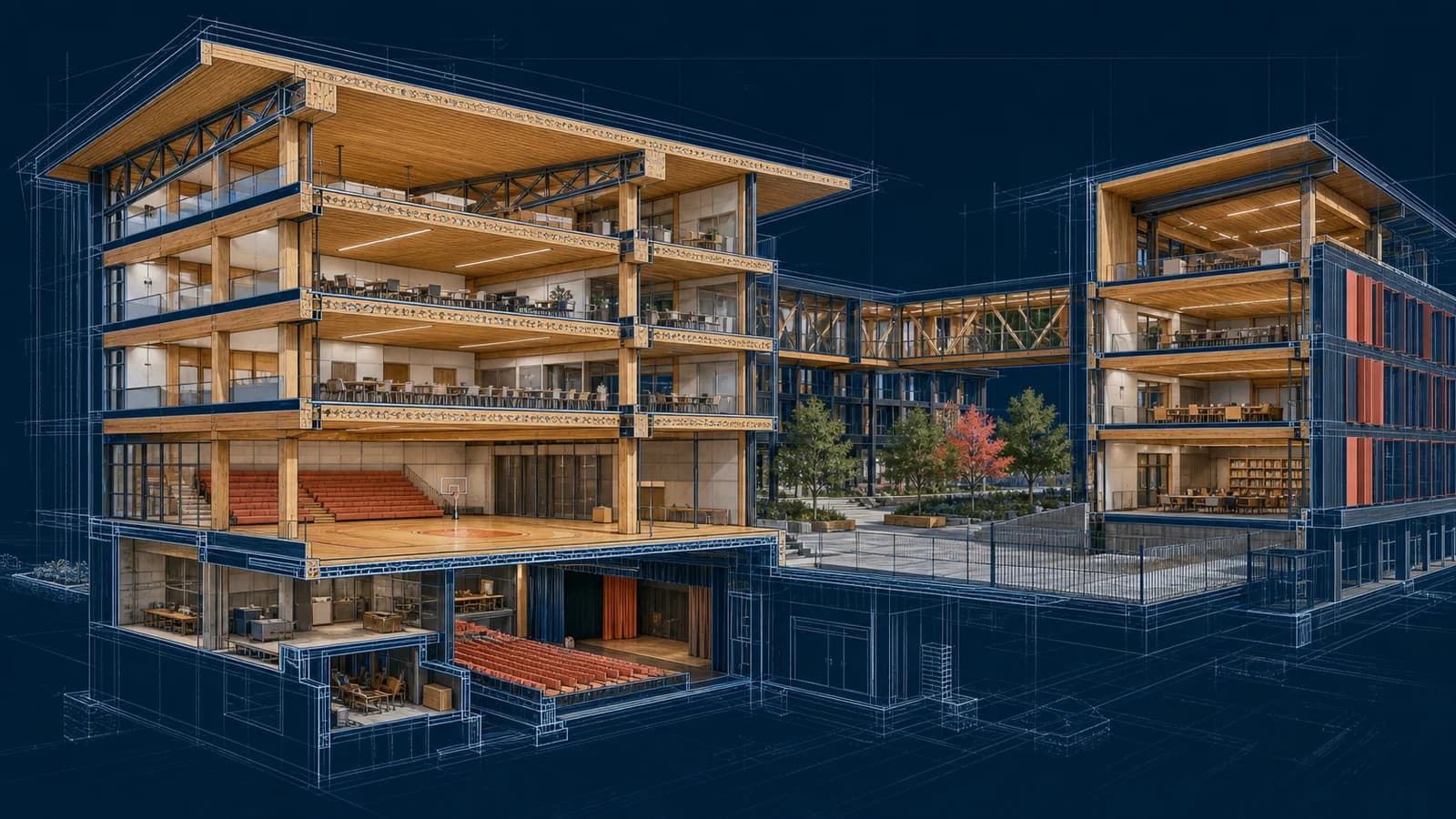
Cleveland High School: What 870,000 Board Feet Means
Portland’s planned Cleveland High School includes nearly 870,000 board feet of mass timber. Here is how that quantity converts—and what it cannot tell us.
Nearly 870,000 board feet is the headline timber quantity attached to the modernization of Cleveland High School in Portland, Oregon. It is large enough to sound self-explanatory, but a board-foot figure needs context before it becomes useful.
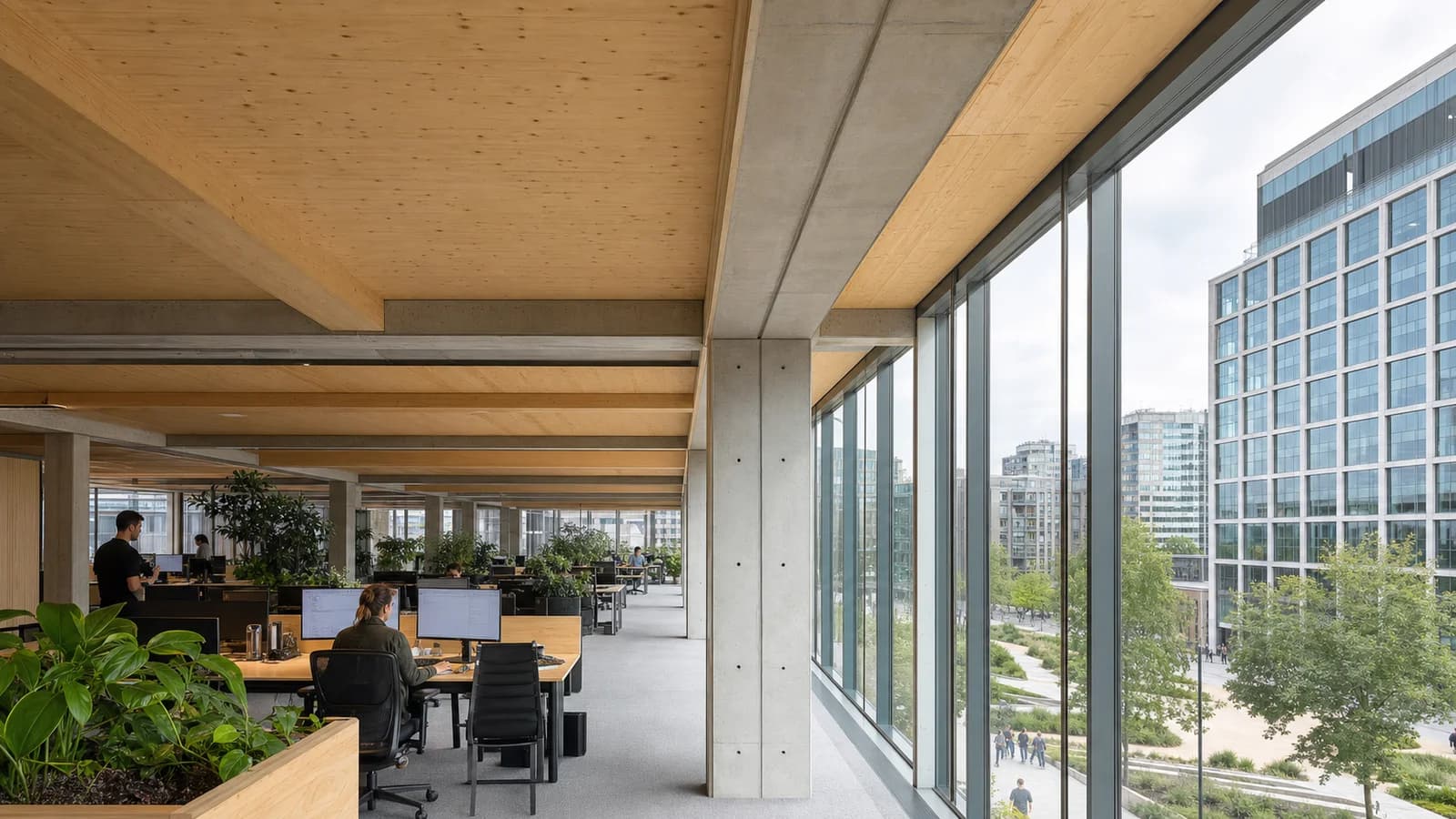
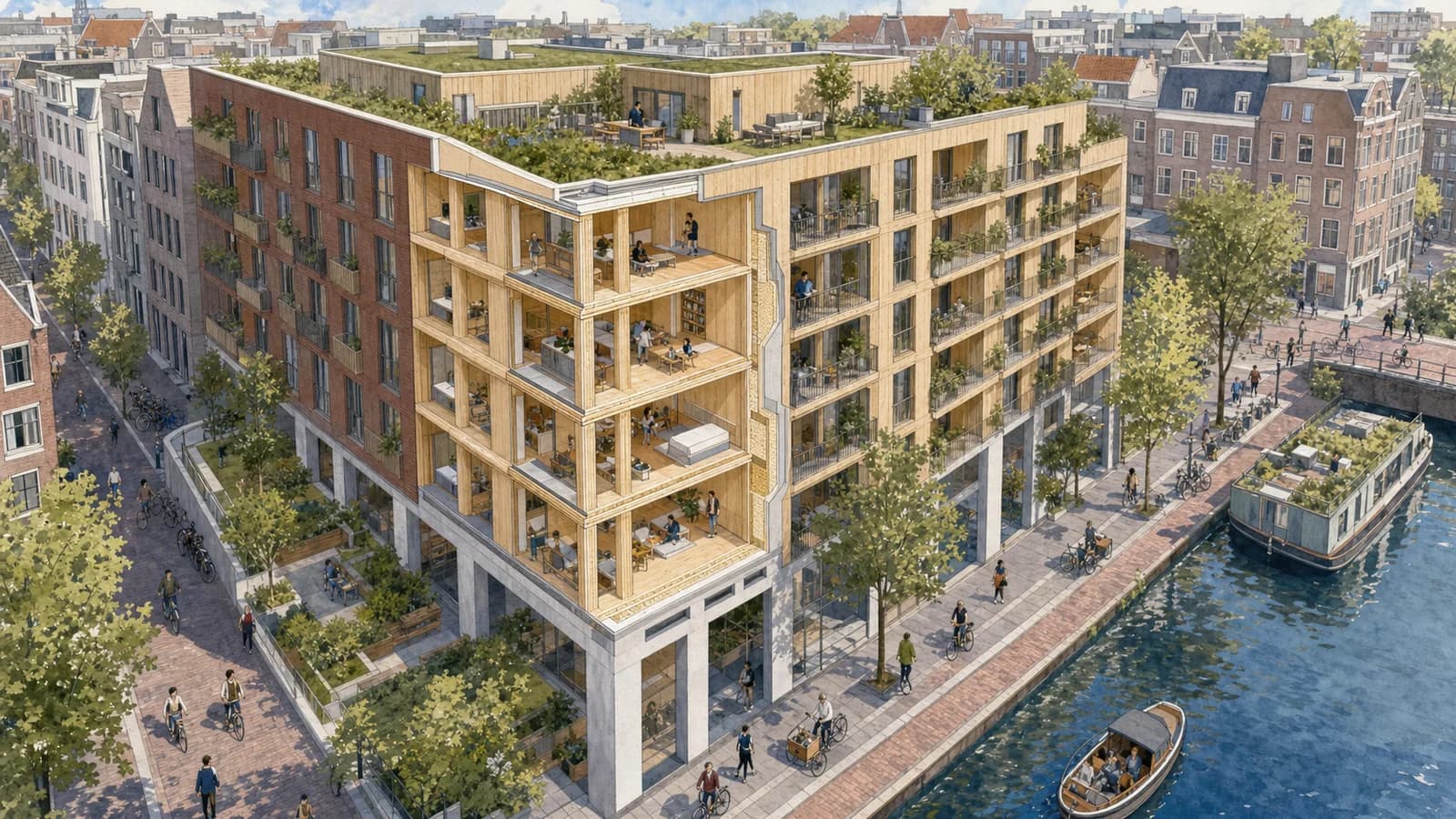
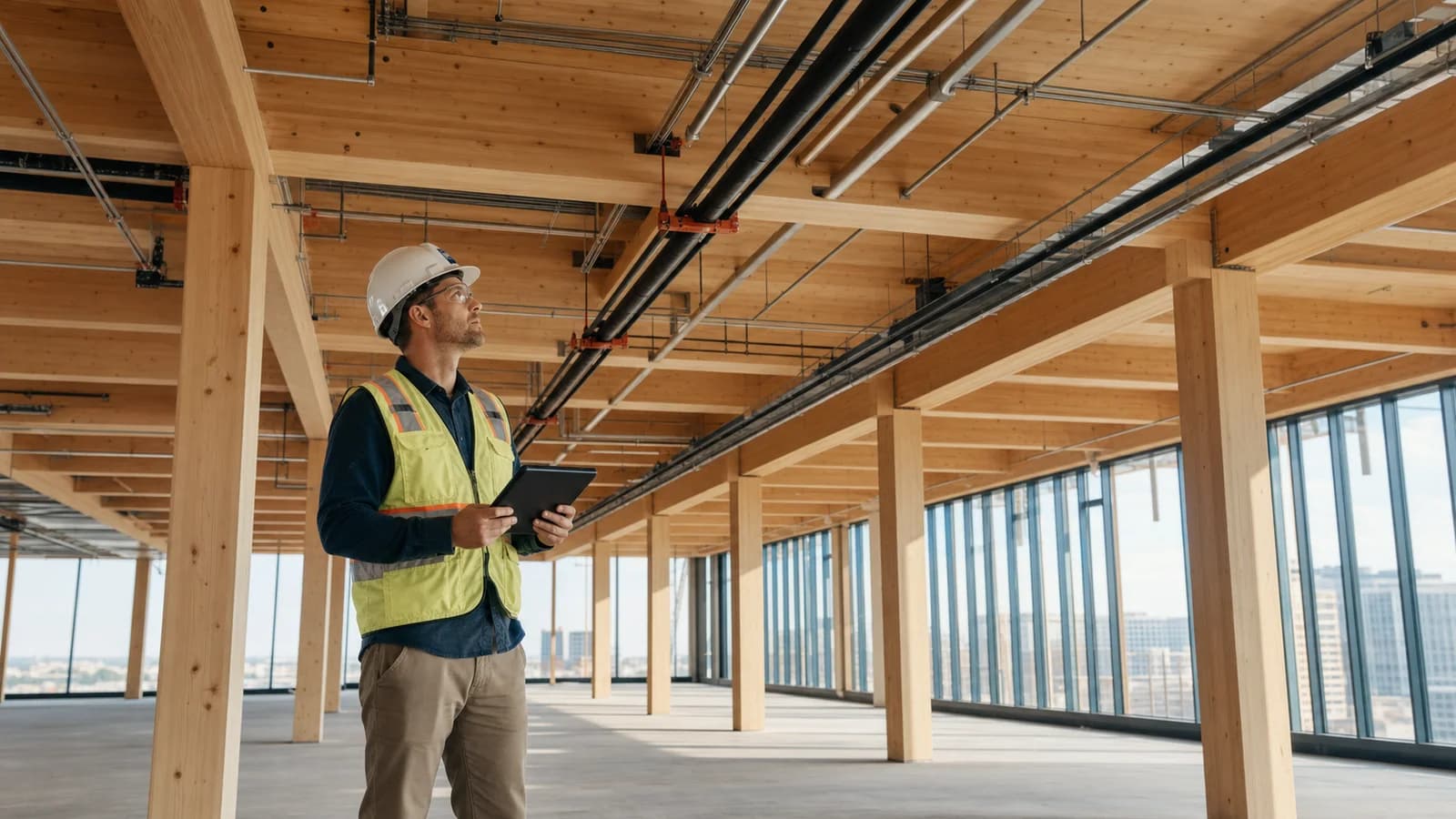
The project announcement describes a roughly 300,000-square-foot school with two four-storey wings linked by a skybridge. Its planned structural palette includes acoustic dowel-laminated timber decking, glulam beams and columns, structural steel and lower-carbon concrete. In other words, this is a hybrid building, not a block of one uniform wood product.
The most responsible reading of the headline is therefore narrow: nearly 870,000 board feet is a project-team estimate for mass timber. It is not, by itself, the verified installed volume, weight, purchase price or carbon result.
The project is still in progress
A groundbreaking event took place on 12 June 2026. The contractor’s announcement said construction was expected to run from July 2026 to summer 2029. Portland Public Schools publishes a more detailed, changeable programme: its July 2026 page showed design at 90% complete, construction at 0%, deconstruction planned for July–December 2026, new-building construction expected to start in winter 2027 and finish in fall 2029.
Those descriptions are not necessarily incompatible; one may use “construction” for the wider site programme while the other separates deconstruction from the new building. They do show why the article should not describe the school as complete. Dates, quantities and specifications can change before procurement and installation.
The contractor also characterized it as one of the Pacific Northwest’s largest K–12 mass-timber projects. That is an attributed project claim, not an independently audited regional ranking.
What one board foot represents
NIST Handbook 130 defines a board foot as a volume equal to a board one foot long, one foot wide and one inch thick. That is 144 cubic inches, or one-twelfth of a cubic foot.
For a purely geometric conversion:
1 board foot = 144 in³ = 1/12 ft³
1 board foot = 0.002359737216 m³
Applying that definition to the published figure:
870,000 board feet ÷ 12 = 72,500 ft³
72,500 ft³ × 0.028316846592 = 2,052.97 m³
So, 870,000 geometric board feet corresponds to approximately 72,500 cubic feet or 2,053 cubic metres.
That calculation is exact for the stated geometric unit, but the source says “nearly” 870,000 board feet and does not publish the underlying takeoff or explain the commercial measurement convention. The converted result should therefore remain an approximate theoretical volume equivalent, not be presented as a surveyed as-built quantity.
Why the conversion is not the whole takeoff
A mass-timber schedule can include solid rectangular members, panels with openings and machining, curved or tapered components, and multiple products. Procurement quantities may also include allowances, offcuts or stock rules that differ from the net geometry in the building.
The Cleveland announcement identifies acoustic DLT decking and glulam beams and columns, but it does not split the 870,000 board feet between those products. It also does not state whether the figure includes machining losses, replacement material or other ordering allowances.
This matters because two projects with the same gross board-foot figure may require different numbers of panels, delivery loads, fabrication hours and connections. Board feet can normalize a wood volume; they cannot describe the complete bill of materials.
What the number does not reveal
The headline quantity cannot establish timber weight without an appropriate density. Density varies with species, product construction and moisture condition. A generic softwood value should not be presented as the project’s actual value.
It cannot establish material cost either. A credible cost estimate would need the purchasing basis for each product, current supplier prices, fabrication scope, waste or ordering rules, delivery, tax and any exclusions. Glulam columns and factory-machined acoustic panels are not made commercially equivalent by expressing them in one volume unit.
Nor does the figure prove a carbon outcome. A whole-life assessment requires product-specific or otherwise suitable environmental data, transport and construction information, use-stage assumptions and end-of-life scenarios. Multiplying board feet by an unsourced carbon factor would skip those requirements.
Use the calculator for the question it can answer
The Timber Volume, Weight & Cost Calculator can convert 870,000 geometric board feet into cubic feet and cubic metres. It can also show how a user-selected density or unit price affects an estimate, provided those entries are clearly labelled assumptions.
For this case study, the most defensible workflow is:
- Enter 870,000 board feet as a known volume.
- Confirm the cubic-foot and cubic-metre conversions.
- Leave density and price blank unless a documented project value is available.
- Keep the result labelled “published estimate converted geometrically.”
The calculator does not verify the project takeoff, select products, infer structural performance or calculate embodied carbon. It should not turn a project count or media statement into precision the source does not contain.
Why the figure is still useful
Read carefully, the 870,000-board-foot estimate gives readers a tangible sense of the project’s planned timber scale. The structural description adds an equally important lesson: large mass-timber buildings often combine different engineered-wood systems with steel and concrete where the design calls for them.
The Cleveland modernization also shows how a familiar North American lumber unit can travel into mass-timber reporting. Converting it to approximately 2,053 m³ helps international readers compare magnitude, while the caveats protect that comparison from becoming an unsupported claim about installed material, weight, price or emissions.
The best case study does both: it makes a large number understandable and preserves what remains unknown.
Sources
- Project contractor, “Skanska breaks ground on Cleveland High School modernization, a landmark mass timber project,” June 2026: https://www.skanska.com/us/en/media/press-releases/2026/skanska-breaks-ground-on-cleveland-high-school-modernization-a-landmark-mass-timber-project
- Portland Public Schools, “Cleveland Modernization,” project status and timeline: https://bond.pps.net/current-modernizations/cleveland-modernization
- Softwood Lumber Board, “Mass Timber Competition 2025,” Cleveland High School project summary: https://softwoodlumberboard.org/mass-timber-competition-2025/
- KPTV, “Cleveland High School breaks ground on modernization project in SE Portland,” 14 June 2026: https://www.kptv.com/2026/06/14/cleveland-high-school-breaks-ground-modernization-project-se-portland/
- National Institute of Standards and Technology, “Handbook 130—2026,” board-foot definition and method-of-sale context: https://www.nist.gov/system/files/documents/2025/12/23/2026_HB_130_Full-Document-20251223.pdf
Free timber planning tool
Timber Volume, Weight & Cost Calculator
Calculate timber volume, estimated weight and cost from dimensions or a known volume. Supports metric, imperial and geometric board feet.
Results update instantly. No account is required, and inputs stay in your browser. Exchange rates and structural sizing are not included.
Estimate results
Enter valid values to see the estimate.