Wooden Dowels vs Metal Fasteners: A Beginner’s Guide to Timber-Only Connections
May 2026 tests compare wooden-dowel capacity with design models and show where timber-only connections offer circular potential.
Wooden Dowels vs Metal Fasteners
Timber-only connections are attractive: fewer material types, traditional craft and easier separation at end of life. Research published in May 2026 tested double-shear timber joints with wooden dowels and compared their capacities with analytical models. The result is promising, not a licence to replace every bolt.
How dowels carry load
A wooden dowel transfers force through bearing in the surrounding timber and bending or shear in the dowel. Species, density, grain direction, diameter, spacing, edge distances and moisture all influence response. The study tested several timber and dowel species with diameters of 15, 18 and 20 mm.
Failure mode matters as much as peak capacity. A joint that splits suddenly behaves differently from one that deforms and redistributes load. Designers therefore need stiffness, ductility and variability, not only one maximum number.
What metal does differently
Bolts, screws, plates and proprietary connectors offer mature design routes, compact capacity and controlled manufacturing. They can also complicate machining, create thermal bridges, remain visible, hinder clean recycling or concentrate damage. None of those outcomes is automatic; detail and use determine them.
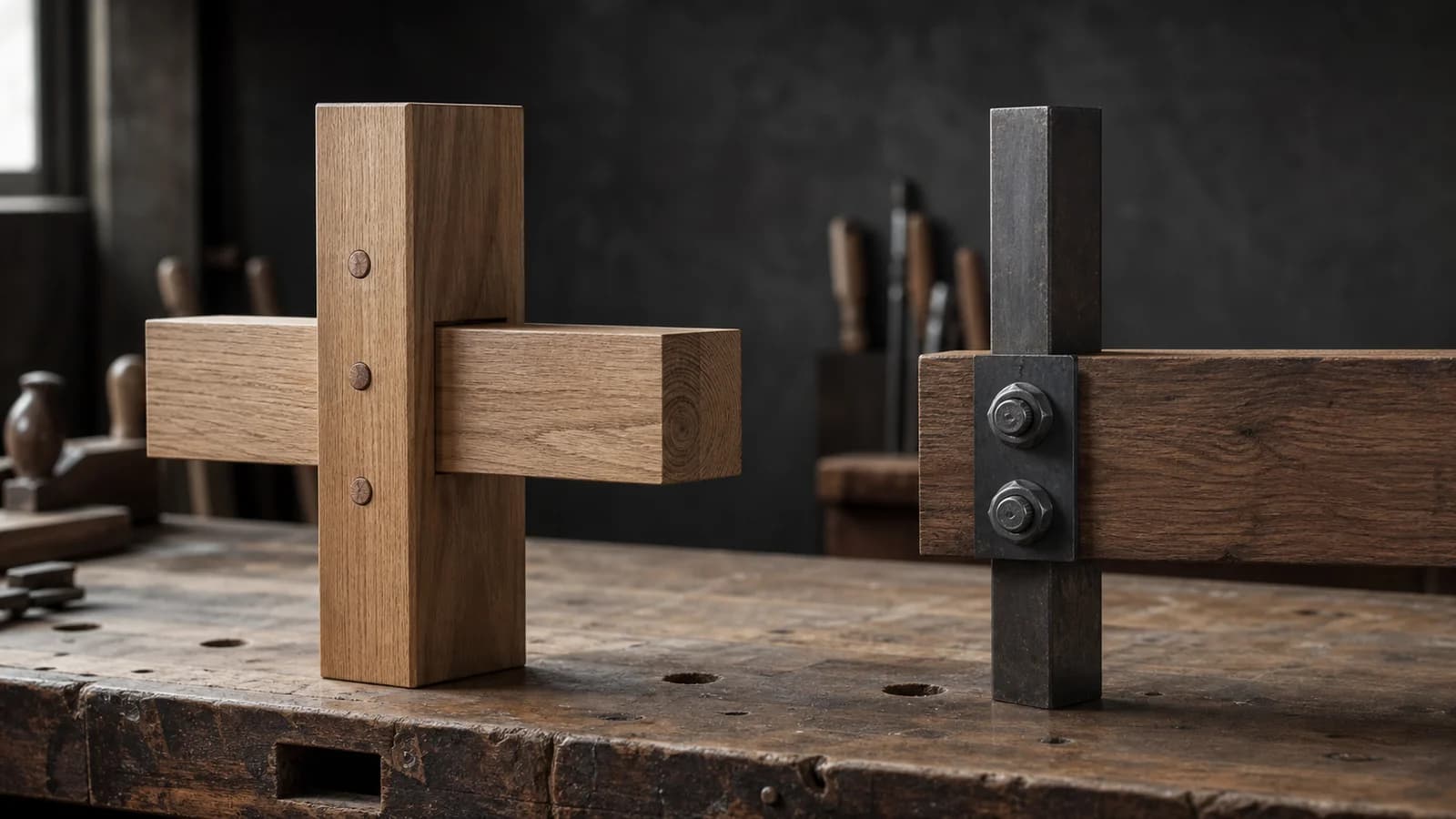
Wooden dowels can support disassembly and mono-material thinking, but they introduce species-dependent behaviour, dimensional movement and fewer standardised design provisions. “No metal” is a design constraint, not proof of better performance.
From test to building
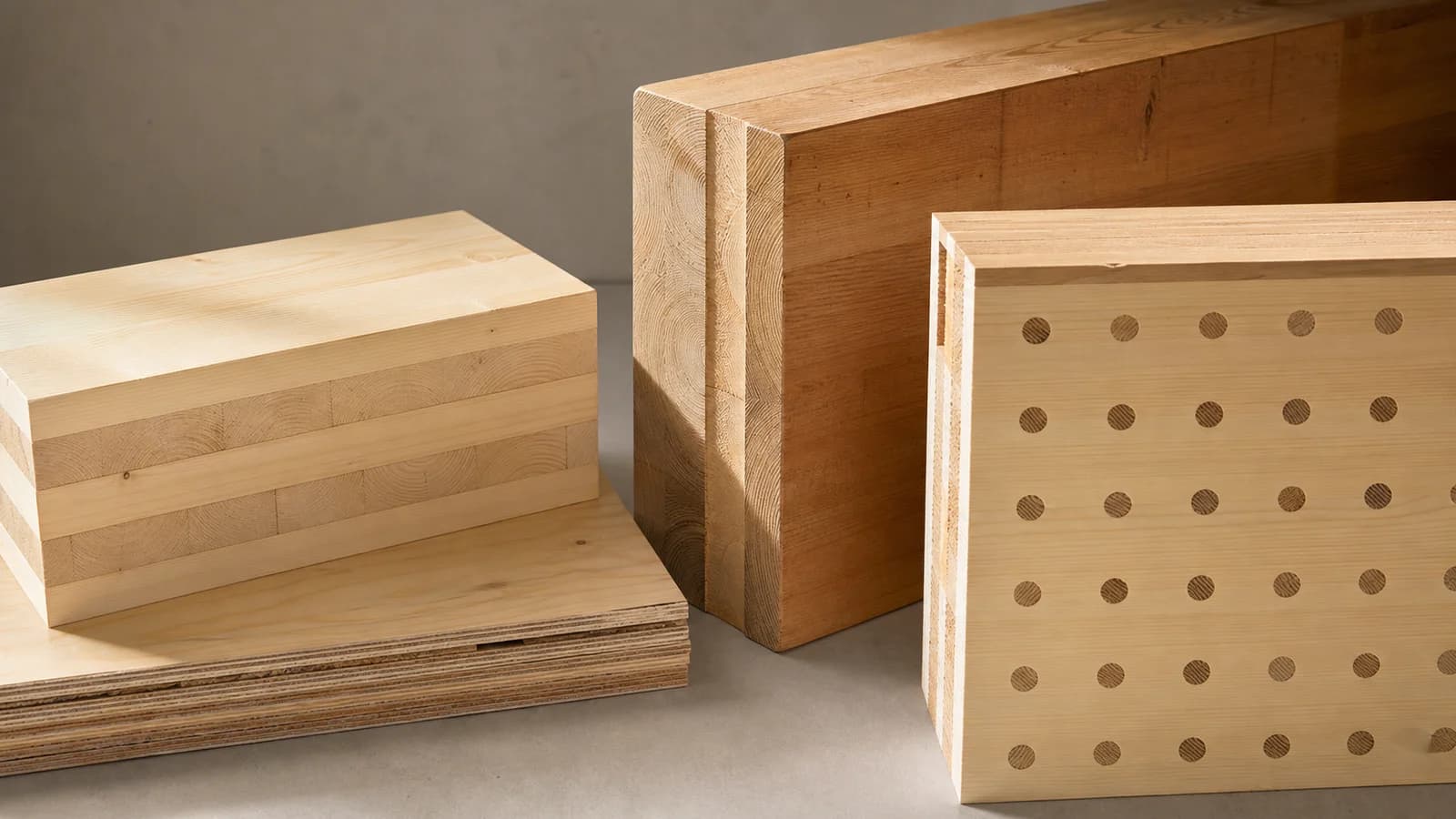
The May study compared experiments with Eurocode 5 and Timber Frame Engineering Council predictions and highlighted the limits of current guidance for wooden dowels. A separate July study of adhesive-free, metal-free laminated panels found that flexural behaviour was governed largely by lamella properties. Together they show why product and connection evidence must stay distinct.
A laboratory specimen is not a complete building connection. Real joints also face combined loads, fire, moisture cycling, tolerances, erection and repeated service. Approval depends on local rules and verified calculations or testing.
Beginner’s comparison
Ask what loads the connection carries, how much slip is acceptable, whether ductility is required, how it is protected from moisture and fire, how it will be fabricated and inspected, and whether it must be disassembled. Compare whole details, including extra timber, plates, drilling, tolerances and replacement.
A practical decision sequence
Start with verified performance, not a material slogan. Establish ultimate and service loads, allowable movement, required fire resistance, exposure and the consequence of brittle failure. Compare layouts meeting the same brief. A beautiful dowel requiring a much larger timber section is not directly equivalent to a compact steel detail.
Next, examine manufacture and use. Wooden dowels need controlled moisture, accurate holes, suitable grain orientation and inspection. Metal fasteners need corrosion compatibility, edge distances, tightening or embedment rules and protection where heat or condensation matters. Both can fail through poor tolerances even when the calculation is sound.
Finally, test the circular claim against real disassembly. Can workers find and release the connector without destroying the member? A timber-only joint may be hard to reverse, while a visible dry steel connector may be simple to remove. Circularity belongs to the complete assembly and its documentation.
Record the final choice with its governing test, calculation, moisture limits and inspection method. That evidence prevents a later visual substitution from quietly creating a different structural connection.
The FrameVerk view
Digital connections need identity and provenance. Dowel species, diameter, orientation, spacing and holes must flow into machining and quantities. Metal connections need the same treatment. Software should never swap one connector family for another based on appearance; the verified load path and rule set must change together.
Sources
- Structures, “Load-carrying capacity of timber-to-timber connections with wooden dowels: Experimental, theoretical and probabilistic evaluation,” May 2026: https://www.sciencedirect.com/science/article/abs/pii/S2352012426004832 - Journal of Building Engineering, “Flexural performance of adhesive-free and metal-free laminated timber panels,” July 2026: https://www.sciencedirect.com/science/article/abs/pii/S2352710226016086 - WoodWorks, “Mass Timber Technical Reference Guide”: https://www.woodworks.org/mass-timber-technical-reference-guide/