Mass Timber Types Explained: Species, Grades and Bonding
CLT, glulam, DLT and NLT are not interchangeable. Learn how product type, species, grade, bonding and moisture affect a useful quantity estimate.
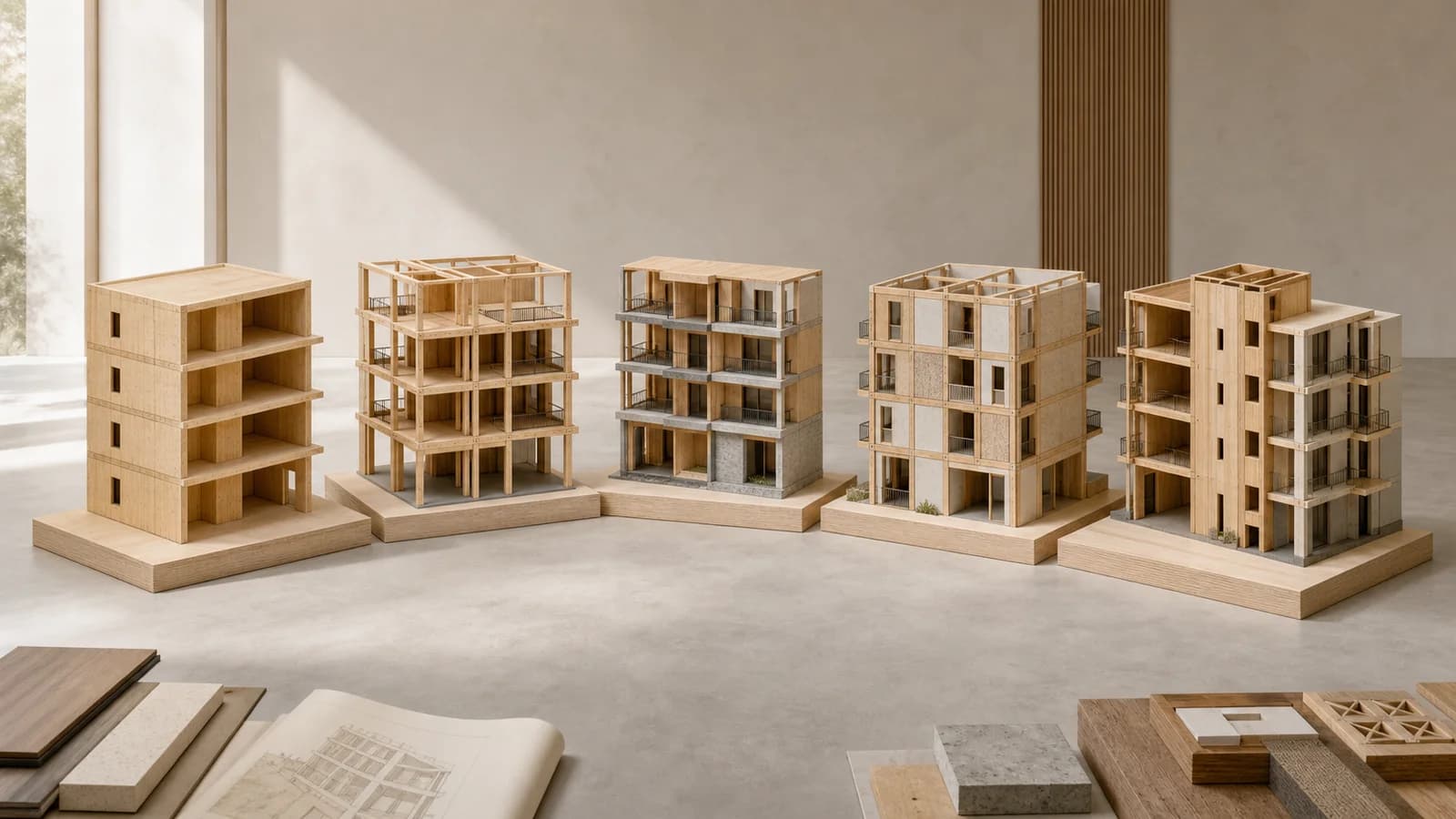
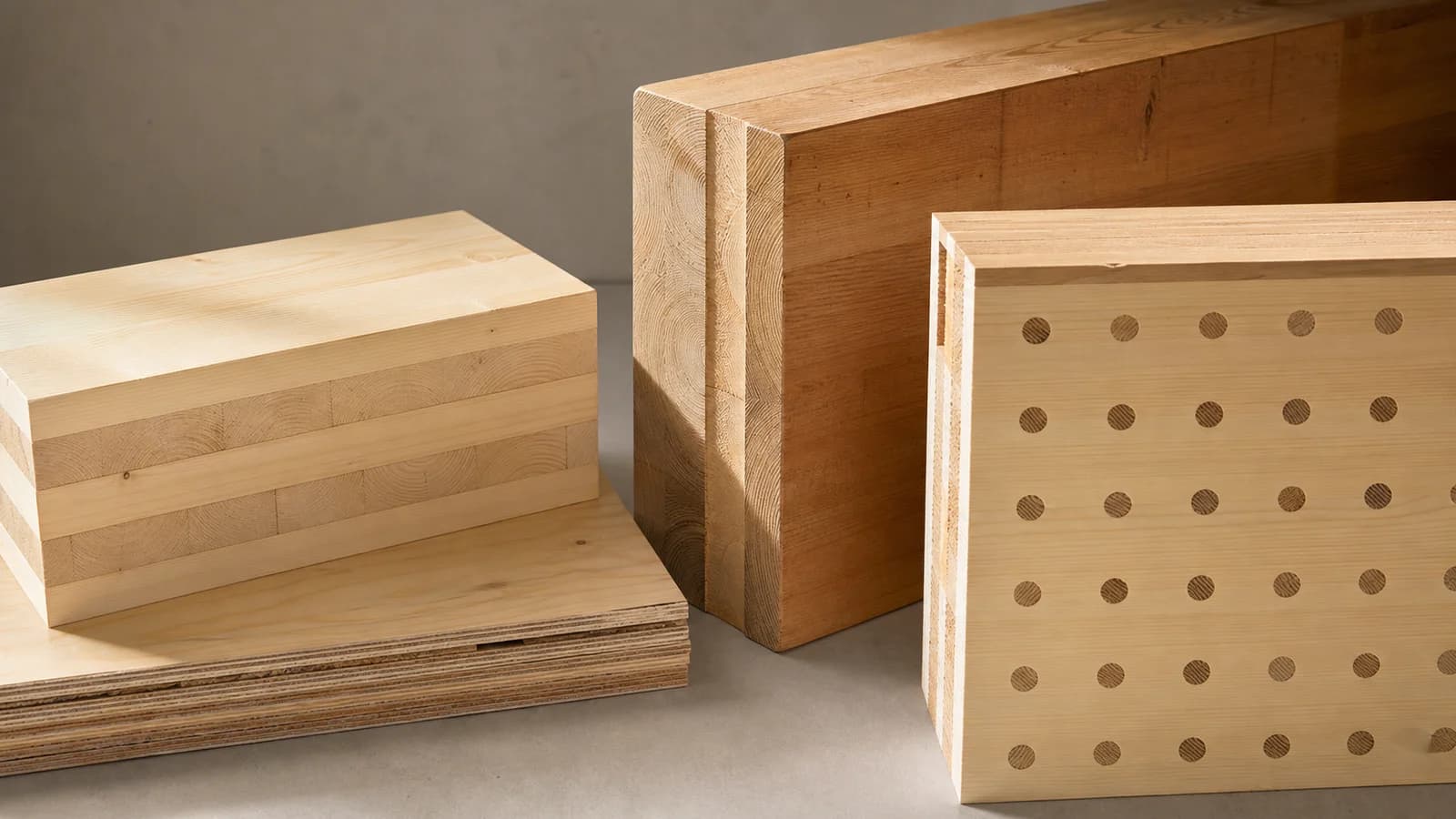
Mass timber is a family of engineered wood products, not a single material. Cross-laminated panels, glued beams, dowelled panels and nail-laminated decks can all appear in the same building, yet they are manufactured differently and carry different product information.
That distinction matters before any volume, weight or cost calculation. A useful estimate begins by identifying the actual product and its declared properties. “Mass timber” alone is not a density, grade, purchasing unit or structural specification.
Product type comes first
Cross-laminated timber, or CLT, is generally formed from layers of lumber placed at right angles and bonded into panels. It is commonly used for floors, roofs and walls. In North America, ANSI/APA PRG 320 covers manufacturing, qualification and quality-assurance requirements for performance-rated CLT.
Glulam uses laminations arranged with their grain primarily parallel to the member length and bonded with adhesive. Beams and columns are common applications; glued-laminated planks also exist. The layup, grade and product specification matter, so “glulam” is not a complete structural description.
Dowel-laminated timber, or DLT, uses hardwood dowels to hold boards side by side. Nail-laminated timber, or NLT, uses nails or screws. Both are commonly associated with floor and roof assemblies. Their mechanical lamination also shows why the statement “all mass timber is glued” is incorrect.
Structural composite lumber—including products such as laminated veneer lumber and parallel strand lumber—is another related engineered-wood family. These products use veneers or strands and adhesives, generally with fibres aligned predominantly along the member. Whether a specific product is grouped under “mass timber” can depend on the source and application, so record the exact commercial product rather than relying on the umbrella term.
Species is not the same as grade
Softwoods such as spruce, pine and fir are common in current mass-timber production, but products may use one species, a species group or different materials in different layers. Hardwood and hybrid products also exist.
A species name does not establish a product’s structural performance. Natural wood varies, and engineered products combine material selection, layup, manufacturing and quality control. Product grades and certified properties—not a generic species reputation—are what the project team uses for design.
The reverse is also true: a structural grade is not a universal density value. Two products that satisfy a particular performance requirement may have different declared densities, moisture conditions or layups. Do not use species, grade and density as interchangeable labels.
Bonding needs a precise description
For adhesive-bonded products, the important question is not simply “does it contain glue?” Standards, manufacturing controls, bondline testing and the intended service conditions are all relevant. The applicable product documentation should identify the standard and limitations.
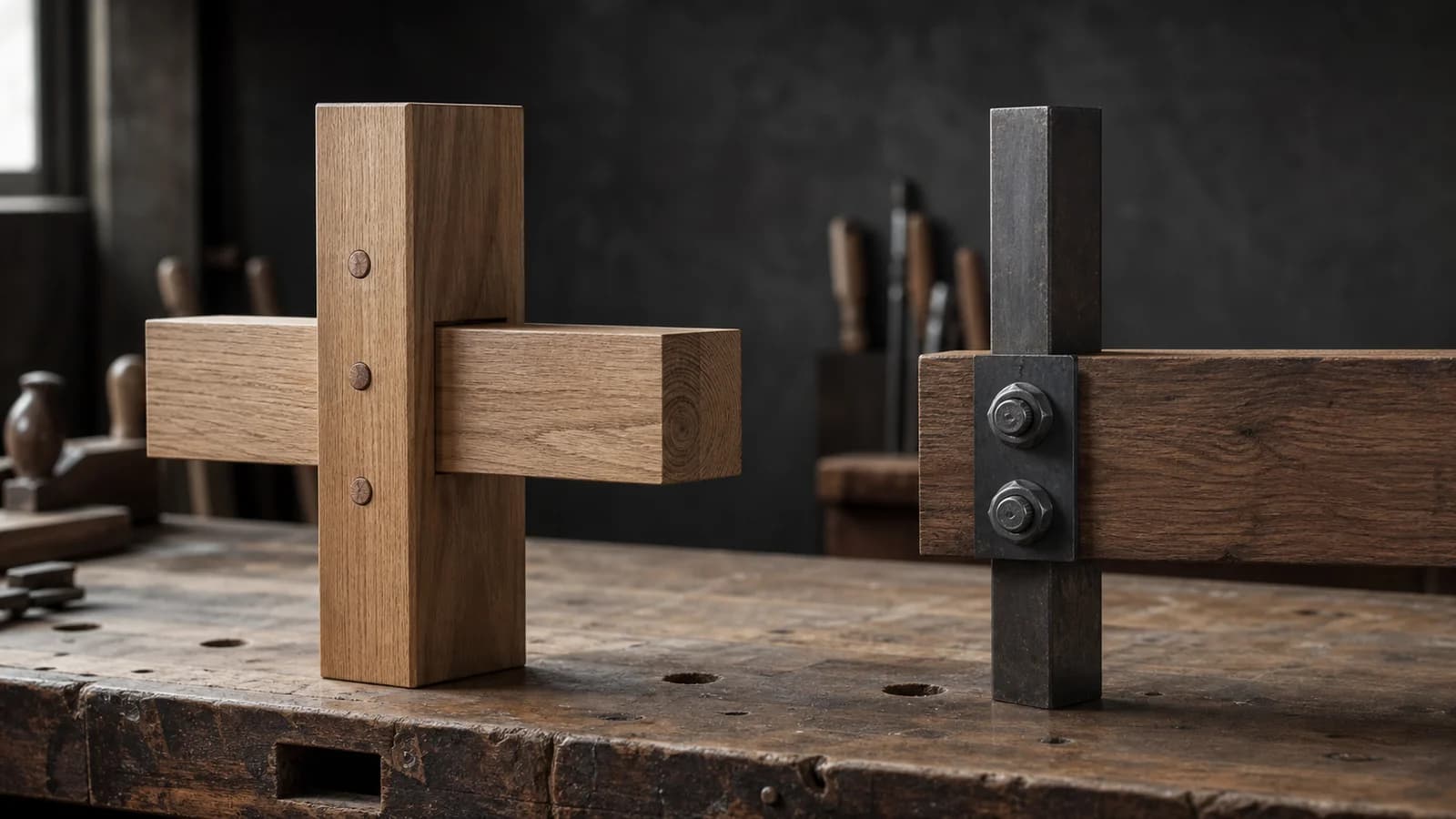
Mechanically laminated products avoid adhesive between the main board laminations, but that fact alone does not prove superior performance or environmental impact. Dowels, nails, screws, manufacturing, transport, finishing, maintenance and end-of-life scenarios still belong in a full comparison.
Avoid ranking an adhesive-bonded and mechanically laminated product from one attribute. Product selection also involves structural, fire, acoustic, vibration, moisture, fabrication, availability and code requirements. Those decisions belong to qualified project professionals.
Density and moisture shape the weight estimate
The USDA Wood Handbook explains that wood exchanges moisture with its environment. Moisture content affects mass and can affect dimensions; density also varies by species, product and individual material.
For an early estimate, use a density supplied for the actual product whenever possible. Record whether it is a characteristic, average or design value and the moisture basis to which it applies. A generic species value can be used as a visibly labelled assumption when nothing better exists, but it should not silently replace manufacturer data later.
The basic relationship is:
Estimated mass = volume × selected density
The equation is simple; selecting a defensible density is the substantive step. Plates, connectors, coatings, moisture protection and packaging may also contribute to delivery or lifting mass and should not be hidden inside a timber-only figure.
From the schedule to volume, weight and cost
Start with actual finished dimensions and counts from an approved schedule. Separate CLT panels, glulam members, DLT panels and other products when they have different densities or prices. For a known net volume, confirm whether openings, machining and waste have already been deducted or added.
Then use the Timber Volume, Weight & Cost Calculator to normalize dimensions or known volumes into cubic metres, cubic feet and geometric board feet, and to estimate mass and material cost from user-entered assumptions.
The calculator cannot decide whether CLT, glulam, DLT or NLT is suitable. It does not verify grades, spans, fire resistance, vibration, acoustics, connections or code compliance. Its role begins after product selection and geometry have been defined.
A comparison checklist
When comparing schedules or quotations, capture the same fields for every option:
- exact product type and intended application;
- applicable standard, grade and certification;
- species or species group, where declared;
- actual panel or member dimensions and count;
- density value and moisture basis;
- adhesive or mechanical lamination description;
- machining, openings, finishes and protection;
- net volume, ordering allowance and commercial pricing unit;
- exclusions such as connectors, transport, installation and tax.
This prevents a low price per cubic metre from being compared with a quotation that includes fabrication, protection or delivery. It also preserves the difference between geometrically equal quantities and technically equivalent products.
Read “mass timber” as the start of the question
A 2026 systematic review covering 189 peer-reviewed papers describes mass timber as products made from boards, veneers or strands joined by adhesives, dowels, nails or screws. That breadth is precisely why the category is useful—and why it is too broad for a takeoff by itself.
Identify the product, read its documentation, keep grade separate from density, and state the moisture and pricing assumptions. Once those inputs are explicit, a quantity calculator can provide a transparent comparison without pretending that all mass timber is the same.
Sources
- Chen, Tamagnone and Wan-Wendner, “Review of wood species and material characteristics of mass timber for structural applications,” 2026: https://link.springer.com/article/10.1007/s44242-026-00104-1
- APA—The Engineered Wood Association, “ANSI/APA PRG 320: Standard for Performance-Rated Cross-Laminated Timber”: https://www.apawood.org/ansi-apa-prg-320
- WoodWorks, “What is mass timber?”: https://www.woodworks.org/resources/what-is-mass-timber/
- USDA Forest Products Laboratory, “Wood Handbook: Wood as an Engineering Material”: https://research.fs.usda.gov/fpl/wood-handbook
- WoodWorks, “Standards and Testing: Ensuring Adhesive Performance in Mass Timber Buildings”: https://www.woodworks.org/resources/standards-and-testing-ensuring-adhesive-performance-in-mass-timber-buildings/
Free timber planning tool
Timber Volume, Weight & Cost Calculator
Calculate timber volume, estimated weight and cost from dimensions or a known volume. Supports metric, imperial and geometric board feet.
Results update instantly. No account is required, and inputs stay in your browser. Exchange rates and structural sizing are not included.
Estimate results
Enter valid values to see the estimate.