Beech Fibre Inside Bricks: A New Bio-Based Insulation Route
Researchers are testing mats and loose granules made from beech fibre as two ways to insulate perforated masonry.
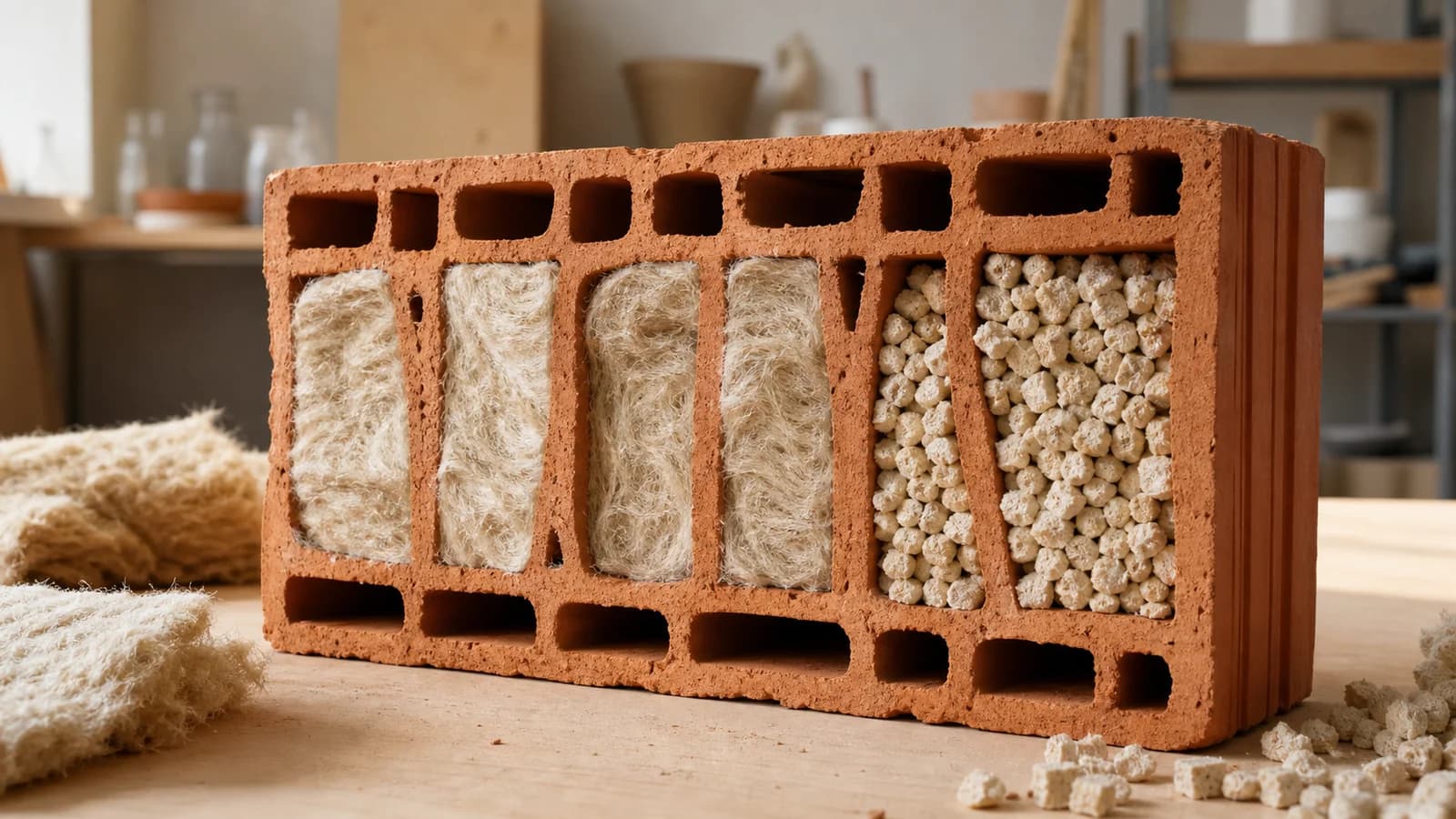
A German research project reported on 5 May 2026 has developed two insulation formats made from beechwood fibres for use inside perforated bricks. One is a flexible mat cut to fit a brick’s cavity pattern. The other is a loose, foam-like granulate that can fill different void geometries. The work is early-stage research, but it points to a useful design question: can regional hardwood residues become a practical part of a high-performance wall?
Two routes into the same brick
Perforated clay blocks reduce material use and trap air, but their cavities can also receive insulation. The research team followed two manufacturing routes. Fibre mats offer controlled shape and density, yet must match the pattern of each block. Granules or pumpable suspensions are less dependent on that pattern and may reach irregular spaces more easily.
That distinction matters for production. A bespoke insert can give repeatable geometry, while a flowable fill may simplify adaptation across product families. Neither route can be judged from the raw fibre alone. Final performance depends on density, moisture behaviour, settlement, bonding, fire classification, dimensional stability and the complete wall assembly.
Why beech is interesting
Most wood-fibre insulation markets are associated with softwood feedstock. Beech is widely available in parts of Europe, and processing residues could offer an additional raw-material stream. Using a different species is not merely a substitution exercise: fibre length, bulk density and processing response influence how the insulation forms and performs.
The circular logic is attractive when it upgrades a clean residue that has no higher-value reuse. It is weaker if valuable timber is reduced directly to fibre or transported excessive distances. A credible environmental assessment therefore needs source, transport, processing energy, binders, service life and end-of-life assumptions.
Energy efficiency is an assembly result
An insulating infill can lower heat flow through the repeating cavities of a masonry unit, but a product concept is not yet a certified wall value. Mortar joints, lintels, floor edges, openings and workmanship create additional heat paths. Moisture can also change thermal performance.
This is why designers need declared test conditions and assembly-level calculations. A promising conductivity value should connect to a verified U-value, climate-specific moisture analysis and junction details. Comparing only insulation thickness or fibre origin tells too little about annual demand or comfort.
What has—and has not—been demonstrated
The May announcement establishes that beech fibre was processed into mat and granulate formats intended for brick filling. It does not establish universal energy savings, market availability or approval in every jurisdiction. The supporting 2026 literature on wood-fibre systems is broader: it examines thermal and moisture behaviour in building envelopes, not an independent replication of this exact brick concept.
The next evidence should include ageing, moisture cycling, fire, settlement, manufacturability and full-wall testing. Monitoring pilot walls across seasons would then show whether laboratory promise survives construction tolerances and weather.
The FrameVerk view
For digital design, the useful object is not “bio-insulation” as a generic label. It is a traceable assembly component with species or feedstock class, density, declared thermal data, moisture limits, fire status, compatible brick geometry and evidence date.
That structure would let a model compare mat and granulate options without pretending they are interchangeable. It could also flag missing declarations before a specification reaches procurement. New material routes become valuable when their evidence travels with the geometry. That is the difference between a material idea and a specification-ready building component.
Sources
- Fraunhofer WKI, “Beechwood-fiber insulation as a filling for thermal-insulation bricks,” 5 May 2026: https://www.wki.fraunhofer.de/en/press-media/2026/press-release_2026-06_beechwood-fiber-insulation-as-a-filling-for-thermal-insulation-bricks.html
- Energy and Buildings, 2026 research on wood-fibre envelope performance: https://www.sciencedirect.com/science/article/pii/S0378778826006092
- Energy and Buildings, 2026 research on moisture and energy behaviour of bio-based envelopes: https://www.sciencedirect.com/science/article/pii/S037877882600040X