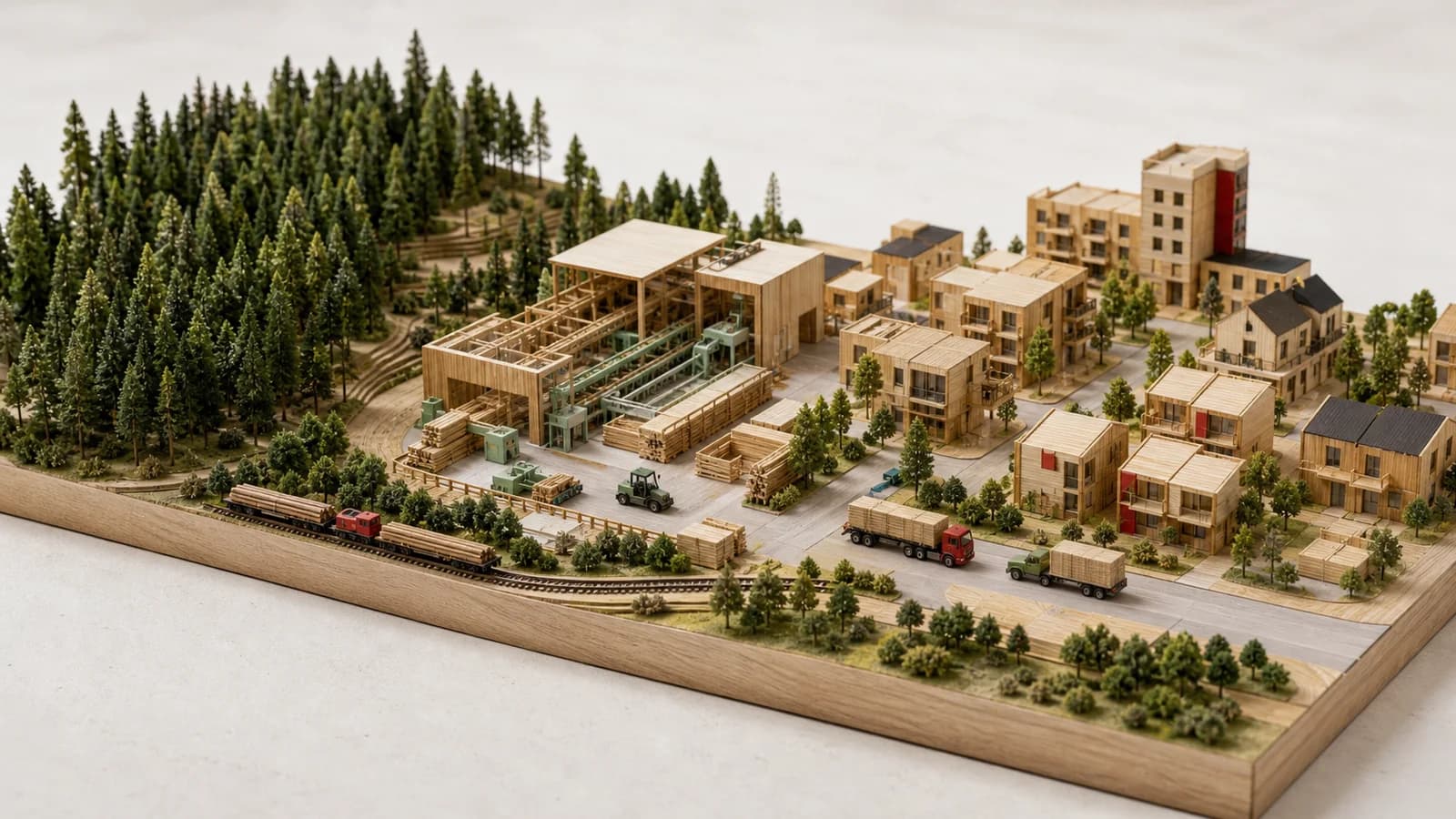
Canada puts mass timber inside its 2026 forest-sector reset
A federal transformation task force, new manufacturing investments and a renewed housing-focused wood programme place mass timber and prefabrication inside Canada’s industrial strategy—not just its architecture pages.
Canada began 2026 by treating mass timber as an industrial-policy question.
On 19 January, Natural Resources Canada announced the first meeting of the Canadian Forest Sector Transformation Task Force. Its agenda includes expanding mass timber, modular construction and prefabricated building systems, particularly for housing. The group was asked to engage industry, provinces, territories, Indigenous organisations and labour, then deliver recommendations after 90 days.
That announcement sits within a broader sequence. In March, the federal government detailed more than C$4.4 million for ten Prairie forest-sector projects, including support for a major automated glulam and mass-timber plant and a university research network. In its 2026 renewal, the Green Construction Through Wood programme redirected demonstration funding toward projects that can support higher housing output.
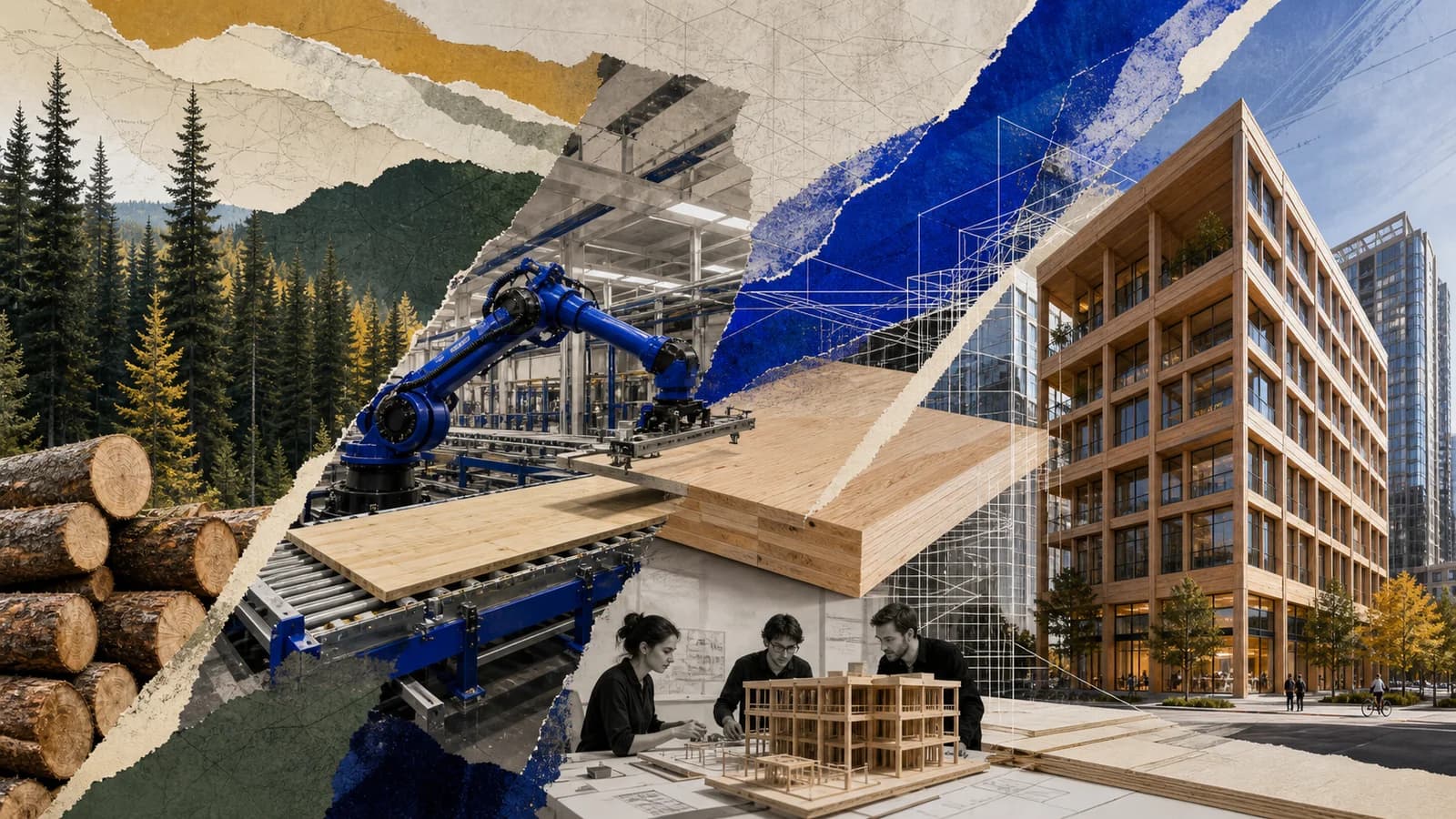
The pieces suggest a shift from “wood as a showcase material” to “wood as a coordinated production system.”
Why the forest sector needs transformation
Canada has large forest resources, established wood-products manufacturing and a deep engineering base. It also faces trade pressure, regional mill closures, fibre constraints, volatile construction demand and a housing shortage.
The task force is expected to consider product diversification, domestic and international markets, productivity, digitalisation and advanced technologies. Mass timber fits all five categories. It can turn structural-grade lumber into higher-value components, support local manufacturing, enter multi-storey markets and connect naturally with off-site production.
That does not mean every log should become CLT or every building should be timber. Fibre quality, species, mill capacity, transport distance and end-market demand vary by region. A successful strategy has to match resources to products rather than repeat a national slogan.
The factory signal from Alberta
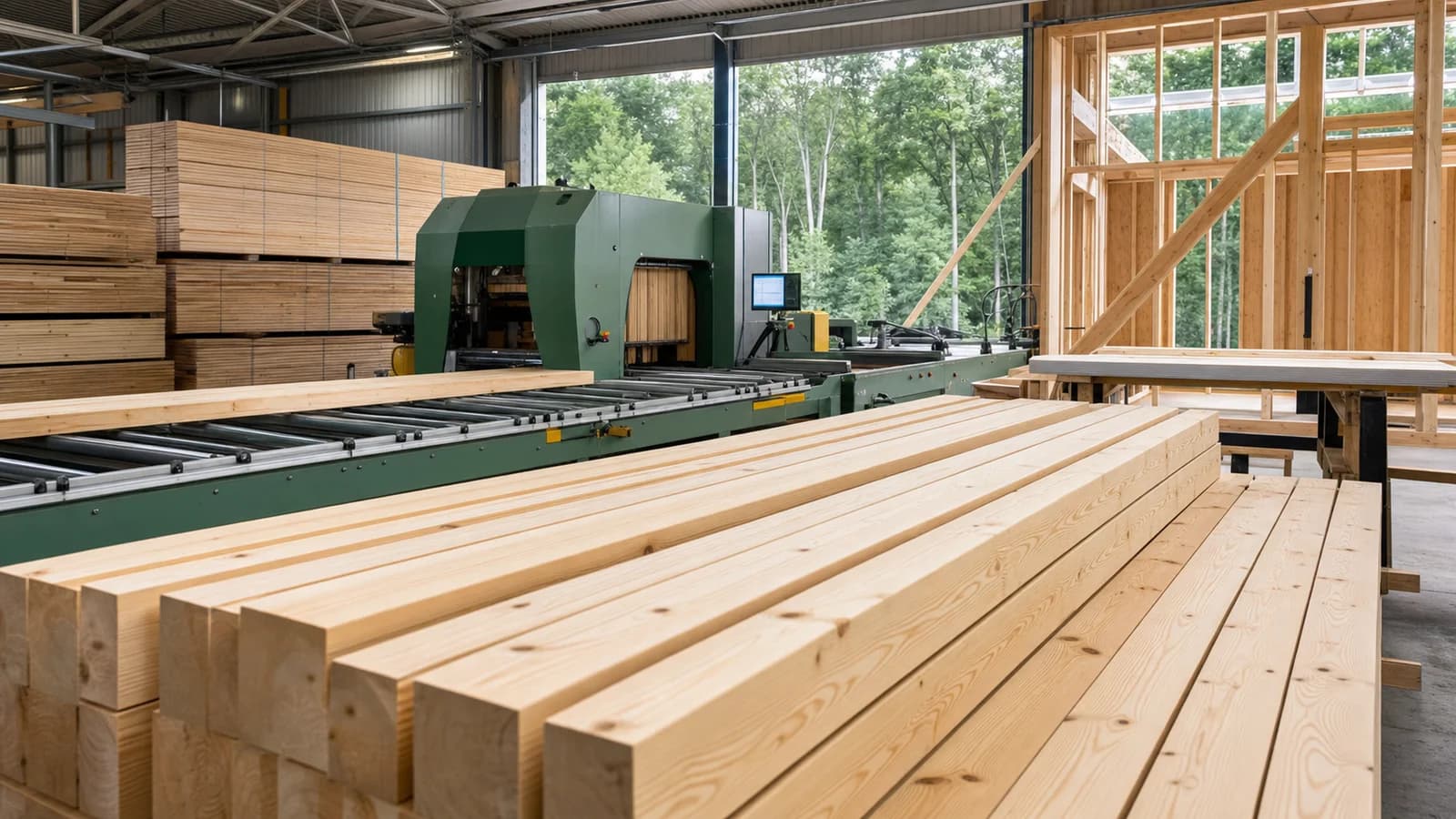
The March investment package includes C$2,311,494 for Western Archrib’s new plant in Sturgeon County, Alberta. Natural Resources Canada describes a 160,000-square-foot facility representing more than C$80 million in total capital investment.
The automated line is expected to increase annual production capacity from 12 million to 30–35 million board feet. The project is framed around glulam and other mass-timber components for construction and housing supply.
Automation can improve throughput, repeatability and data capture. It can also expose weak upstream information faster. A CNC line cannot resolve an uncoordinated opening, ambiguous connection or late architectural revision. Industrial capacity only translates into lower cost when design decisions arrive early and consistently.
The most important investment may therefore be the interface between the factory and the design team: standard product data, machine-ready geometry, revision control and reliable quantities.
Research is being connected to codes
The same federal backgrounder allocates C$450,000 to the University of Alberta for a Canadian Wood Construction Research Network project. Its stated purpose is to coordinate wood-construction research across universities and generate technical information supporting building-code and standards updates.
That matters because demonstration buildings alone do not create a repeatable market. Designers, authorities, insurers and manufacturers need shared evidence on fire, acoustics, vibration, durability, connections and structural systems.
Networks can reduce duplicated testing and turn project-specific knowledge into broadly usable design methods. The value will depend on open publication, representative testing and clear routes from research results to standards.
Housing changes the test
Canada’s Green Construction Through Wood programme has supported tall and innovative timber projects for years. Its 2026 demonstration stream explicitly connects funding to the federal commitment to double housing starts over the next decade.
Housing is a harsher test than an institutional showcase. It is repetitive, cost-sensitive and measured by rent, sale price, programme and long-term maintenance. A timber system that performs beautifully in a flagship office may require different spans, grids, fire strategies and acoustic assemblies in an apartment building.
The opportunity is scale through repeatability, not identical buildings. Standardised interfaces can allow multiple layouts while preserving manufacturing efficiency. A family of wall, floor and connection systems can be configured for different sites without redesigning the entire production logic.
Indigenous participation cannot be a footnote
The task force includes leadership from the BC First Nations Forestry Council, and the March package includes Indigenous forestry initiatives. That representation is material, not ceremonial.
Forest-sector transformation affects land, employment, revenue, stewardship and community infrastructure. Mass-timber policy that focuses only on urban buildings risks separating the visible product from the territories and workers that supply it.
Meaningful participation can include tenure, ownership, training, manufacturing partnerships, procurement and decision-making. The exact model will differ among Nations and regions; the principle is that value should not travel only downstream.
What the policy still has to prove
The 2026 announcements are direction, not delivery. The task force must convert broad goals into recommendations, and programmes must select projects that survive real procurement and construction conditions.
Several risks deserve attention:
- New factory capacity without a stable project pipeline can create price pressure rather than resilience. - Domestic-content preferences can support local industry but still need transparent performance and value criteria. - Fast housing targets can encourage premature standardisation around systems that lack regional validation. - Carbon claims can become misleading if forestry, transport, adhesives, construction waste and end-of-life scenarios are excluded. - Digitalisation grants can buy software without fixing information ownership or workflow discipline.
Good policy should make these trade-offs visible.
What a joined-up strategy could look like
A credible national pathway would connect five layers.
First, sustainable fibre supply and regional forest management. Second, manufacturing investment for lumber, glulam, panels and modular components. Third, open technical research and code development. Fourth, procurement and finance that recognise whole-project value. Fifth, digital standards connecting design intent to fabrication and handover.
If one layer is missing, the others underperform. A factory cannot compensate for an uncertain code path. A permissive code cannot create skilled installers. A government grant cannot make an uncoordinated model manufacturable.
Canada already has examples, expertise and resources. The 2026 question is whether those assets can operate as a system.
The FrameVerk angle
For timber software, industrial policy becomes a data problem surprisingly quickly. Manufacturers need product definitions and machining constraints. Designers need verified spans, assemblies and connections. Estimators need quantities that update with geometry. Authorities need traceable compliance information. Owners need an as-built record.
The task force’s references to digitalisation and prefabrication should therefore be read together. Digital construction is not a visual model placed beside a factory; it is the chain of verified information that lets the factory cut the right component once.
National programmes can help by requiring interoperable deliverables, material provenance and measurable performance—without locking the market into one vendor. Open formats and documented rules can let regional manufacturers compete while maintaining reliable project data.
From pilot to production
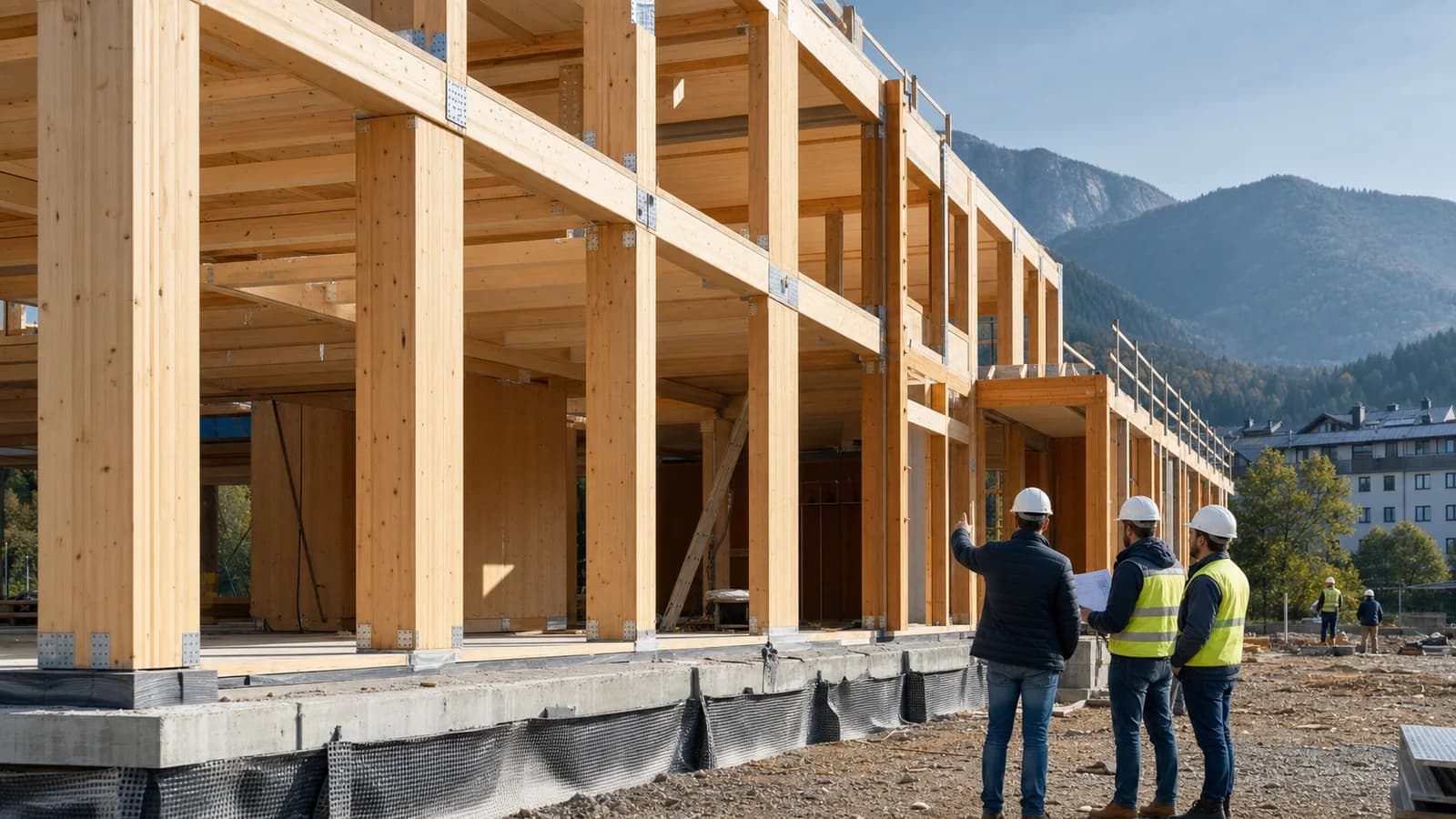
Canada’s mass-timber story has often been told through landmark buildings. The 2026 policy sequence asks a different question: can engineered wood contribute to ordinary housing, regional manufacturing and forest-sector resilience at scale?
The answer is not guaranteed. It depends on demand, cost, fibre, codes, skills and the unglamorous quality of project information.
But the framing matters. By placing mass timber, modular systems and prefabrication inside a forest-sector transformation agenda, Canada is acknowledging that the next breakthrough may not be the tallest timber building.
It may be a repeatable floor cassette, produced locally, documented correctly and installed in thousands of homes without becoming news at all.
Sources
- Natural Resources Canada, “Task Force begins work to transform Canada’s forest sector,” 19 January 2026: https://www.canada.ca/en/natural-resources-canada/news/2026/01/task-force-begins-work-to-transform-canadas-forest-sector.html - Natural Resources Canada, “Government of Canada invests in strengthening the Prairies’ forest sector,” 6 March 2026: https://www.canada.ca/en/natural-resources-canada/news/2026/03/government-of-canada-invests-in-strengthening-the-prairies-forest-sector.html - Natural Resources Canada, GCWood Demonstration Project Stream, 2026 renewal: https://natural-resources.canada.ca/funding-partnerships/gcwood-demonstration-project-stream - Housing, Infrastructure and Communities Canada, “Catalyze the housing industry,” 9 April 2026: https://housing-infrastructure.canada.ca/bch-mc/catalyze-housing-industry-stimuler-lindustrie-logement-eng.html