Three Global Studies Redraw the Tall-Timber Map in 2026
New datasets covering 56, 79 and 258 buildings quantify material intensity, structural systems and recurring tower types—replacing isolated records with a broader global picture.
Tall timber is often compared by height, storeys or carbon claims. Three global studies published in 2026 ask more useful questions: how much mass timber does each square metre require, which structural systems dominate, and which architectural types recur across countries?
Researchers Felipe Victorero and Waldo Bustamante developed a methodology using publicly available data from a global set of contemporary tall timber projects. From a database of 301 buildings, they selected a representative sample of 56, stratified by region, use and structural system.
The study reports an average mass-timber material intensity of 132.8 kilograms per square metre.
Hybrid and all-timber results diverge
The average for hybrid buildings was 123.0 kg/m², while all-timber buildings averaged 173.3 kg/m². Buildings in seismic regions recorded a slightly lower mean of 119.4 kg/m².
These values should not be read as universal design targets. A building’s material intensity depends on spans, loads, height, structural grid, fire strategy, core, product types and the boundary used for counting material.
They do provide a more useful baseline than assuming every tall timber project consumes the same volume per floor area. For early carbon or supply studies, a representative range can be better than copying one famous tower.
The authors derived the representative sample from a much larger project pool, rather than selecting only the tallest or best-documented icons. That sampling decision is important because headline towers can distort assumptions used for ordinary projects.
Why hybrids may use less timber
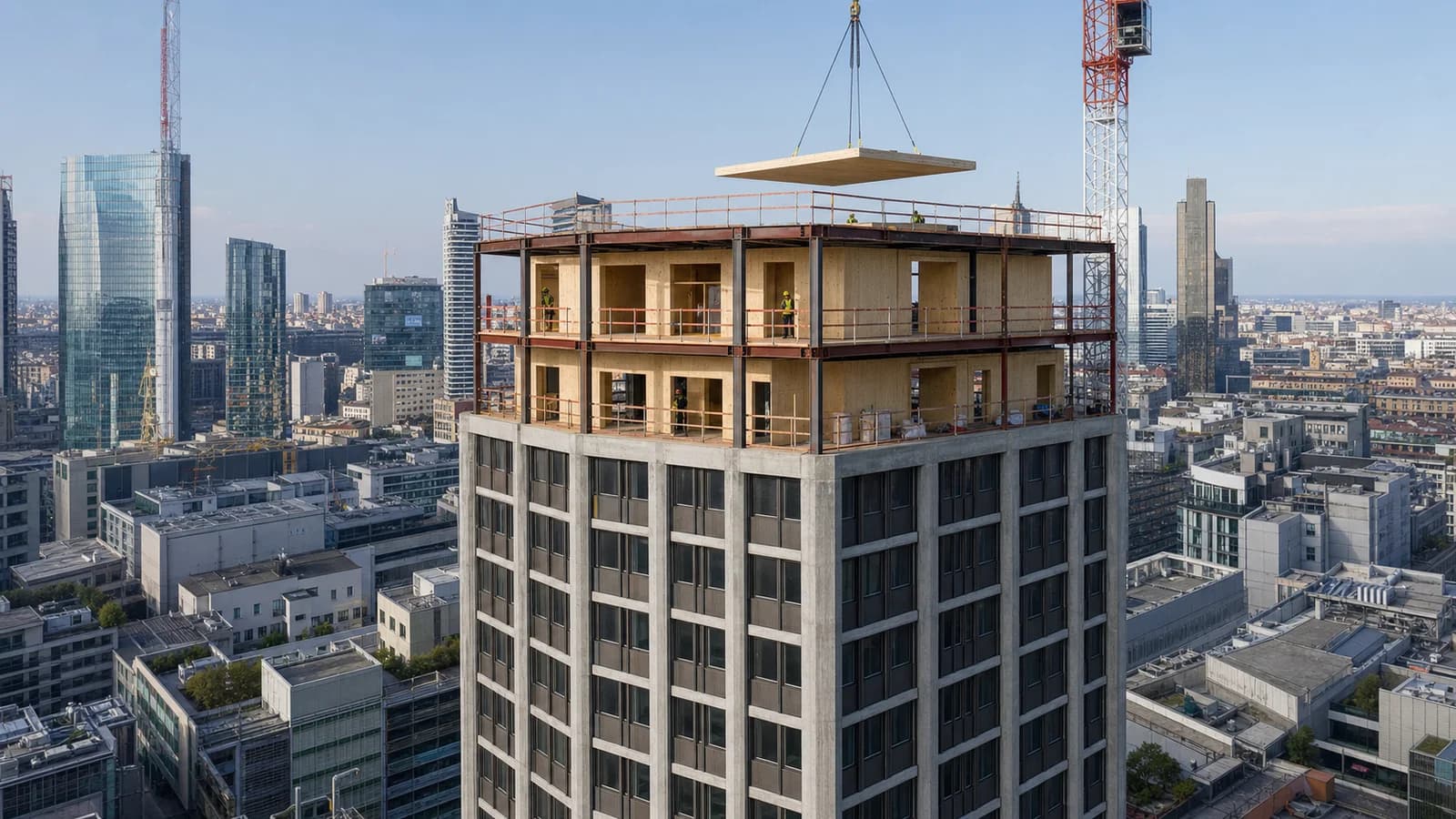
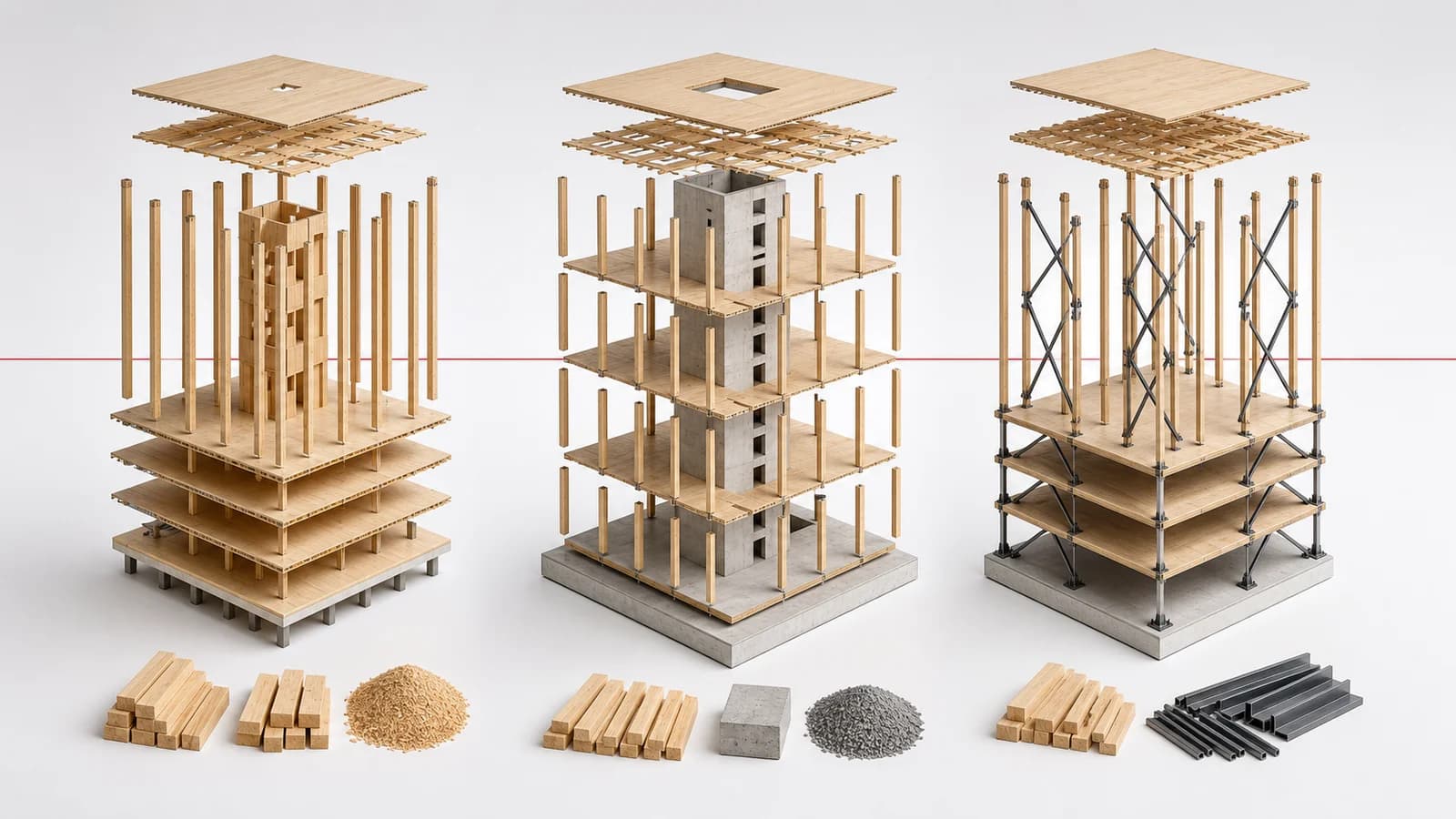
Hybrid structures allocate different jobs to different materials. Concrete or steel may form the lateral core, podium, transfer structure or selected long-span elements, while timber provides floors, columns and beams.
That can lower measured timber intensity without necessarily lowering total structural material or whole-life impact. Less wood is not automatically better if it is replaced by a more emissions-intensive system. The correct comparison needs all materials and the performance they deliver.
A separate 2026 global analysis of 258 mid- and high-rise mass-timber buildings found three dominant classifications: all-timber at 49.2%, hybrid timber–concrete core at 44.2%, and hybrid timber–steel at 6.6%. Together, the studies show that hybridisation is central to tall timber practice, not a rare exception.
The 79-building morphological study adds architectural organisation to the structural data, examining programme, core layout, form and material composition. Its value is not a single winning type, but evidence that recurring combinations are emerging across a young international field.
From kilograms to procurement
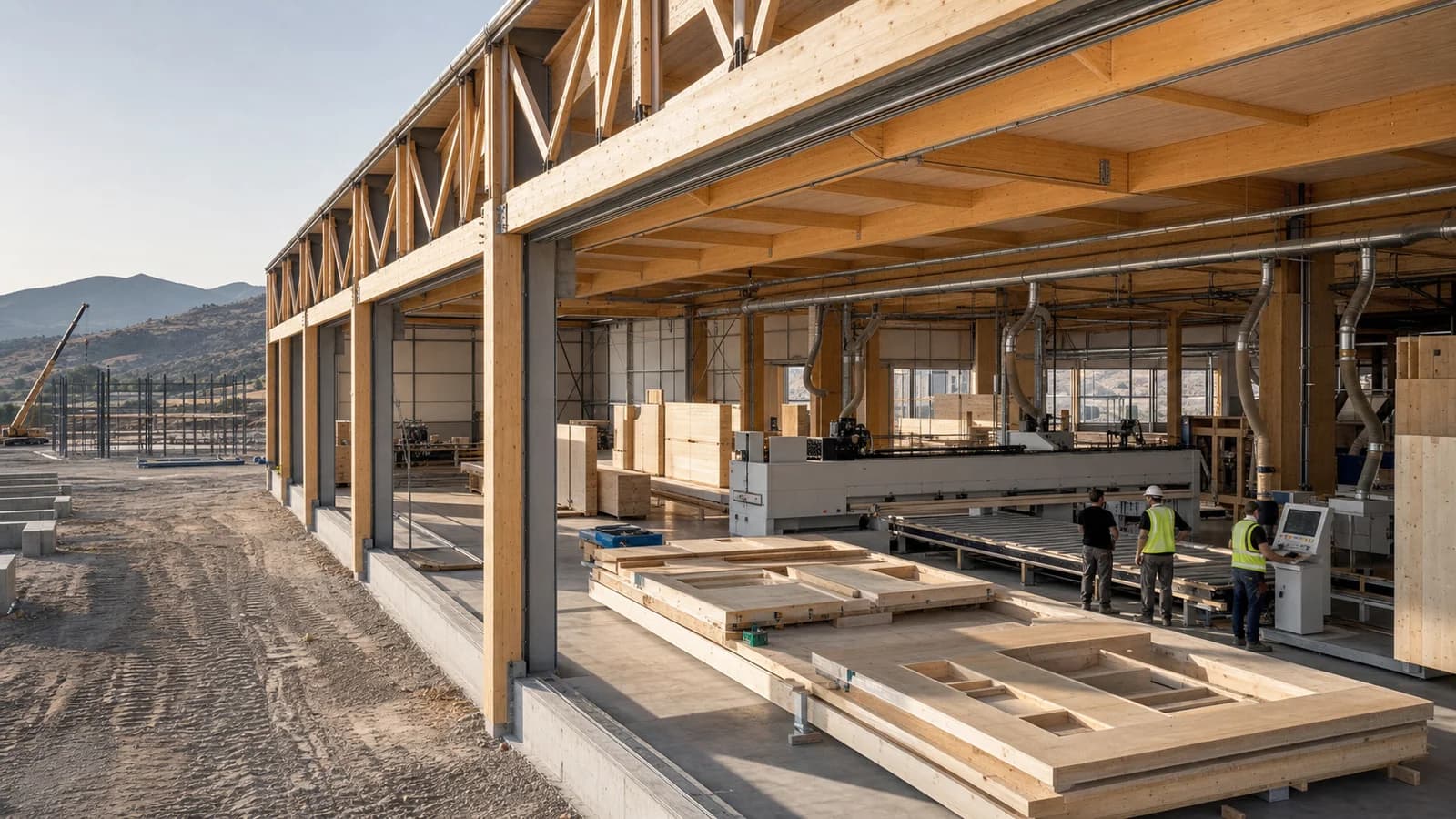
Material-intensity data can inform supply forecasting, early cost models and embodied-carbon scenarios. Converting kilograms per square metre into product orders still requires density, panel layups, member sizes, waste factors and fabrication strategy.
For design software, the goal should be to replace generic intensity assumptions with model-derived quantities as the project develops. At concept stage, a benchmark can test whether an option is plausible. At detailed stage, every beam and panel should contribute to an auditable total.
If the design model reports a value far outside published ranges, the answer may be an innovative structure—or a quantity error. Either result deserves investigation.
A benchmark, not a league table
The authors describe their work as a first-approach methodology and a foundation for research into carbon storage, fire safety, economics and policy. Public project data remains inconsistent, and structural boundaries can be difficult to compare.
That caution is a strength. The 132.8 kg/m² average is not a commandment carved into CLT. It is a transparent reference point for asking better questions about efficiency.
Tall timber needs those questions. Height attracts attention, but material discipline determines whether a system can scale responsibly.
Sources: Victorero and Bustamante, “Estimating material intensity of mass timber products in contemporary tall timber buildings,” Journal of Building Engineering, 15 February 2026: https://www.sciencedirect.com/science/article/abs/pii/S2352710226004298
“Global analysis in 258 mid- and high-rise mass timber buildings,” 2026: https://www.sciencedirect.com/science/article/pii/S2095263526001147
“Toward a morphological typology of high-rise timber buildings: a comparative analysis of 79 global cases,” 2026: https://link.springer.com/article/10.1007/s44290-026-00405-1