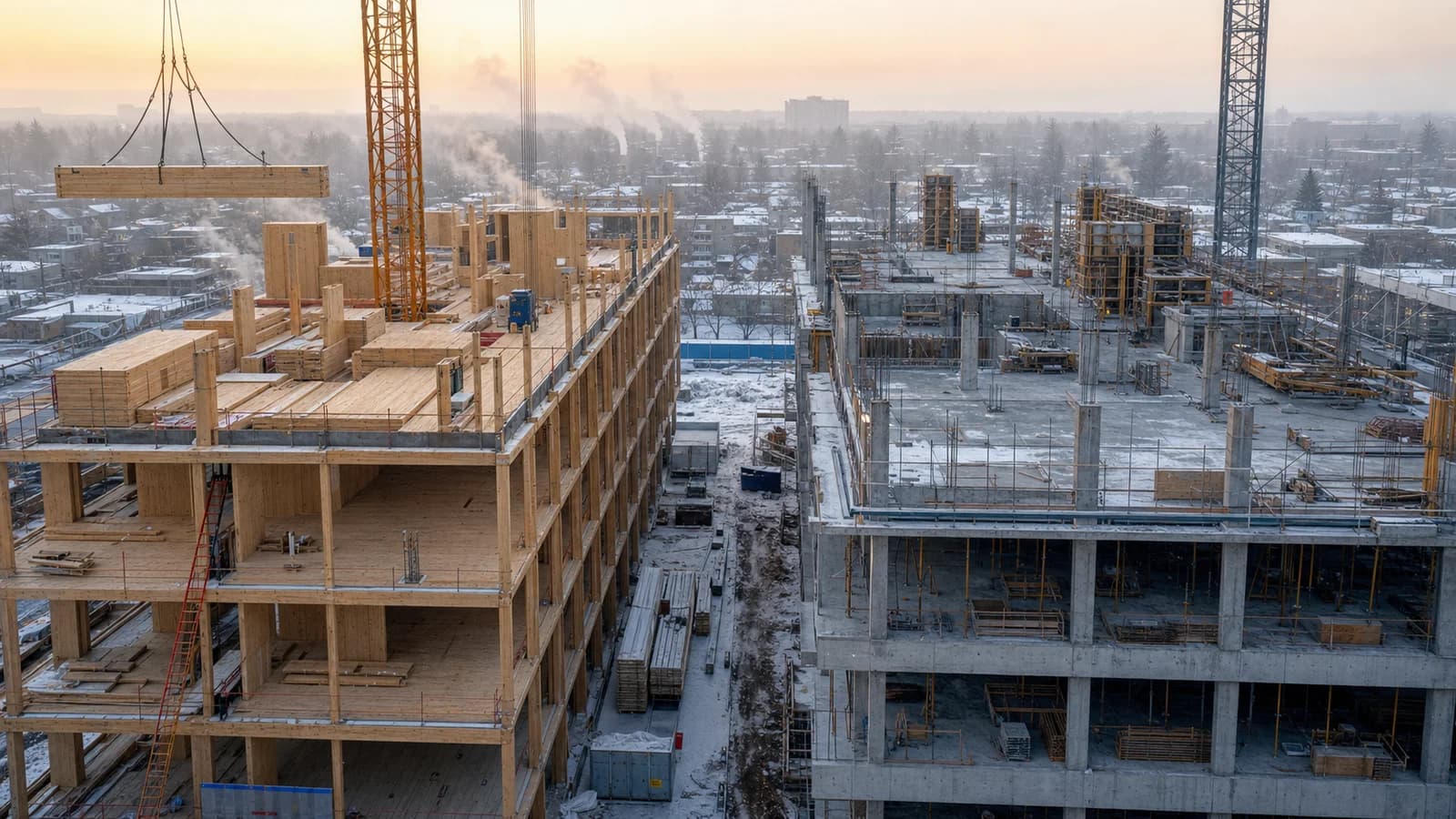
Mass Timber vs Concrete on Site: Construction Energy Was 30% Lower in a New Study
A 2026 analysis of completed projects isolates construction-stage energy—and shows why winter heating can dominate the result.
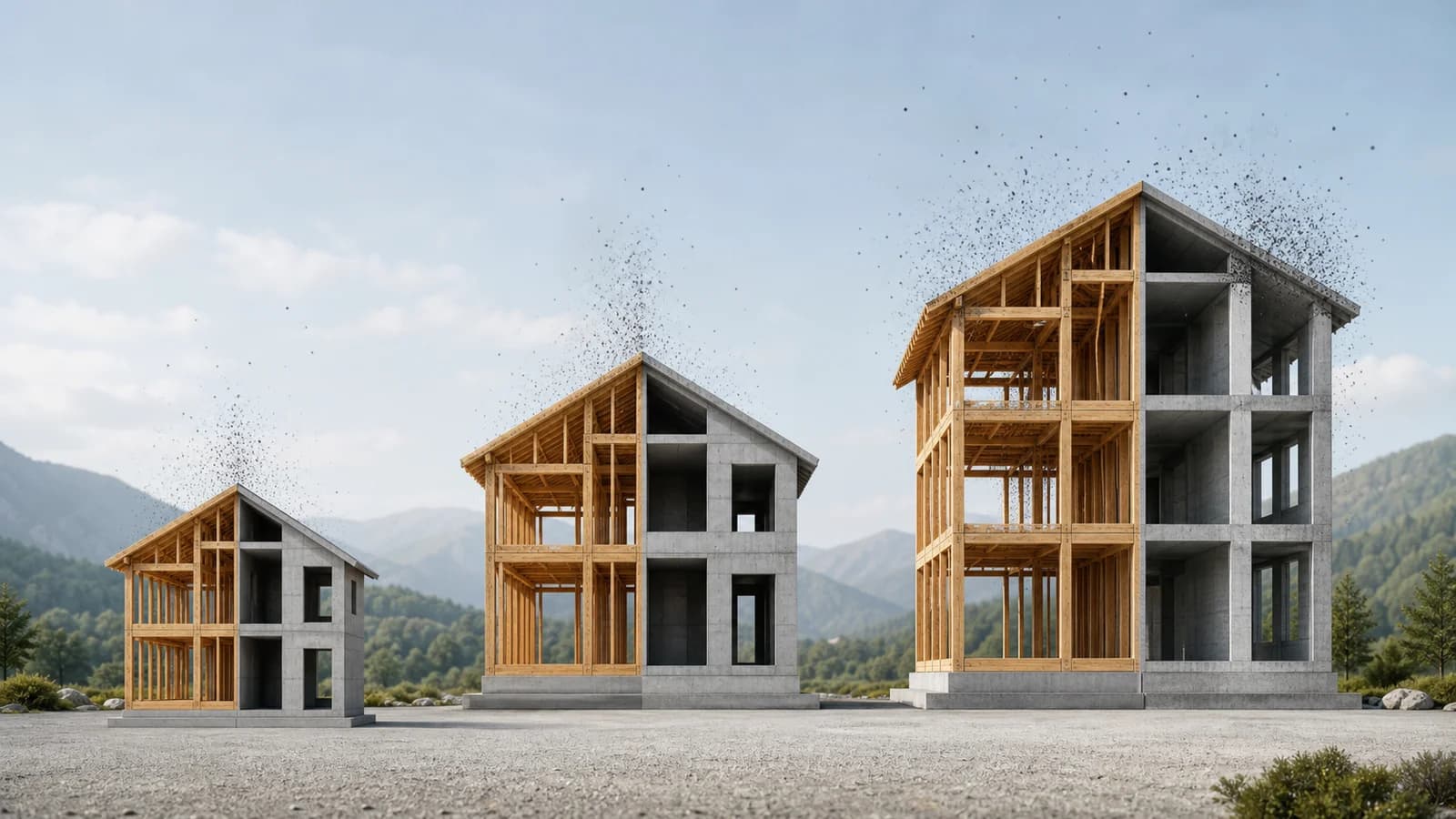
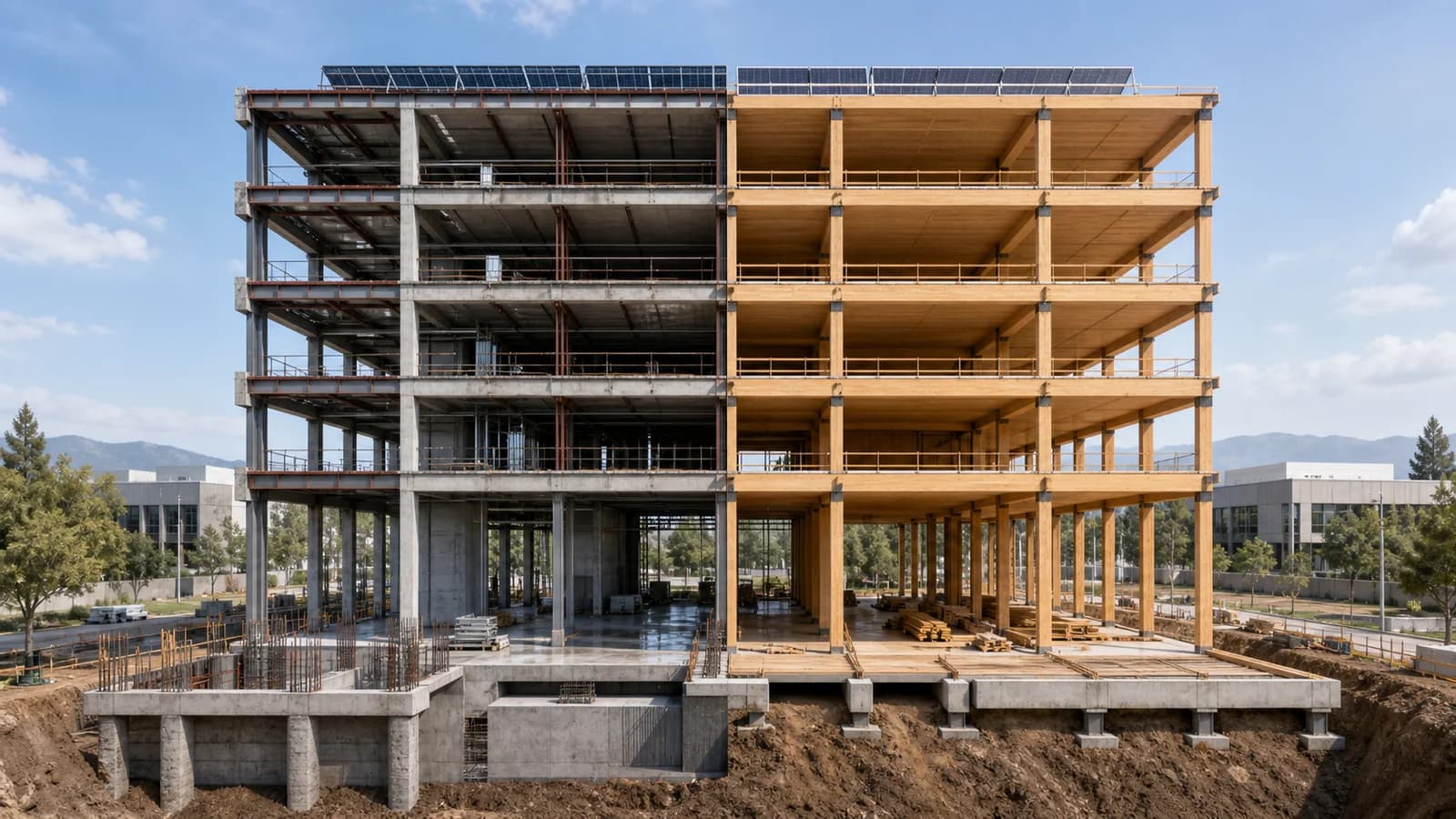
A peer-reviewed study published online on 1 July 2026 compared construction-stage energy for mass timber, reinforced concrete and structural steel. Applied first to two completed mass-timber buildings in the US Midwest, its framework estimated mass timber at about 30% lower A5 energy than reinforced concrete and roughly 13% lower than steel across climate zones 1A to 5A. The result is notable, but its boundary is just as important: this is energy used during construction, not the full life-cycle footprint of a building.
What A5 energy includes
Life-cycle assessments divide a building into stages. A5 covers construction and installation: equipment, site logistics and temporary services required to turn delivered products into a completed building. It sits after product manufacture and transport, and before decades of operation.
The researchers used a dual-track method. One track creates a lower estimate from known activities; another uses the project schedule to define an upper range. Monte Carlo analysis then represents uncertainty rather than hiding it behind a single precise number. The model was applied to two completed projects and extended to equivalent concrete and steel structures.
Why weather can outweigh the fasteners
In the cold-climate cases, temporary heating accounted for 52% to 60% of construction energy. Installation of mechanical fasteners contributed less than 0.2%. That contrast corrects a common intuition: the many visible connections in a timber frame are not necessarily the dominant site-energy load.
Schedule and enclosure sequence can matter more. If a team reaches a weather-tight condition earlier, it may shorten the period during which temporary heat serves an unfinished volume. The study also reported a 44% learning-curve productivity improvement in cross-laminated-timber installation, showing how repetition can change the site model.
What the comparison does not settle
The reported 30% and 13% differences come from a defined framework, project data and modeled equivalents. They are not universal discounts for every timber project. Climate, building form, grid or fuel mix, crane strategy, crew learning, temporary enclosure and schedule can move the result.
Most importantly, A5 does not include the complete product, use and end-of-life story. A material can perform well on site and still require separate scrutiny of manufacturing emissions, operational energy, durability, replacements and disposal or reuse. The study strengthens one part of the evidence; it does not replace a whole-building assessment.
A better way to compare site plans
Teams can use the finding before procurement. Model alternative structural sequences, enclosure dates, equipment hours and temporary-heating scenarios. Show a range, not a ceremonial exact total. Then record actual fuel, electricity, equipment time and installed quantities during construction.
That feedback turns a comparison into a learning system. It also prevents the structural material from receiving credit for gains actually produced by logistics—or blame for a winter schedule chosen elsewhere.
The FrameVerk view
Construction energy should be connected to the model’s real objects and time. A panel, beam or slab needs installation productivity, equipment demand and sequence; the temporary enclosure needs area and dates; heating needs climate and fuel assumptions. When the schedule changes, the A5 scenario should update with it.
The practical headline is not that timber always wins. It is that fast, repeatable dry construction can create an energy advantage—and that advantage becomes measurable when quantities, activities and weather share one audit trail. The audit trail makes that distinction explicit.
Sources
- Case Studies in Construction Materials, “A dual-track framework for estimating construction-stage energy in mass timber buildings,” online 1 July 2026: https://www.sciencedirect.com/science/article/pii/S2214509526005310
- Canadian Wood Council and public-sector partners, “Comparative Feasibility Study for Encapsulated Mass Timber Construction,” contextual comparison methodology: https://www.publicarchitecture.ca/wp-content/uploads/2024/02/Comparative-Feasibility-Study-for-Encapsulated-Mass-Timber-Construction.pdf
- WoodWorks, “Tall with Timber: A Seattle Mass Timber Tower Case Study,” construction sequencing context: https://www.woodworks.org/resources/tall-with-timber-a-seattle-mass-timber-tower-case-study/