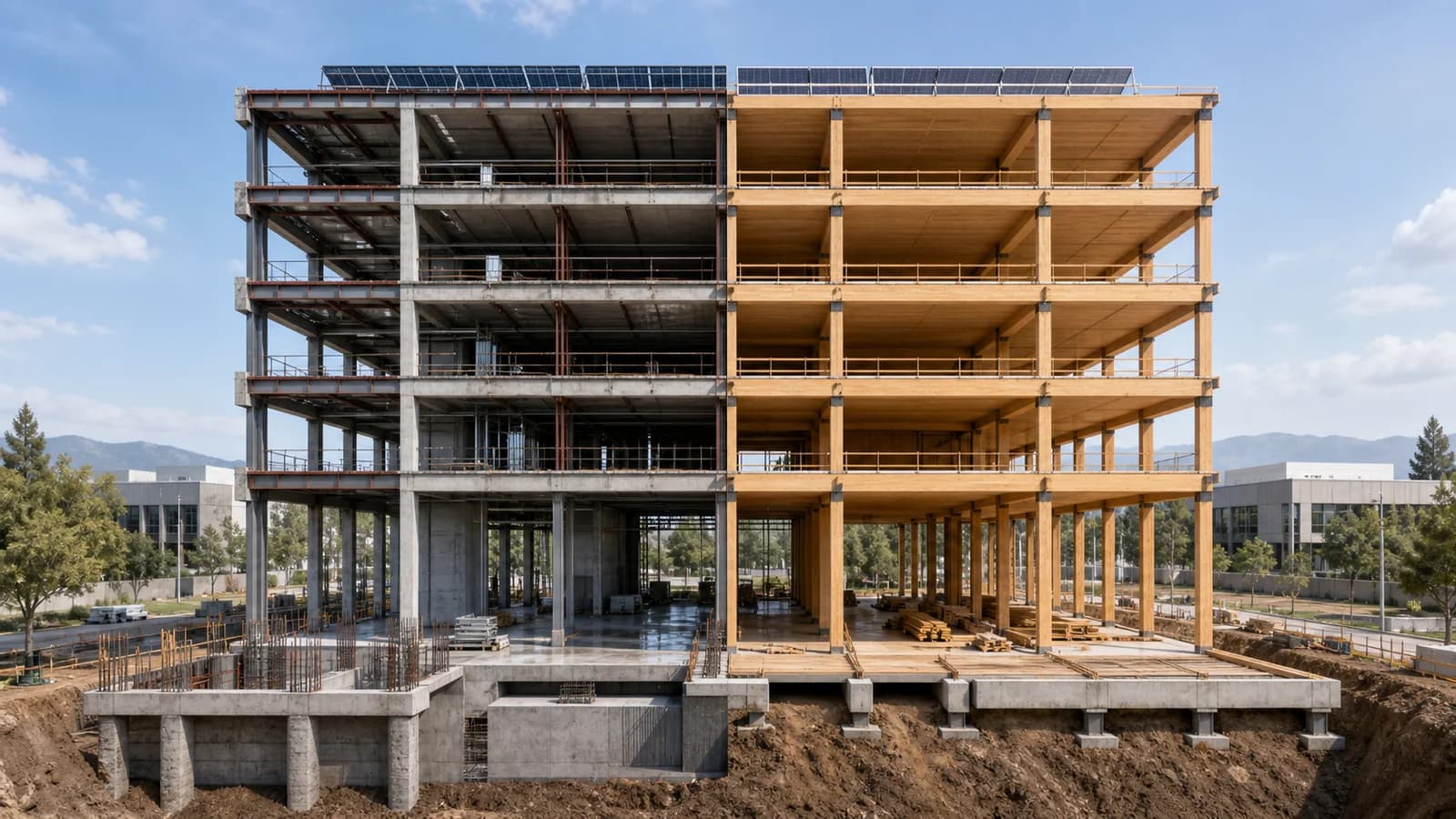
500 County Center: What Its Mass-Timber Carbon Case Study Reports
The civic building’s project team reports lower structural embodied carbon and a shorter programme. The useful lesson lies in the hybrid system, comparison boundary and assumptions—not a universal percentage.
500 County Center in Redwood City, California, is often presented as evidence that mass timber can reduce the embodied carbon of a large civic building. The project is relevant, but the wording matters. Its widely repeated reduction is a modelled structural comparison against a conventional alternative, not a measured whole-building or whole-life saving.
The case study is most useful when three questions stay visible: What was built? What baseline was used? Which life-cycle stages and carbon categories were included?
What was built
The five-storey office building provides approximately 208,000 square feet of civic workspace. Public project information describes a hybrid structure using glulam columns and beams, cross-laminated timber floor panels and steel lateral elements, alongside concrete foundations and other non-timber components.
The word “hybrid” is important. A mass-timber building is not an inventory containing only wood. Its embodied-carbon assessment must still count the concrete, steel, connectors, envelope, interiors and building services that fall inside the chosen scope.
Construction was completed in 2024. Operational-energy goals and environmental certification are part of the project story, but they answer different questions from structural embodied carbon. A highly efficient all-electric building can still have substantial product-stage emissions, while a low-carbon structural system does not guarantee low operational energy.
The reported structural carbon reduction
The project team and Engineering News-Record report an 85% reduction in structural embodied carbon compared with a conventional steel structural baseline. That is a strong project claim, but it needs all three qualifiers:
- it applies to the structure;
- it is relative to a modelled conventional steel alternative;
- it belongs to the project team’s assessment method.
It should not be rewritten as “the building saved 85% carbon.” Such wording implies a measured whole-building outcome and hides the counterfactual baseline.
Architectural Record describes the reduction as approximately 80% compared with a conventional steel or concrete solution and notes the role of biogenic carbon. The difference between approximately 80% and 85% may reflect rounding, a different baseline or a different treatment of stored carbon. Without the complete calculation sheets, those figures should not be treated as interchangeable.
A careful article can report the 85% structural claim with attribution and then explain that another reputable account uses different wording. That is more credible than selecting the larger percentage without discussing method.
Biogenic carbon needs its own line
Timber products contain carbon absorbed during tree growth. Life-cycle methods can report this biogenic carbon as stored in products during their use in the building. Its treatment depends on the method and on later assumptions about disposal, reuse, combustion or recycling.
For that reason, fossil product-stage emissions, GWP-total and stored biogenic carbon should remain visible as separate indicators. A negative or very low net value produced by immediately subtracting stored carbon can obscure manufacturing emissions and future releases.
The public summaries for 500 County Center do not provide enough detail to reconstruct every factor and module. The article should therefore attribute the reported reduction rather than present it as an independently recalculated fact.
Schedule and procurement are separate findings
WoodWorks reports that the mass-timber approach shortened the construction programme by approximately three months and enabled smaller foundations. Engineering News-Record reports project-specific procurement or material savings of about $1 million.
These findings should be presented independently from the carbon percentage. A shorter programme is not a carbon unit, and a procurement saving is not proof of a lower whole-life cost. Both depend on the baseline, market conditions, contracting strategy and programme assumptions used for this building.
WoodWorks is an industry-supported technical and education organisation. Its case study is valuable for system and delivery details, but its institutional role should be disclosed. Independent trade-press reporting provides useful corroboration, although it also relies in part on information from the project team.
What can be transferred to another project
The transferable lesson is a process, not the 85% figure:
- Develop a credible baseline for the same function.
- Build complete structural material inventories for both schemes.
- Keep hybrid concrete and steel elements in the timber option.
- Apply compatible carbon factors and the same modules.
- Report stored biogenic carbon separately.
- Record cost and programme assumptions outside the carbon total.
This workflow allows a new project to test whether a similar opportunity exists without claiming the California result in advance.
Test the A1–A3 inventory, not the headline
The FrameVerk Embodied Carbon Calculator can be used to model the product-stage A1–A3 emissions of a project’s structural material inventory. A user can enter timber, concrete and steel quantities for a baseline and alternative, review the factors and see which lines drive the difference.
The natural action is: “Model your project’s A1–A3 structural materials.”
The calculator cannot confirm that a baseline is structurally equivalent, recover the unpublished assumptions behind the 500 County Center percentage or calculate certification, programme and procurement outcomes. It also does not include transport to site, construction, use or end-of-life stages. Its output is an early estimate that should be reviewed as the design and product data develop.
Questions to ask when reading a project claim
Before using a reported saving, check:
- Is the result structural or whole-building?
- Is it A1–A3, another module set or a whole-life total?
- What material system is the baseline?
- Are floor area and building function equivalent?
- Is stored biogenic carbon included in the percentage?
- Are product-specific declarations or generic factors used?
- Is the result a design model, an as-built assessment or a verified disclosure?
- Are cost and schedule findings based on the same counterfactual?
500 County Center is a useful built case because it shows how timber, steel and concrete can be coordinated in a large hybrid civic structure. Its reported carbon performance deserves attention. The claim becomes more useful—not less—when its baseline, boundary and attribution remain attached.
Sources
- County of San Mateo, official “County Office Building 3” project page, accessed 30 July 2026: https://www.smcgov.org/ceo/county-office-building-3
- WoodWorks, “500 County Center” technical case study, accessed 30 July 2026. WoodWorks is an industry-supported education organisation: https://www.woodworks.org/resources/500-county-center/
- Engineering News-Record, “Excellence in Sustainability: County of San Mateo County Office Building 3,” project reporting: https://www.enr.com/articles/60436-excellence-in-sustainability-county-of-san-mateo-county-office-building-3-cob3
- Architectural Record, project review and carbon-method context, accessed 30 July 2026: https://www.architecturalrecord.com/articles/17674-som-foregrounds-sustainability-at-a-multitasking-county-office-building-in-northern-california
- Project architect, “500 County Center,” project data and reported structural-carbon intensity, accessed 30 July 2026: https://www.som.com/projects/500-county-center/
Embodied carbon screening
Model A1-A3 material inventories
Estimate product-stage A1-A3 emissions with bundled open, generic typical factors from Boverket’s Climate Database. This is an indicative screening estimate, not a project-specific or certified LCA.
Inputs and calculations stay in this browser session; they are not saved to a FrameVerk project or account.
Methodology and sources
The calculator uses bundled, versioned open generic typical A1-A3 factors from Boverket’s Climate Database. No factor data is fetched at runtime, and inputs and results stay in the browser.
A1-A3 boundary
A1-A3 covers raw-material supply, transport to manufacturing and manufacturing. The bundled factors are generic screening data, not project- or product-specific evidence, and this is not a whole-life assessment.
What is excluded
A4 transport, A5 construction, use, maintenance, replacement, end of life, module D and functional-performance verification are excluded.
Biogenic carbon
Timber products can contain temporarily stored biogenic carbon. Direct GWP-GHG excludes biogenic uptake and emissions; any source-reported stored carbon is shown separately and never treated as an extra credit. A1-A3 does not describe end-of-life release, reuse or recycling, or storage permanence.
Uncertainty
Boverket’s generic typical factors are not project-specific. Factor choice, geography, product specification, quantities, functional equivalence and omitted life-cycle stages can materially change this indicative estimate.
Methodology authorities
Factor sources
Sawn softwood timber — Sawn timber, u 16 %, coniferous
- Factor version
- BOVERKET-6000000007 · 02.07.000
- Declared unit
- 1 kg
- Direct GWP-GHG A1-A3 factor
- 0.064 kgCO₂e / 1 kg
- System boundary
- A1-A3
- Publisher
- Boverket (Swedish National Board of Housing, Building and Planning)
- Production geography
- Swedish market — Generic value representative of products consumed on the Swedish market; not product- or project-specific.
- Next review
- Jan 20, 2027
Cross-laminated timber (CLT) — Cross-laminated timber, u 12 %, coniferous
- Factor version
- BOVERKET-6000000167 · 02.07.000
- Declared unit
- 1 kg
- Direct GWP-GHG A1-A3 factor
- 0.096 kgCO₂e / 1 kg
- System boundary
- A1-A3
- Publisher
- Boverket (Swedish National Board of Housing, Building and Planning)
- Production geography
- Swedish market — Generic value representative of products consumed on the Swedish market; not product- or project-specific.
- Next review
- Jan 20, 2027
Glued laminated timber (glulam) — Glulam, u 12 %, spruce
- Factor version
- BOVERKET-6000000168 · 02.07.000
- Declared unit
- 1 kg
- Direct GWP-GHG A1-A3 factor
- 0.106 kgCO₂e / 1 kg
- System boundary
- A1-A3
- Publisher
- Boverket (Swedish National Board of Housing, Building and Planning)
- Production geography
- Swedish market — Generic value representative of products consumed on the Swedish market; not product- or project-specific.
- Next review
- Jan 20, 2027
Laminated veneer lumber (LVL) — Laminated veneer lumber (LVL)
- Factor version
- BOVERKET-6000000185 · 02.07.000
- Declared unit
- 1 kg
- Direct GWP-GHG A1-A3 factor
- 0.306 kgCO₂e / 1 kg
- System boundary
- A1-A3
- Publisher
- Boverket (Swedish National Board of Housing, Building and Planning)
- Production geography
- Swedish market — Generic value representative of products consumed on the Swedish market; not product- or project-specific.
- Next review
- Jan 20, 2027
Concrete C30/37 — Ready-mix made concrete, buildings C30/37
- Factor version
- BOVERKET-6000000032 · 02.07.000
- Declared unit
- 1 kg
- Direct GWP-GHG A1-A3 factor
- 0.116 kgCO₂e / 1 kg
- System boundary
- A1-A3
- Publisher
- Boverket (Swedish National Board of Housing, Building and Planning)
- Production geography
- Swedish market — Generic value representative of products consumed on the Swedish market; not product- or project-specific.
- Next review
- Jan 20, 2027
Primary structural steel — Structural steel, all sorts, 80 % primary material
- Factor version
- BOVERKET-6000000150 · 02.07.000
- Declared unit
- 1 kg
- Direct GWP-GHG A1-A3 factor
- 2.52 kgCO₂e / 1 kg
- System boundary
- A1-A3
- Publisher
- Boverket (Swedish National Board of Housing, Building and Planning)
- Production geography
- Swedish market — Generic value representative of products consumed on the Swedish market; not product- or project-specific.
- Next review
- Jan 20, 2027
frameverk_a1_a3_2026_v1 · 02.07.000 · Jan 20, 2027