Timber Frame vs Concrete Homes: What Four Korean LCA Models Show
Four Korean standard-house models produced lower material-stage emissions for timber than converted concrete alternatives. The result is useful, but geometry, service life and regional data limit how far it can travel.
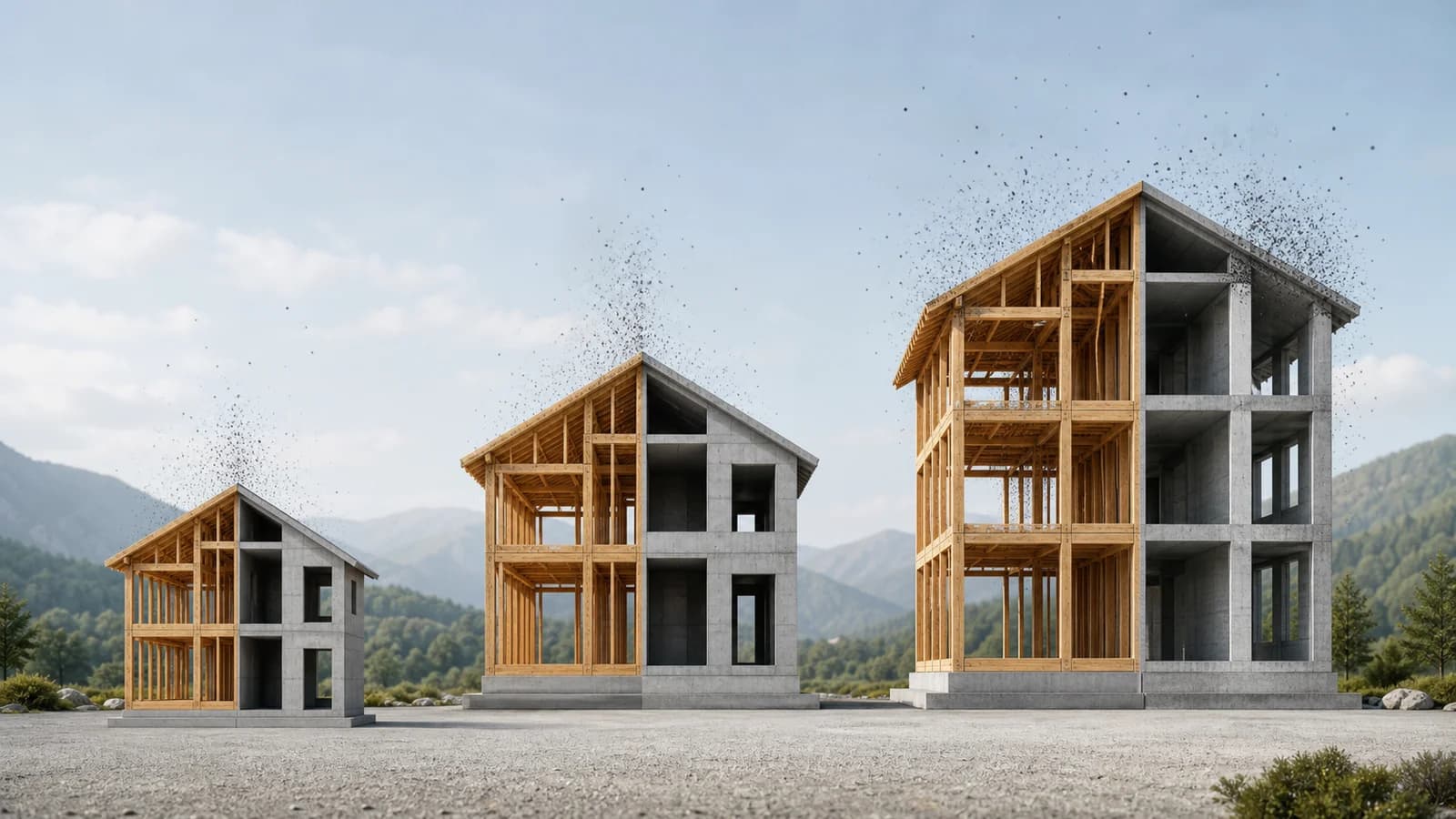
A 2026 Korean life-cycle assessment compared four timber-frame house designs with reinforced-concrete versions derived from the same national standard plans. Across those models, the timber options had 43% to 50% lower greenhouse-gas emissions in the material-production stage.
That is a meaningful result for the designs studied. It is not a universal reduction for every house, and the paper does not show that size alone determines the carbon advantage. The models use Korean design standards, regional data, a stated service life and several simplifying assumptions. A reader should carry those conditions forward with the percentages.
What the researchers modelled
The study began with four timber-frame houses based on standard designs published by the Korea Forest Service. The houses differed in floor area and configuration. Researchers then converted each design into a reinforced-concrete alternative so they could compare material production, construction, use and disposal over the assumed building life.
This is more informative than comparing a generic tonne of concrete with a generic cubic metre of wood. Both options originate from the same architectural house type. However, the conversion did not produce perfectly identical geometry.
The paper reports dimensional changes caused by the concrete wall system. Interior dimensions were reduced by 63 mm in the converted models, and roof or overall height changed in at least one case. Roof area could therefore change as well. Those differences do not invalidate the study, but they limit the claim to the modelled alternatives rather than a perfectly controlled material substitution.
The material-production result
For the material-production stage, the four timber-frame alternatives were reported to have 43% to 50% lower greenhouse-gas emissions than their concrete counterparts.
This is the result most relevant to an early material-inventory comparison. It reflects the quantities and emission factors selected for these Korean house designs. It should not be converted into the statement that “timber houses are 43–50% lower” without the regional and methodological qualification.
The study also reports 21 to 34 tonnes of CO₂ stored in the timber products, depending on the model. Stored biogenic carbon should be shown separately from fossil and other production emissions. Combining it immediately with avoided emissions can make it difficult to see what was emitted, what was stored temporarily in products and what end-of-life assumption controls the later release or transfer.
What happened over the modelled life cycle
The paper used a 40-year baseline service life and included operational energy. In the total results, the use stage dominated both structural options. The largest absolute difference between timber and concrete was reported for the Farm-41 model: 52.6 tonnes of CO₂ over the assessed life cycle.
The study’s operational-energy input was based on energy statistics associated with house scale. It was not a simulation showing that the timber structural system itself consumed less operational energy than the concrete version. This matters because a large whole-life difference can appear precise even when the dominant input is common to, or only loosely differentiated between, the two structures.
The authors also tested 30- and 50-year service lives. Total emissions moved by roughly 20% in either direction, while the relative ordering of the alternatives remained. That sensitivity result supports the direction found in the models, but it also shows how strongly the total depends on an assumed study period.
Did the carbon gap change with scale?
Both structural systems showed lower emissions per square metre as house size increased. Absolute emissions and the difference between the alternatives did not follow the same pattern as intensity per square metre.
With only four models, it would be unsafe to describe this as a general law of scale. Larger buildings can distribute some fixed quantities over more floor area, but geometry, surface-to-floor ratio, spans, material efficiency and building systems also change. The paper itself calls for research using real buildings and a wider range of sizes.
The defensible conclusion is narrower: within these four standard-house models, size and configuration affected the reported totals and intensities. More evidence is needed before transferring the pattern to another country or building type.
Why regional data matters
Material emissions reflect production routes, electricity, transport assumptions, product specifications and the database used. A 2025 peer-reviewed study comparing five life-cycle databases found a wide spread in reported mass-timber results, especially where biogenic carbon was handled differently.
Another functionally equivalent comparison, for an eight-storey building in China, reported a different percentage for its own A1–A5 scope. That is not a contradiction. It demonstrates that a result belongs to a project, region, life-cycle boundary and method.
For a new estimate, the useful question is not “Which published percentage should I use?” It is “Which quantities and factors describe my design?”
Translate the study into your own A1–A3 inventory
The FrameVerk Embodied Carbon Calculator can help compare the product-stage portion of a timber and concrete option. Build a baseline and alternative using the actual material quantities, then attach A1–A3 factors whose units and geography are visible.
The natural action is: “Test a timber-versus-concrete material inventory.”
The calculator does not reproduce the Korean whole-life model. It does not calculate operational energy, select a structural system, correct geometric differences, determine service life or resolve the future treatment of biogenic carbon. Its result should remain an A1–A3 estimate.
A checklist for using the paper responsibly
When citing or applying the study:
- Say that there were four modelled Korean standard-house types.
- Attach the 43–50% range to the material-production stage.
- Keep stored biogenic carbon separate.
- Note the 40-year baseline and the 30-/50-year sensitivity.
- Explain that operational energy dominates the whole-life totals.
- Disclose that the converted structures were not geometrically identical.
- Avoid turning four cases into a universal scale rule.
The paper adds useful evidence to the timber-versus-concrete discussion because it exposes how results change across several house models. Its value is greatest when the limitations remain visible.
Sources
- Han, Yang and Kim, “Comparative Analysis of Greenhouse Gas Emissions between a Timber-Framed House Based on Korea’s Standard Design and a Concrete House with a Converted Structure,” BioResources, 2026: https://bioresources.cnr.ncsu.edu/resources/comparative-analysis-of-greenhouse-gas-emissions-between-a-timber-framed-house-based-on-koreas-standard-design-and-a-concrete-house-with-a-converted-structure/
- Korea Forest Service, standard-design source for the house models, accessed 30 July 2026: https://www.forest.go.kr/kfsweb/cop/bbs/selectBoardArticle.do%3Bjsessionid%3D0liGI9viNLSw2WraCN1XFKM7zpOWlOX0h7zs8p50p1pEG7XrTBTYXKO14elxPirI.frswas02_servlet_engine5?bbsId=BBSMSTR_1804&mn=AR01_04_01_03&nttId=3144652&orgId=&pageIndex=1&pageUnit=10
- “Comparative Life Cycle Assessment of an Eight-Story Mass Timber Building and a Reinforced Concrete Alternative,” Sustainability, 2022: https://doi.org/10.3390/su14010144
- Duan et al., database comparison for mass-timber life-cycle assessment, Resources, Conservation and Recycling, 2025: https://doi.org/10.1016/j.resconrec.2025.108491
Embodied carbon screening
Model A1-A3 material inventories
Estimate product-stage A1-A3 emissions with bundled open, generic typical factors from Boverket’s Climate Database. This is an indicative screening estimate, not a project-specific or certified LCA.
Inputs and calculations stay in this browser session; they are not saved to a FrameVerk project or account.
Methodology and sources
The calculator uses bundled, versioned open generic typical A1-A3 factors from Boverket’s Climate Database. No factor data is fetched at runtime, and inputs and results stay in the browser.
A1-A3 boundary
A1-A3 covers raw-material supply, transport to manufacturing and manufacturing. The bundled factors are generic screening data, not project- or product-specific evidence, and this is not a whole-life assessment.
What is excluded
A4 transport, A5 construction, use, maintenance, replacement, end of life, module D and functional-performance verification are excluded.
Biogenic carbon
Timber products can contain temporarily stored biogenic carbon. Direct GWP-GHG excludes biogenic uptake and emissions; any source-reported stored carbon is shown separately and never treated as an extra credit. A1-A3 does not describe end-of-life release, reuse or recycling, or storage permanence.
Uncertainty
Boverket’s generic typical factors are not project-specific. Factor choice, geography, product specification, quantities, functional equivalence and omitted life-cycle stages can materially change this indicative estimate.
Methodology authorities
Factor sources
Sawn softwood timber — Sawn timber, u 16 %, coniferous
- Factor version
- BOVERKET-6000000007 · 02.07.000
- Declared unit
- 1 kg
- Direct GWP-GHG A1-A3 factor
- 0.064 kgCO₂e / 1 kg
- System boundary
- A1-A3
- Publisher
- Boverket (Swedish National Board of Housing, Building and Planning)
- Production geography
- Swedish market — Generic value representative of products consumed on the Swedish market; not product- or project-specific.
- Next review
- Jan 20, 2027
Cross-laminated timber (CLT) — Cross-laminated timber, u 12 %, coniferous
- Factor version
- BOVERKET-6000000167 · 02.07.000
- Declared unit
- 1 kg
- Direct GWP-GHG A1-A3 factor
- 0.096 kgCO₂e / 1 kg
- System boundary
- A1-A3
- Publisher
- Boverket (Swedish National Board of Housing, Building and Planning)
- Production geography
- Swedish market — Generic value representative of products consumed on the Swedish market; not product- or project-specific.
- Next review
- Jan 20, 2027
Glued laminated timber (glulam) — Glulam, u 12 %, spruce
- Factor version
- BOVERKET-6000000168 · 02.07.000
- Declared unit
- 1 kg
- Direct GWP-GHG A1-A3 factor
- 0.106 kgCO₂e / 1 kg
- System boundary
- A1-A3
- Publisher
- Boverket (Swedish National Board of Housing, Building and Planning)
- Production geography
- Swedish market — Generic value representative of products consumed on the Swedish market; not product- or project-specific.
- Next review
- Jan 20, 2027
Laminated veneer lumber (LVL) — Laminated veneer lumber (LVL)
- Factor version
- BOVERKET-6000000185 · 02.07.000
- Declared unit
- 1 kg
- Direct GWP-GHG A1-A3 factor
- 0.306 kgCO₂e / 1 kg
- System boundary
- A1-A3
- Publisher
- Boverket (Swedish National Board of Housing, Building and Planning)
- Production geography
- Swedish market — Generic value representative of products consumed on the Swedish market; not product- or project-specific.
- Next review
- Jan 20, 2027
Concrete C30/37 — Ready-mix made concrete, buildings C30/37
- Factor version
- BOVERKET-6000000032 · 02.07.000
- Declared unit
- 1 kg
- Direct GWP-GHG A1-A3 factor
- 0.116 kgCO₂e / 1 kg
- System boundary
- A1-A3
- Publisher
- Boverket (Swedish National Board of Housing, Building and Planning)
- Production geography
- Swedish market — Generic value representative of products consumed on the Swedish market; not product- or project-specific.
- Next review
- Jan 20, 2027
Primary structural steel — Structural steel, all sorts, 80 % primary material
- Factor version
- BOVERKET-6000000150 · 02.07.000
- Declared unit
- 1 kg
- Direct GWP-GHG A1-A3 factor
- 2.52 kgCO₂e / 1 kg
- System boundary
- A1-A3
- Publisher
- Boverket (Swedish National Board of Housing, Building and Planning)
- Production geography
- Swedish market — Generic value representative of products consumed on the Swedish market; not product- or project-specific.
- Next review
- Jan 20, 2027
frameverk_a1_a3_2026_v1 · 02.07.000 · Jan 20, 2027