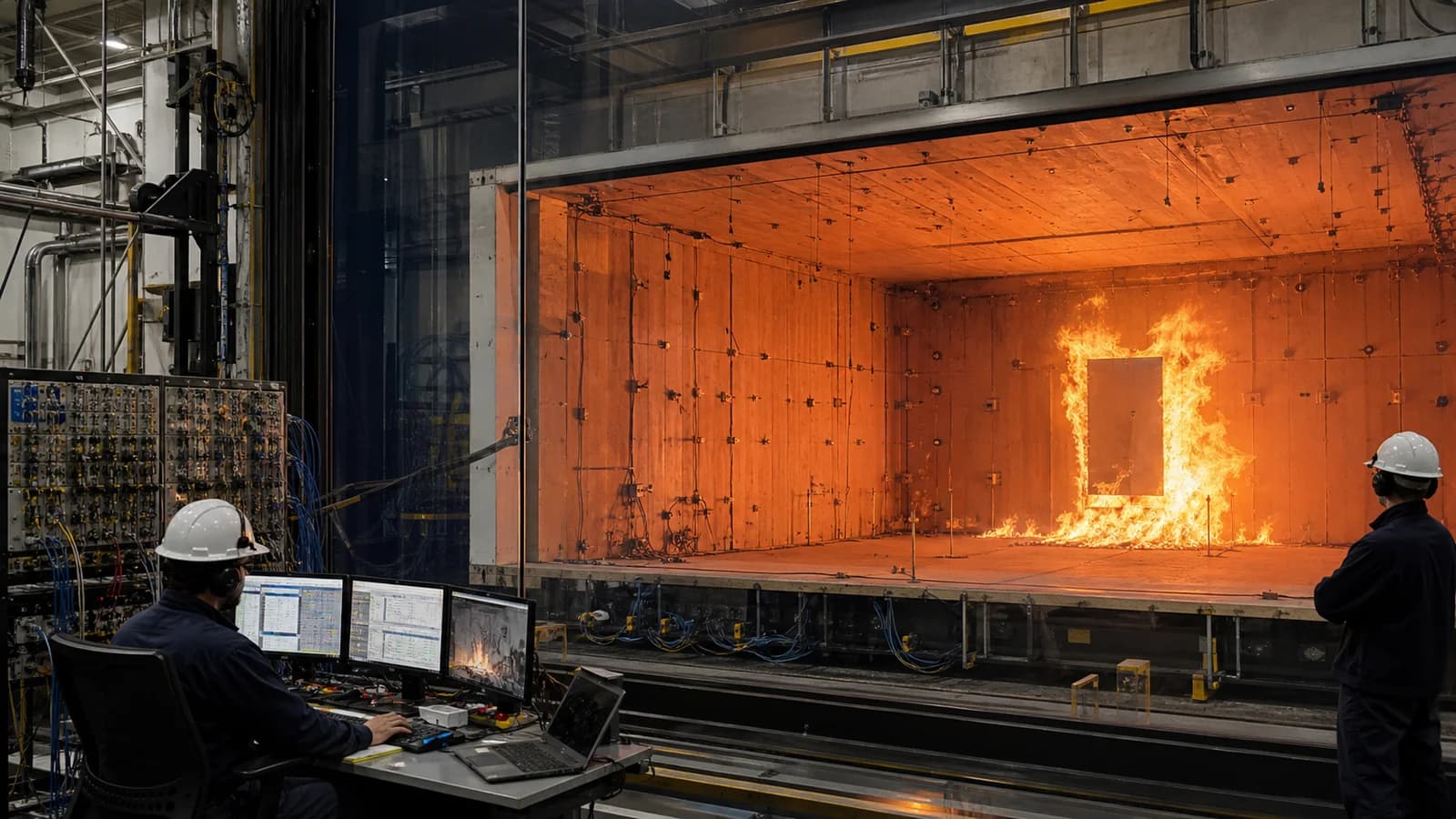
Inside WOODWISE: Full-Scale Fire Tests Put Mass Timber to the Test
USDA researchers and partners are burning room-sized CLT compartments to measure fire behaviour, emissions and the effect of exposed versus encapsulated timber.
What happens when a mass-timber room burns through an entire fire event? The WOODWISE research programme is using full-scale experiments to answer that question with measured data.
The first phase, reported by the USDA Forest Service in February 2026, brings together the Forest Products Laboratory, the Northern Research Station, Oregon State University, the US Environmental Protection Agency and engineering firm Arup.
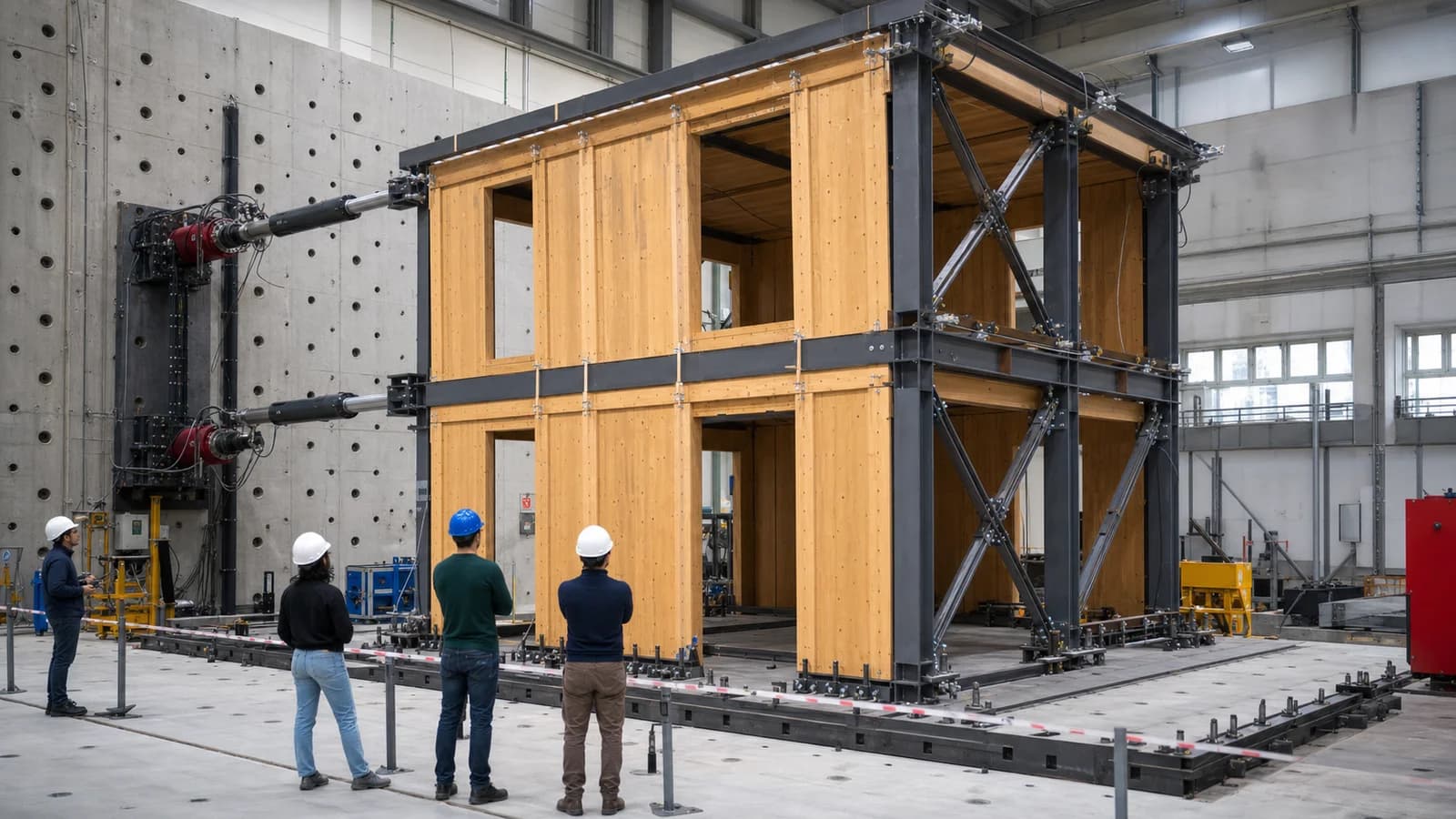
Researchers are testing room-sized compartments built with cross-laminated timber and equipped with extensive sensors. The objective is to measure fire development, heat, structural behaviour and emissions from ignition through decay.
Exposed, protected and partially exposed timber
The programme compares several configurations. One compartment is fully encapsulated with three layers of Type X gypsum board. Another leaves the timber surfaces exposed, while a third is partially exposed.
Tests use both household furnishings and controlled wood-crib fuel loads. This allows researchers to compare realistic room contents with repeatable experimental conditions.
The work also examines whether smaller-scale test methods can reliably predict full-scale behaviour. If that relationship can be validated, future product and assembly research may become faster and less expensive.
Why the complete fire duration matters
Mass timber chars at a predictable rate, and that char layer can protect the section behind it. But exposed timber can also contribute fuel to a compartment fire. Designers need to understand whether the fire decays, whether timber surfaces reignite and how connections and residual sections perform.
Full-duration tests provide information that a short resistance rating alone cannot capture. They can support better fire models, more precise encapsulation strategies and evidence-based building-code decisions.
The WOODWISE experiments do not create an immediate new code rule, and the first-phase announcement should not be interpreted as a final verdict on every mass-timber system. Results depend on geometry, ventilation, fuel, protection and detailing.
Their value is methodological: test real assemblies, instrument them thoroughly and publish evidence that engineers and regulators can evaluate. As taller and more complex timber buildings enter the market, that evidence is essential for safety and public confidence.
Source: USDA Forest Service, “WOODWISE Fire Experiments Improve Mass Timber Safety: Phase I”, 25 February 2026: https://research.fs.usda.gov/fpl/articles/woodwise-fire-experiments-improve-mass-timber-safety-phase-i