Norway Opens €200,000 Call for Zero-Waste Timber Construction Ideas
The NIBIO-coordinated WoodStock project will fund four European teams with up to €50,000 each to test circular products and building systems that use underutilised wood.
A Norway-coordinated European programme is putting small but targeted funding behind the next generation of timber construction. In September 2026, the WoodStock project plans to open a call that will award up to €50,000 each to four projects developing zero-waste wood construction solutions beyond Technology Readiness Level 5.
The total available support is therefore up to €200,000. The call is aimed at small and medium-sized companies, start-ups and non-profit organisations, applying alone or in consortia led by one of those eligible organisations. Applicants must be established in an EU member state or a country associated with Horizon Europe, including Norway. The deadline is planned for December 2026, with full guidance to be published through the EU Funding & Tenders Portal.
The material WoodStock wants to unlock
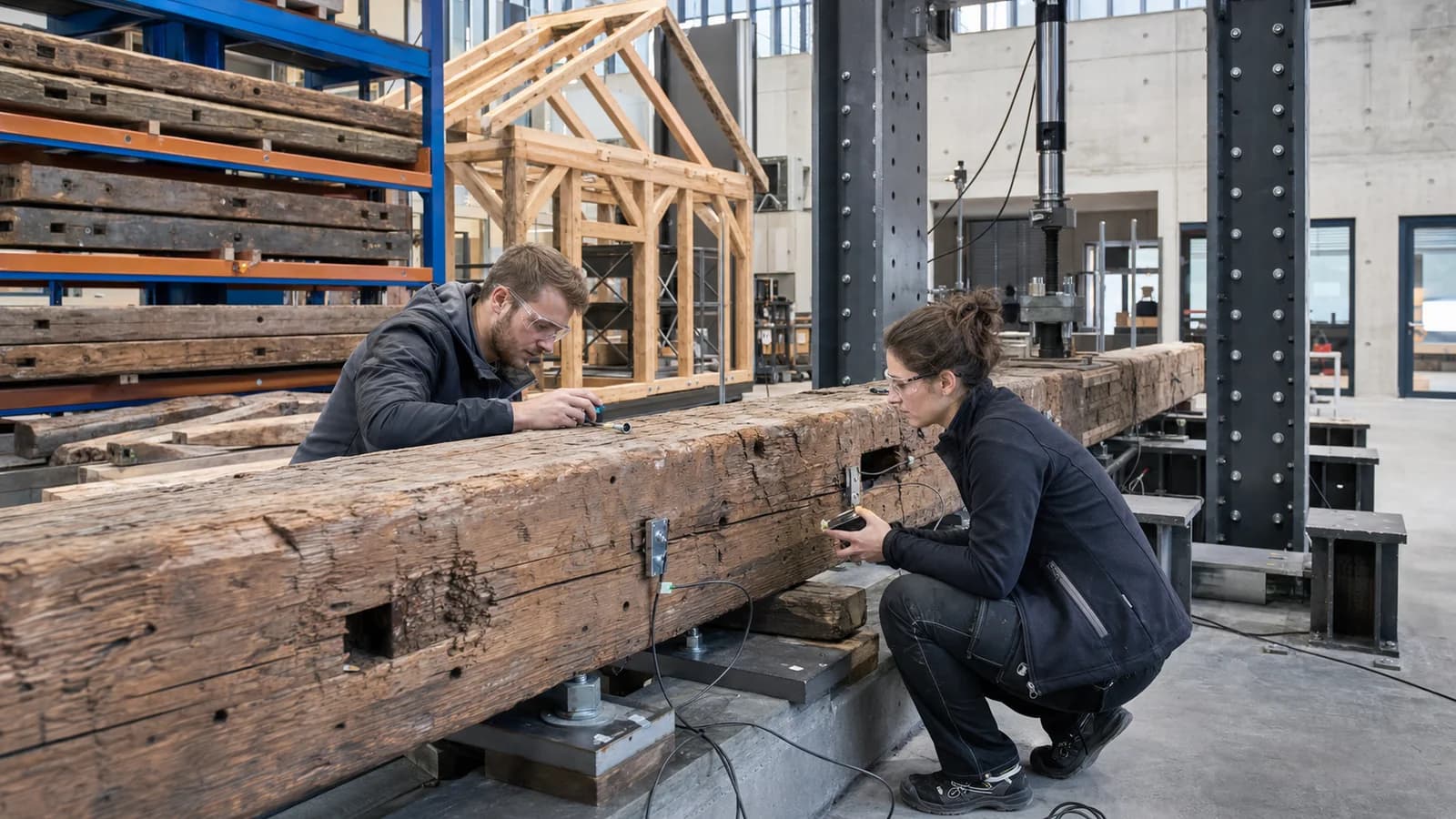
WoodStock focuses on timber resources that are technically available but commonly overlooked: hardwood, residual wood, lower-quality material and damaged wood. Modern timber construction often depends on consistent, certified feedstock and tightly controlled production. That improves reliability, but it can leave large parts of the forest and industrial resource outside higher-value building applications.
The call asks innovators to demonstrate circular and zero-waste approaches that can move such material into products, components or building concepts. At TRL 5 or above, an idea should already have moved beyond an early laboratory principle. The funding is intended to test, develop and scale solutions with a credible technical foundation—not to finance basic speculation.
Potential challenges are substantial. Variable feedstock must be characterised, graded and processed. Products need predictable structural or non-structural performance. Designers require reliable data, while manufacturers must achieve repeatable quality. A solution that uses more of each harvested tree is valuable only when it also meets safety, durability, cost and traceability requirements.
Why a Norwegian institute is coordinating
NIBIO, the Norwegian Institute of Bioeconomy Research, coordinates WoodStock. Its role places Norway at the intersection of forest research, material use and European construction innovation. The wider project runs from November 2024 to October 2028 and aims to create climate-smart solutions for greater use of underutilised wood in European buildings.
WoodStock’s programme goes beyond the four grants. It includes circular product and building design, frameworks for policy and business strategy, a European observatory for wood construction and a New European Bauhaus laboratory. The Bauhaus connection adds three linked criteria—sustainability, aesthetics and inclusion—rather than treating material efficiency as the only measure of success.
What this means for digital timber workflows
For design and fabrication software, non-standard wood is both an opportunity and a data problem. A conventional material library may assume fixed grades, standard sections and uninterrupted availability. Underutilised or recovered resources can vary by batch, species, dimensions and condition.
Useful digital workflows will need to connect inventory with design rules. A product record may require origin, grading method, moisture limits, permitted applications and machining constraints. Optimisation should consider whether a design can absorb changing stock without creating excessive manual engineering work.
The WoodStock grants are modest compared with the cost of certifying and commercialising a construction product. Their value is speed: four teams can test focused solutions, gather evidence and build partnerships before pursuing larger investment. The selection will also show which zero-waste concepts the programme considers mature enough to scale.
A call, not a completed breakthrough
The announcement should be read accurately. WoodStock has not yet selected the four projects, and the call’s full legal and evaluation documents were not available when NIBIO published its March 2026 notice. Applicants should consult the official portal when the call opens.
Nor has the programme proved that every underused wood stream belongs in structural construction. Some material may be better suited to panels, interiors, insulation or other long-lived products. The strongest proposals will likely match material quality to an appropriate use instead of forcing all feedstock into the same solution.
For Europe’s timber sector, the 2026 call is a practical signal. Circularity is being translated into specific experiments, eligibility rules and budgets. For Norwegian companies and research partners, it creates a direct route into a European market searching for ways to build more with the wood already available.
Sources: https://www.nibio.no/en/news/2026/grants-to-accelerate-climate-smart-wood-construction-in-europe https://www.nibio.no/en/projects/woodstock