Sweden Delivers CLT by Electric Truck—and Cuts Transport Emissions About 85%
Stora Enso’s first fully electric delivery programme carries roughly 400 m³ of CLT to ByggPartner’s new timber headquarters in Borlänge.
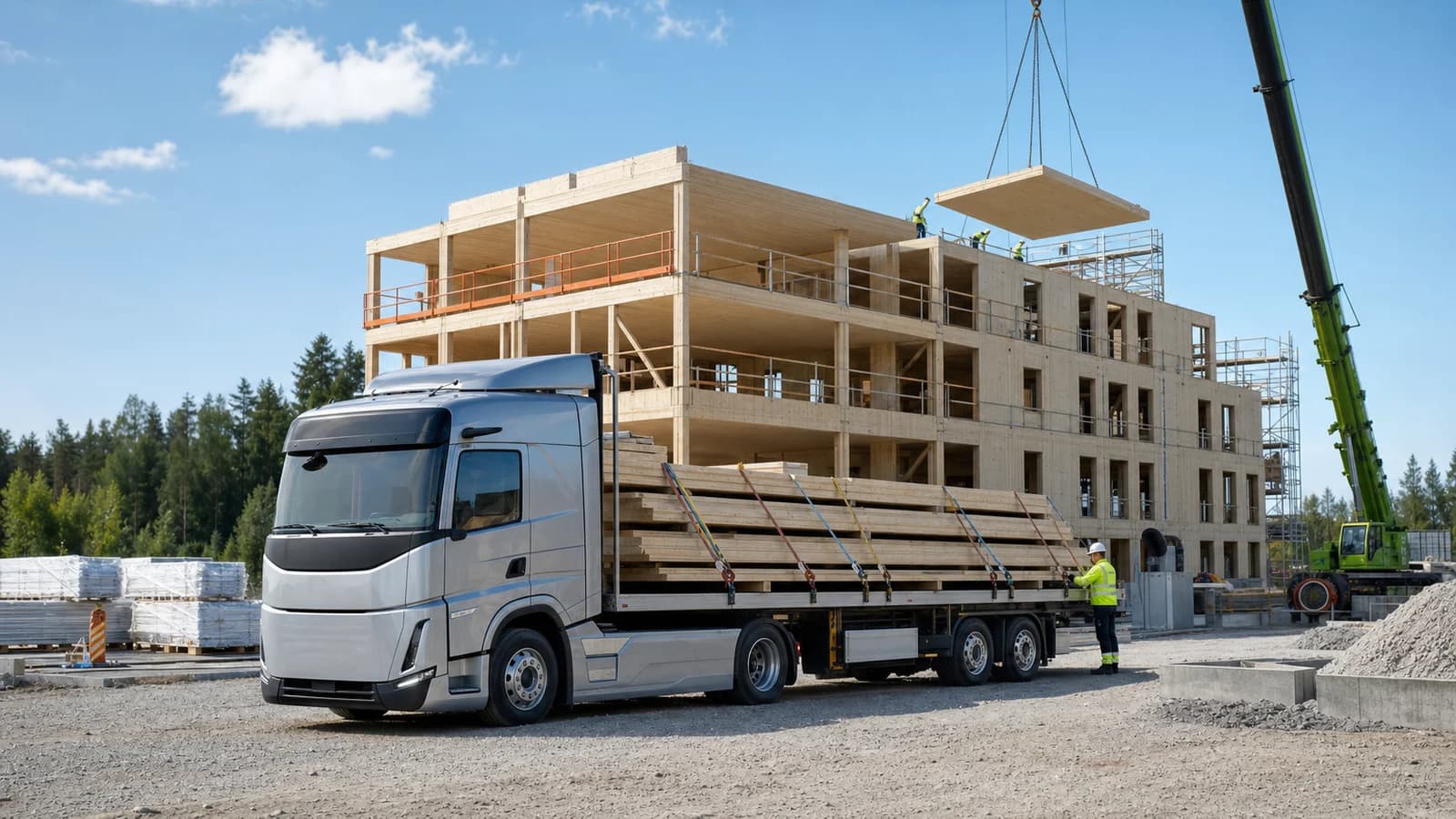
A Swedish office project is testing whether mass timber logistics can be decarbonised along with the building structure. Stora Enso and ByggPartner are delivering CLT elements entirely by electric truck from the Gruvön production site to a new headquarters in Borlänge.
Stora Enso describes it as the company’s first global project using fully electric truck deliveries for its Sylva CLT system. The company estimates that the electric route reduces transport-related carbon dioxide emissions by around 85% compared with diesel trucks.
A timber workplace built from a regional chain
ByggPartner’s three-storey headquarters is designed as an almost entirely timber-based workplace. Wood comes from regional forestry near the Gruvön CLT plant, further processing is carried out nearby and regional timber contractors handle assembly.
Stora Enso is supplying about 400 m³ of mass-timber elements. Installation began in 2026, and the building is planned to open in spring 2027.
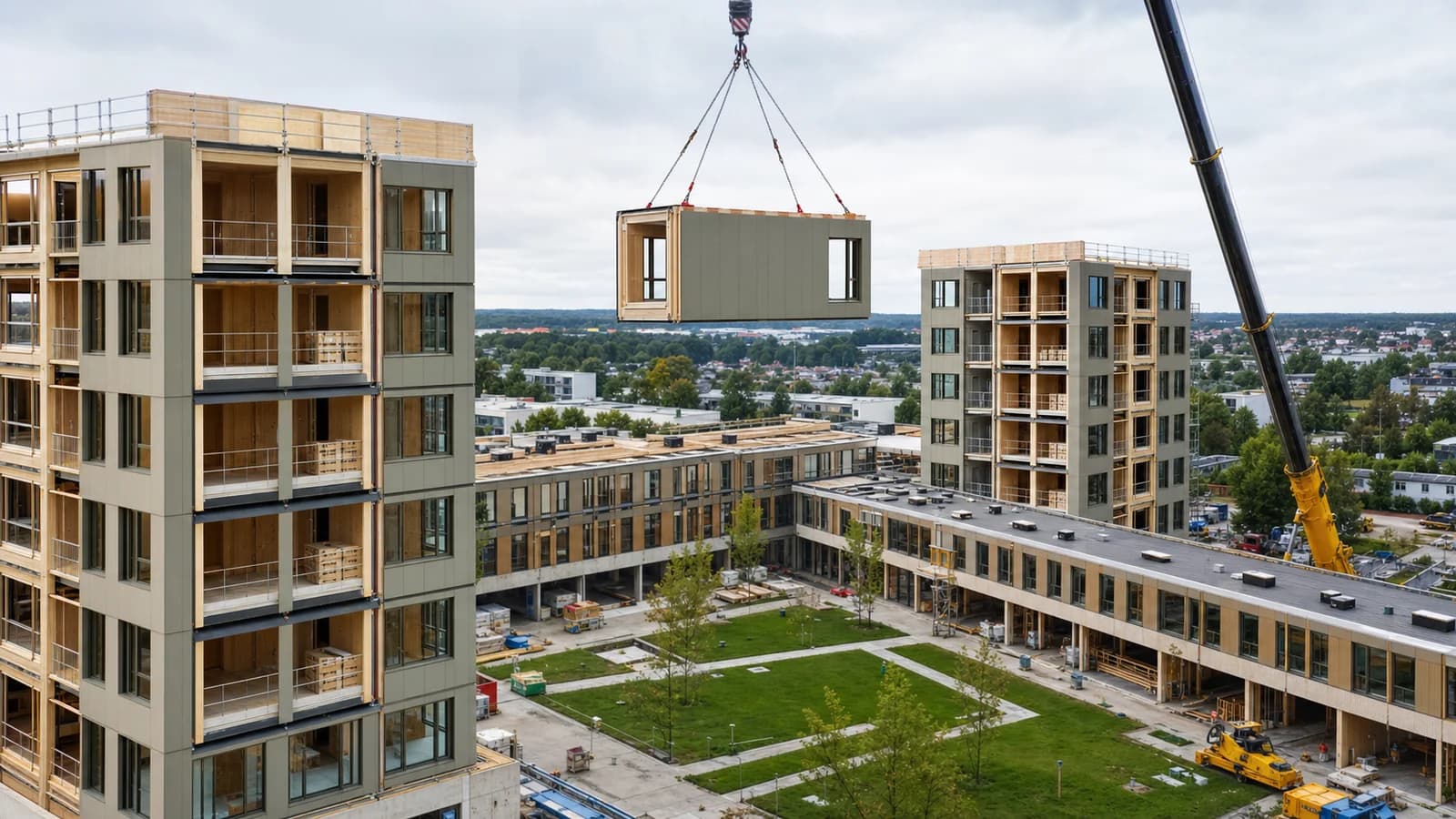
The project uses high-precision prefabrication to shorten site time and reduce waste. It also targets steel substitution where timber solutions can meet the structural requirement.
Logistics is part of embodied carbon
Discussions about mass timber often compare the product with concrete or steel at the factory gate. A real building also includes forestry operations, manufacturing, secondary processing, transport, lifting and site activity.
Electric delivery addresses one visible part of that chain. The truck is operated by LBC Frakt and connected to TREE, a 2024–2026 research and innovation programme coordinated by the Forestry Research Institute of Sweden.
The reduction claimed for this route should not be interpreted as an 85% reduction for the entire building. It refers to the transport comparison reported by Stora Enso. Overall performance still depends on electricity, distance, loading, production and the complete material system.
Electrification changes more than the truck
An electric route must account for vehicle range, charging time, payload and high-power infrastructure. A supplier cannot simply replace a diesel tractor and assume the logistics plan remains identical.
Construction deliveries are demanding because they interact with crane bookings, restricted access and short unloading windows. Reliable electrification therefore depends on coordination between mill, haulier, contractor and energy provider.
The Swedish pilot operates inside a real project rather than a closed demonstration. Data from repeated loads can show where charging fits into working time and whether winter conditions change performance.
Digital planning makes electric delivery practical
Heavy electric vehicles need charging infrastructure and carefully planned routes. Prefabricated CLT also arrives in an exact installation sequence; an element delivered too early occupies space, while one delivered late can stop the crane.
The production model, truck load and assembly schedule therefore need to share the same component identities.
This is where digital timber platforms can move beyond quantities. A panel can carry its fabrication status, load group, truck position and planned lift time. Logistics becomes an extension of the building model.
It can also make carbon reporting more specific. Instead of applying one generic transport factor, teams can record route, vehicle type, load and distance for each shipment. That distinction matters when a project claims improvement across its full value chain.
The same dataset can expose empty return journeys or panels shipped with unused capacity. Improving those details may be less visible than changing the structural material, but repeated logistics savings accumulate across every project delivered by a factory.
The Borlänge project is modest compared with a timber tower, but its logistics experiment is widely relevant. If timber construction aims to reduce embodied carbon, the industry must examine every transfer between forest, factory and site—not only the structure.
Source: Stora Enso, “Stora Enso and ByggPartner collaborate to aim for carbon emission reductions”, 30 June 2026: https://www.storaenso.com/en/newsroom/news/2026/6/stora-enso-andbyggpartner-collaborate-to-aim-for-carbon-emission-reductions