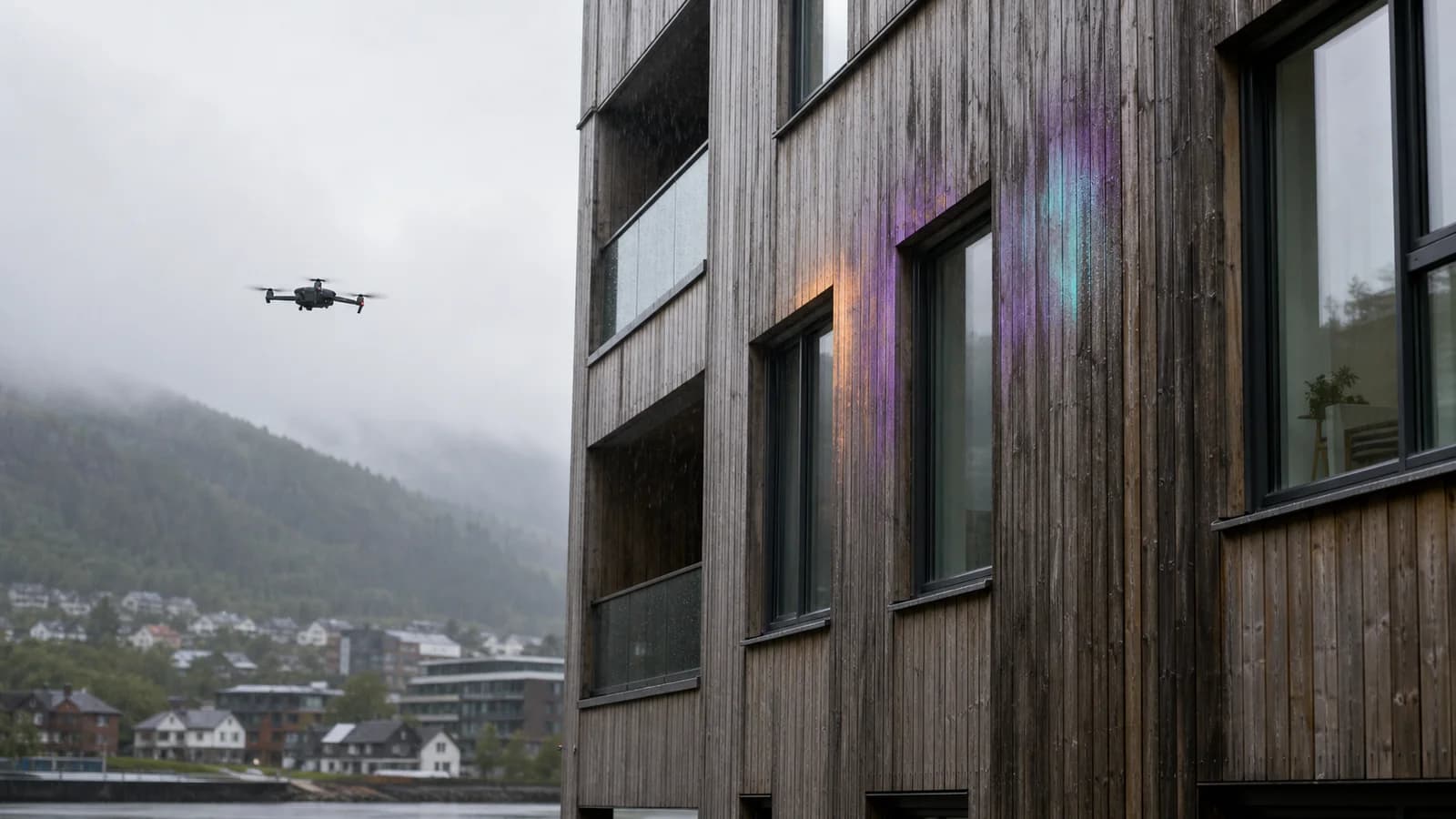
Norway’s SenseWood project wants drones to spot timber façade trouble early
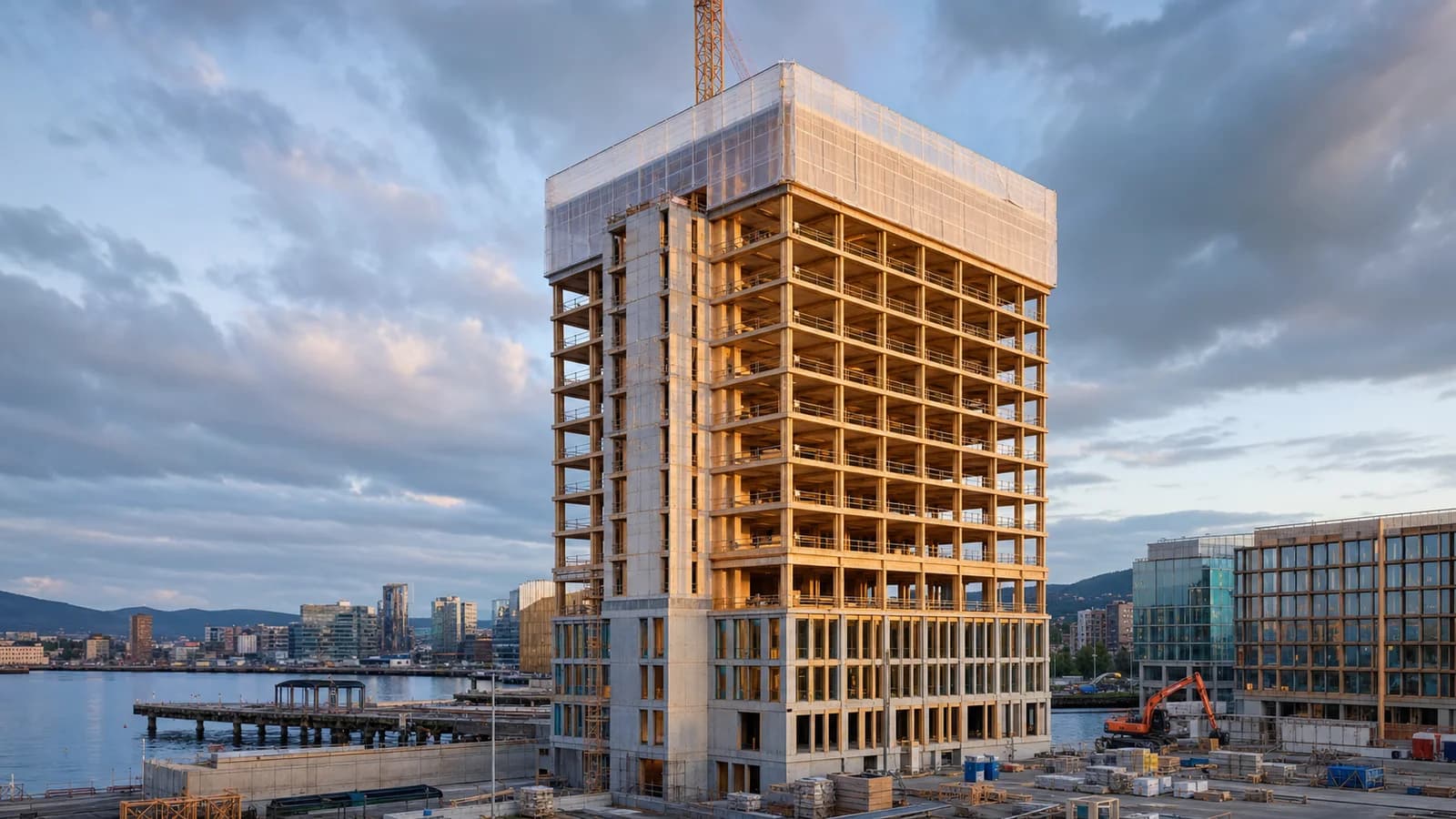
Launched in January 2026, SenseWood combines hyperspectral imaging, microclimate models and digital twins to predict moisture, fungal and fire-protection degradation on timber façades.
Timber façades age in public. Sun, rain, temperature and wind leave different signatures on every orientation, overhang and joint.
Norway’s SenseWood research project, launched in January 2026 and presented by NIBIO in March, aims to make that ageing more measurable. Researchers plan to use hyperspectral cameras—including systems mounted on drones—to detect moisture, biological degradation and changes in fire-retardant chemicals before problems become obvious to the eye.
The project runs through 2029 and brings together NIBIO and the Norwegian University of Life Sciences, with funding from the Research Council of Norway.
What hyperspectral imaging sees
A normal camera records broad bands of visible light. A hyperspectral camera captures many narrow wavelength bands, including information outside ordinary human vision. Material surfaces reflect those bands differently depending on chemistry, moisture and condition.
Researchers can train analytical methods to associate spectral patterns with known states in timber. The goal is not to produce prettier façade photographs. It is to classify risk areas and direct closer inspection or maintenance.
That distinction is important: remote sensing is a screening tool. A suspicious pixel does not prove structural decay. Results need calibration, reference measurements and expert interpretation.
From the sample to the whole elevation
Traditional inspection often relies on visual surveys and spot measurements. Those methods remain useful but can miss variation across a tall or inaccessible façade.
SenseWood links microscale observations to microclimate models. The team wants to simulate how local exposure changes across an entire building skin, then compare predicted risk with measured spectral data.
An NMBU doctoral project connected to SenseWood describes a digital twin for timber façades, combining remote inspection with models of weathering and degradation. If successful, that could help teams decide where maintenance is needed rather than applying the same interval to every surface.
Why fire-retardant condition belongs in the picture
Timber cladding on taller buildings may depend on fire-retardant treatments as part of an approved façade strategy. Weather exposure can change surface condition over time, so inspection cannot stop at colour and moisture.
The project intends to explore whether imaging can identify loss or degradation of fire-protection chemicals. That would be valuable, but it is also a high-stakes application. Any operational method would need conservative thresholds, validation across products and clear links to approved maintenance procedures.
The FrameVerk angle: design data should survive handover
SenseWood extends digital timber thinking from fabrication into operation. A useful building record would connect each façade zone to species, treatment, batch, orientation, detail, installation date and inspection history.
Drone data and risk maps then become more than floating files. They can update the identity of the actual component or zone, preserving a chain from design assumption to observed performance.
This approach also feeds back into design. If years of measurements show that particular junctions or exposures age faster, future projects can change overhangs, drainage, fixings or replacement strategy.
The façade is not a static texture applied to a model. It is a weathering system with geometry, chemistry and a maintenance life. SenseWood’s 2026 start is a useful attempt to let that system report back.
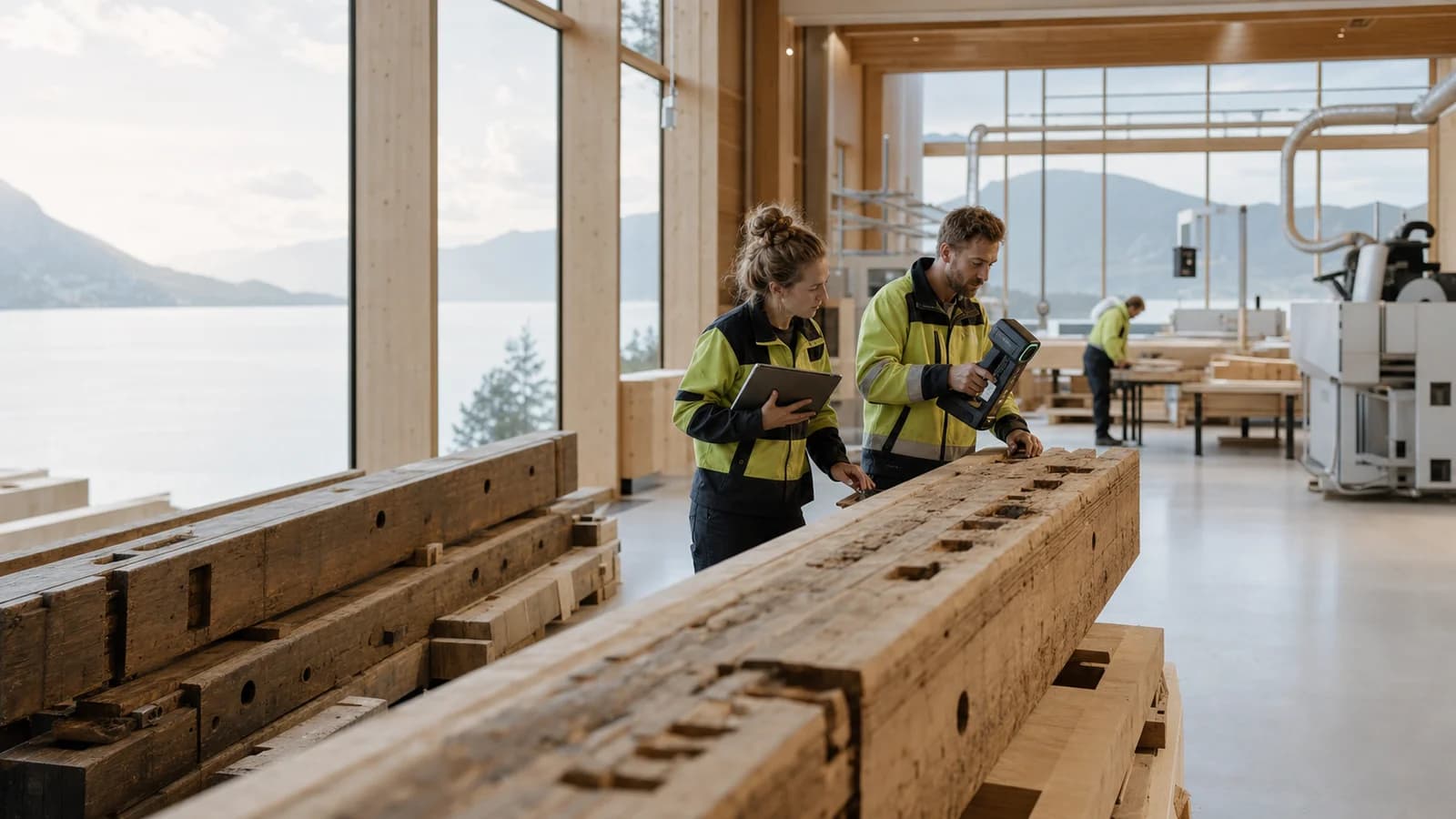
The research may also improve reuse decisions. SenseWood lists material classification before dismantling as one intended application. If imaging and component records can distinguish sound cladding from degraded pieces, fewer elements need to be discarded as an undifferentiated batch. That promise remains to be demonstrated, but it connects inspection directly to circular construction rather than treating maintenance and end of life as separate subjects.
Sources
- NIBIO, SenseWood project page and 17 March 2026 project news: https://www.nibio.no/en/projects/sensewood - NMBU/Jobbnorge, 2026 PhD brief, “Digital Twin for wood façades: from microclimate exposure to degradation risk”: https://www.jobbnorge.no/en/available-jobs/joblisting/pdf/298886 - NMBU, wood-research programme covering hyperspectral imaging and timber engineering: https://www.nmbu.no/en/research/projects/nmbuwood - Circular Economy and Sustainability, “Digital Innovations in Wooden Construction for a Circular Economy”: https://link.springer.com/article/10.1007/s43615-025-00667-4