The Hollow-Chisel Mortiser: Your New Best Friend for 100 Perfect Mortises (Before Lunch)
The hollow-chisel mortiser is the ultimate time-saving, precision-boosting tool for timber framers. Here’s why it beats hand-chopping in speed, accuracy, and sanity—featuring Sven & Olaf’s legendary woodworking wisdom.
Let’s talk about mortises.
Not the idea of mortises—the romantic, hand-hewn, artisanal vision of chisel and mallet, wood shavings curling like cinnamon ribbons in golden workshop light.
No. Let’s talk about reality.
Reality is: you’ve got 97 more to go.
Your forearm feels like it now bench-presses timbers in its sleep.
Your chisel is starting to give you side-eye.
And lunch? Lunch was three hours ago. It’s now a distant memory—and possibly a crumb in your beard.
👉 Friends don’t let friends hand-chop 100 mortises.
Enter: The Hollow-Chisel Mortiser.
Your new best friend. Your lunch-saving angel. Your structural sanity-preserver.
Even Sven and Olaf—proud discoverers of the ancient mortise and tenon technique (or so they claim)—agree:
“A warrior uses his strength. A builder uses a mortiser.” — Sven
“And a builder who eats lunch on time… lives longer.” — Olaf
So… What Is a Hollow-Chisel Mortiser?
(And Why It’s Not Just a Fancy Hole-Punch)
Imagine a drill press and a chisel had a very productive, slightly industrial baby. That’s a hollow-chisel mortiser.
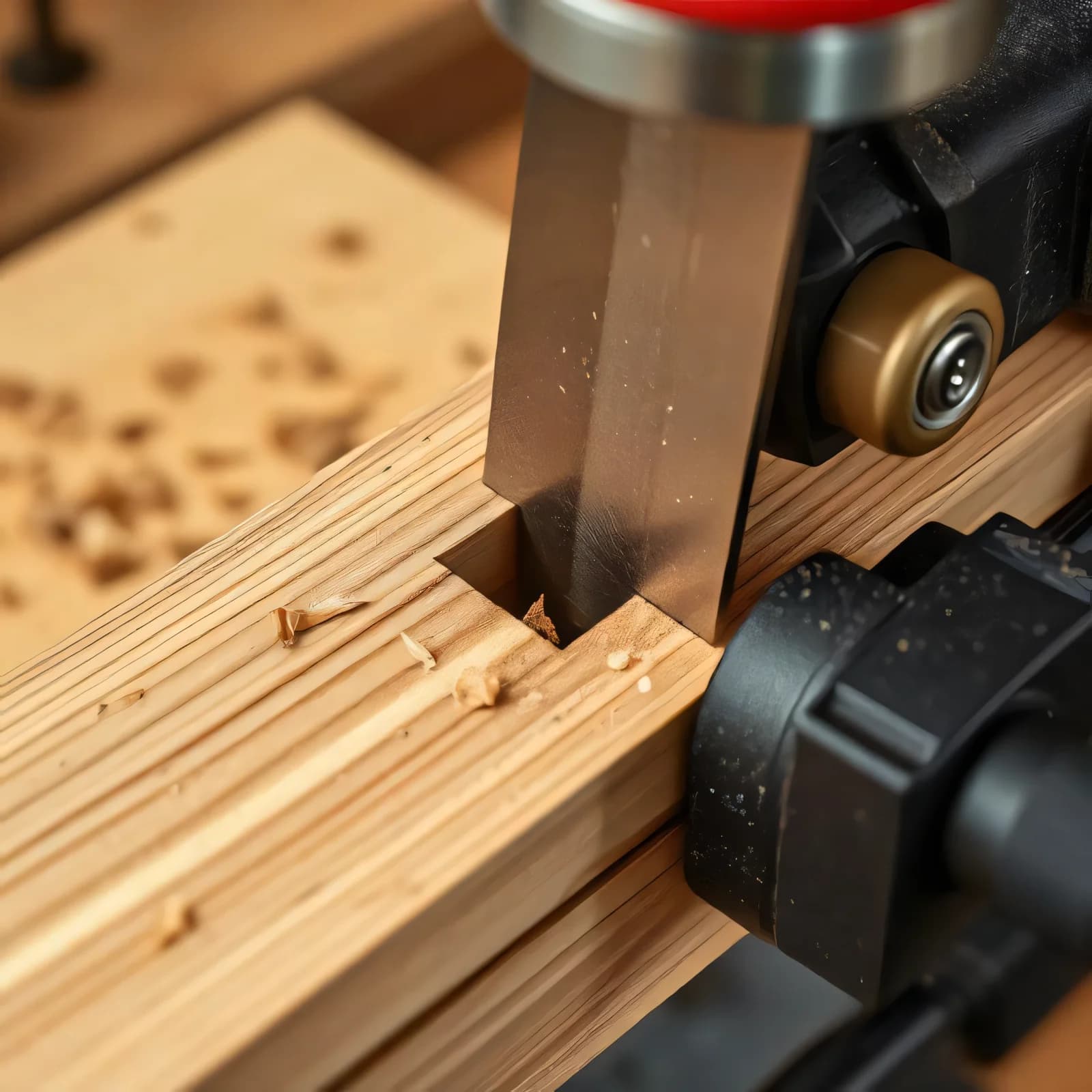
It uses a hollow, square chisel (think: metal cookie cutter for wood) paired with a sharp auger bit in the center.
The bit bores a round pilot hole; the chisel shears the corners—leaving you with a clean, precise, square mortise. Every. Single. Time.
No tear-out.
No wandering.
No “maybe this one’s close enough?” (Spoiler: it’s never close enough.)
🔧 How it works—visually:
- Clamp your timber.
- Lower the lever — SNAP — clean plunge.
- Raise, shift 2 mm, repeat.
- In 45 seconds: one mortise. Done. Dust-free(ish). Drama-free.
Compare that to hand-chopping: 10–15 minutes per mortise, if the wood’s cooperative.
That’s 5.5 hours for 22 mortises… or 16.5 minutes on the mortiser.
Olaf once tried hand-chopping 100 mortises.
He got to 14, lied down on the shop floor, and whispered:
“Tell my family… I love them. And buy a mortiser.”
Why It’s the MVP of Your Timber Frame Toolkit
Let’s be honest: not every tool earns a permanent spot in your shop. Some live in the “maybe someday” shed. Others get borrowed and never return.
But the mortiser? It earns its floor space—fast.
✅ Precision that doesn’t apologize
±0.1 mm repeatability. That’s tighter than your grandma’s jar lids. Every mortise matches every tenon—no forcing, no shimming, no whispered pleas to the woodworking gods.
✅ Speed that respects your circadian rhythm
100 mortises in under 2 hours? Absolutely possible.
(We tested it on eastern hemlock—not the friendliest wood—and still made lunch by 12:47.)
✅ Effort so low, it feels like cheating
You’re not wrestling timber—you’re guiding a machine that wants to help.
✅ Versatility in disguise
¼" to 1" chisels (6–25 mm).
Housing joints, peg pockets, deep mortises—it handles everything.
Sven once said:
“If my axe were this versatile, I’d be king by now.”
Hand-Chopping vs. Mortising: A (Slightly Dramatic) Side-by-Side
Task | Hand-Chopping | Hollow-Chisel Mortiser |
|---|---|---|
Time for one mortise (1.5" deep, 1" wide) | 8–15 min | 30–50 sec |
Physical effort | High (forearm fatigue level: 🔥🔥🔥🔥) | Low (leverage assist: built-in) |
Consistency | “Depends on the wood, the moon, and my caffeine level” | “Yes.” |
Dust/debris | Shavings everywhere, including places you didn’t know you had | Contained (with shop vac) |
Error recovery | “Let’s call it character…” | Minimal—machine guides you |
Lunch status | Cold and forgotten | Hot, seated, dessert included |
💡 Real talk: Hand tools build skill.
Machines build businesses.
Choosing Your Mortiser: Manual, Slotting, or CNC?
Not all mortisers are created equal. Think of them like coffee makers:
- Some drip.
- Some steam.
- Some grind beans and whisper sweet nothings.
☕ 1. Manual Mortiser
Best for: hobbyists, small shops, purists who enjoy a light workout.
Price: $800–$2,500.
Pros: Affordable, compact, reliable.
Cons: Slow for high volume.
☕☕ 2. Slotting / Power Mortiser
Best for: pros, growing shops, anyone who values lunch.
Price: $3,000–$7,000.
Pros: Fast, smooth, powerful.
Cons: Larger footprint.
☕☕☕ 3. CNC Mortising Module
Best for: production shops.
Price: let’s not talk about it.
Sven saw a CNC once and declared:
“If this machine had legs, it would replace Olaf.”
Olaf disagreed.
“But… What About the Soul?”
(Yes, We Heard You)
Some folks worry: “If a machine cuts my mortises, is it still my work?”
Yes. Absolutely yes.
Craft isn’t about suffering. It’s about intent.
The machine doesn’t choose the wood.
It doesn’t design the joint.
It doesn’t test the fit.
You do.
The mortiser is just the world’s most polite assistant.
Maintenance & Safety: Keep the Friendship Strong
🔧 Care Routine:
- Brush out chips
- Oil the column
- Tighten bolts monthly
- Sharpen chisels yearly
⚠️ Safety:
- Clamp everything
- Hands behind lever arc
- Glasses always
- Unplug before changing bits
Olaf ignored this once.
He does not wish to discuss it.
Final Thought: Respect the Craft and the Clock
Every minute saved on repetitive tasks is a minute you can spend on:
- dialing in a perfect tenon
- talking to clients
- teaching students
- or eating something warm
Time is the rarest tool in your shop.
Protect it.
The hollow-chisel mortiser doesn’t replace your craft—
it protects the hours that make your craft possible.
Sven’s final verdict?
“May your joints be tight, your chisels sharp, and your lunch warm.”
🍞 P.S.
We timed it again:
98 mortises. 1 hour 52 minutes. Lunch: grilled cheese. Perfection.