Two Robots, 352 Screws: LASER Schedules a Full-Scale Timber Slab
University of Stuttgart researchers coordinated two robots to assemble a 2.4-by-6-metre timber slab through 108 subroutines and 352 screws, while respecting collisions and adhesive time limits.
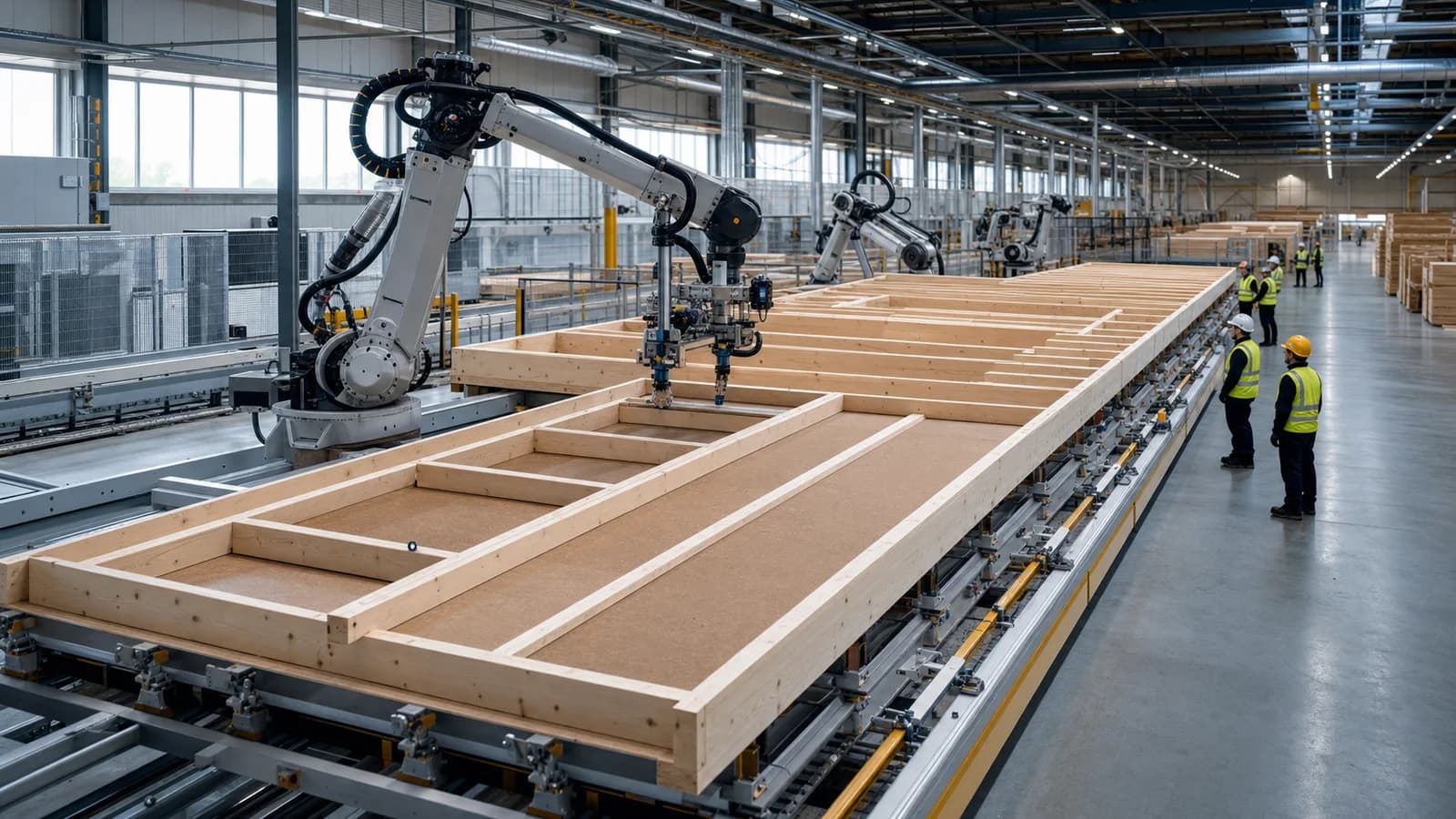
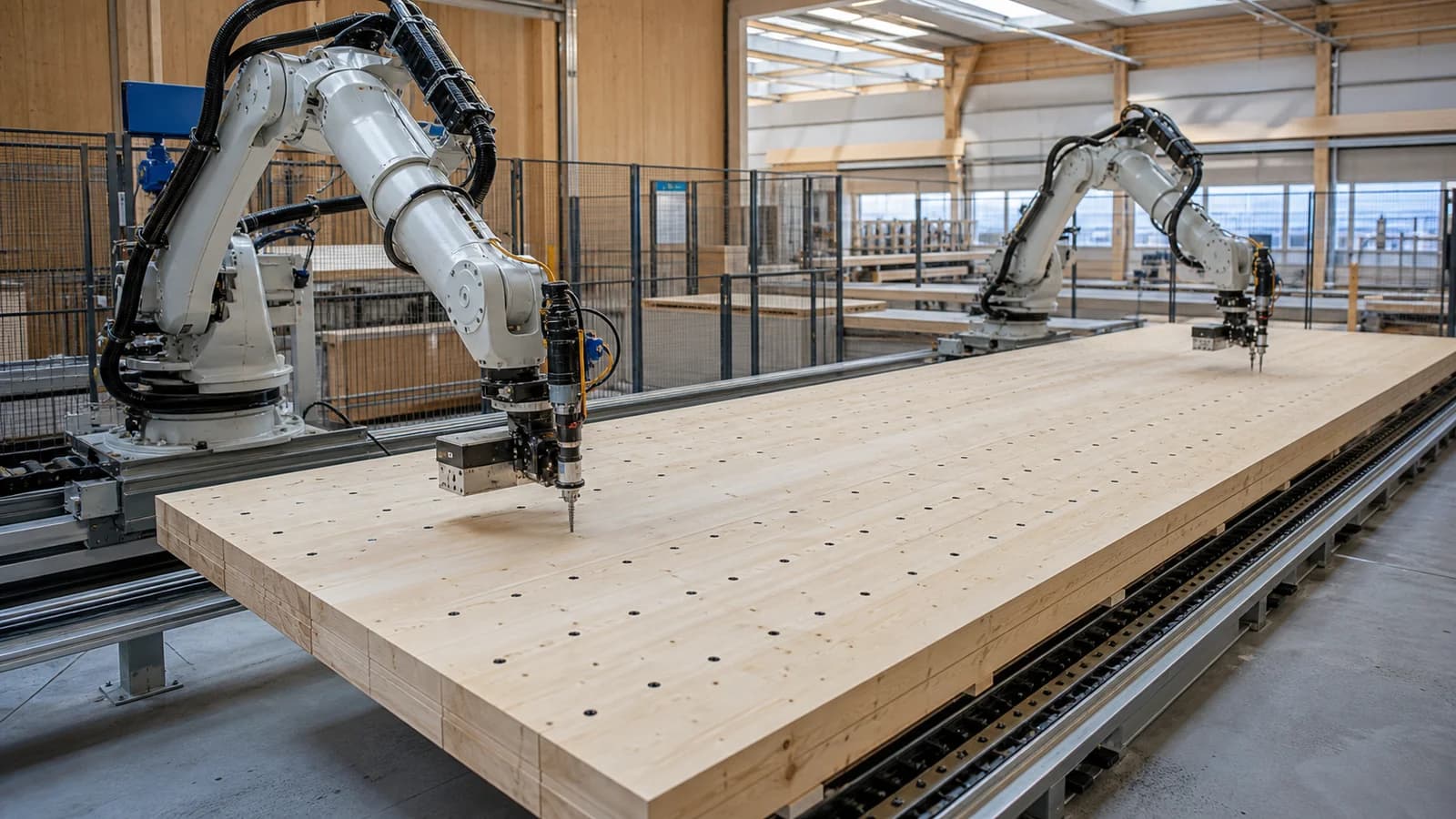
Two robots move along parallel tracks beside a full-scale timber slab. Each must pick tools, apply pressure and drive screws without colliding with the other. The adhesive is curing, so some tasks cannot politely wait until tomorrow.
That is the manufacturing problem addressed by LASER, a 2026 research framework from the University of Stuttgart’s computational construction ecosystem. The name stands for Level-Based Asynchronous Scheduling and Execution Regime. The team validated it by fabricating a 2.4-by-6-metre timber slab with two robots, 108 coordinated subroutines and 352 screws.
The screws are the easy part. Knowing exactly when two industrial robots can place them is the real project.
Why multi-robot work becomes difficult
A single robot already needs a collision-free path, reachable geometry, correct tooling and a reliable sequence. A second robot adds more than twice the planning problem because the machines share space and affect each other’s timing.
Timber assembly adds process constraints. In the demonstrated screw-press gluing system, screws provide distributed pressure while adhesive bonds the slab. Tasks must happen within defined time windows. A delayed operation can affect bond quality, while an over-conservative schedule wastes the potential of parallel work.
A single monolithic optimisation can become computationally heavy as the number of tasks grows. A simple fixed sequence, meanwhile, may leave one robot waiting even when useful work is available.
How LASER organises the work
The researchers formulate the process as a constraint-programming problem and introduce “levels”: sets of tasks that are spatially and temporally separated. Robots can work asynchronously within a level, then synchronise at a barrier before entering the next one.
The level structure guarantees collision-free operation by construction under the modelled constraints. It also provides robustness against timing variation because the machines do not need to match every motion second by second.
The team developed two specialised solution strategies. One uses iterative temporal relaxation for heterogeneous task sequences. The other applies a bi-level decomposition to more homogeneous work and balances the load between robots.
This is not robots improvising like jazz musicians. It is closer to a carefully written score that permits each player some independence without allowing the percussion section to drive into the piano.
The full-scale proof
The experimental slab is significant because construction robotics often performs well on small, isolated demonstrations and then struggles with production scale. Here, the test article measured 2.4 metres by 6 metres—a component with direct relevance to building floors.
The two robots were mounted on parallel linear tracks, increasing their working envelope. The system coordinated 108 subroutines and installed 352 screws while managing adhesive deadlines and shared space.
The associated research on a multi-robot screw-press gluing micro-factory describes a cyber-physical production approach for prefabricating components for a multi-storey timber building system. The broader IntCDC project targets grid-independent, biaxial floor systems with concentrated supports, integrating structural design, building physics, services and digital fabrication.
The robot schedule therefore sits inside a larger building-system question. Automation is useful when it produces a verified component with structural, acoustic, fire and service logic—not merely when it produces an impressive time-lapse video.
Why screw-press gluing is interesting
Traditional industrial pressing equipment can demand a large fixed investment and may constrain component geometry. Using screws to apply local pressure can make production equipment more adaptable, while robotic placement addresses the labour and consistency challenge of installing hundreds of fasteners.
The approach still needs engineering control. Adhesive selection, open time, pressure distribution, screw pattern, timber moisture and manufacturing tolerances influence the final bond. The robots execute the process; they do not remove the need to validate it.
If the building system changes, the manufacturing plan must change with it. That is why the link between computational design and robotic scheduling matters.
What this means for timber software
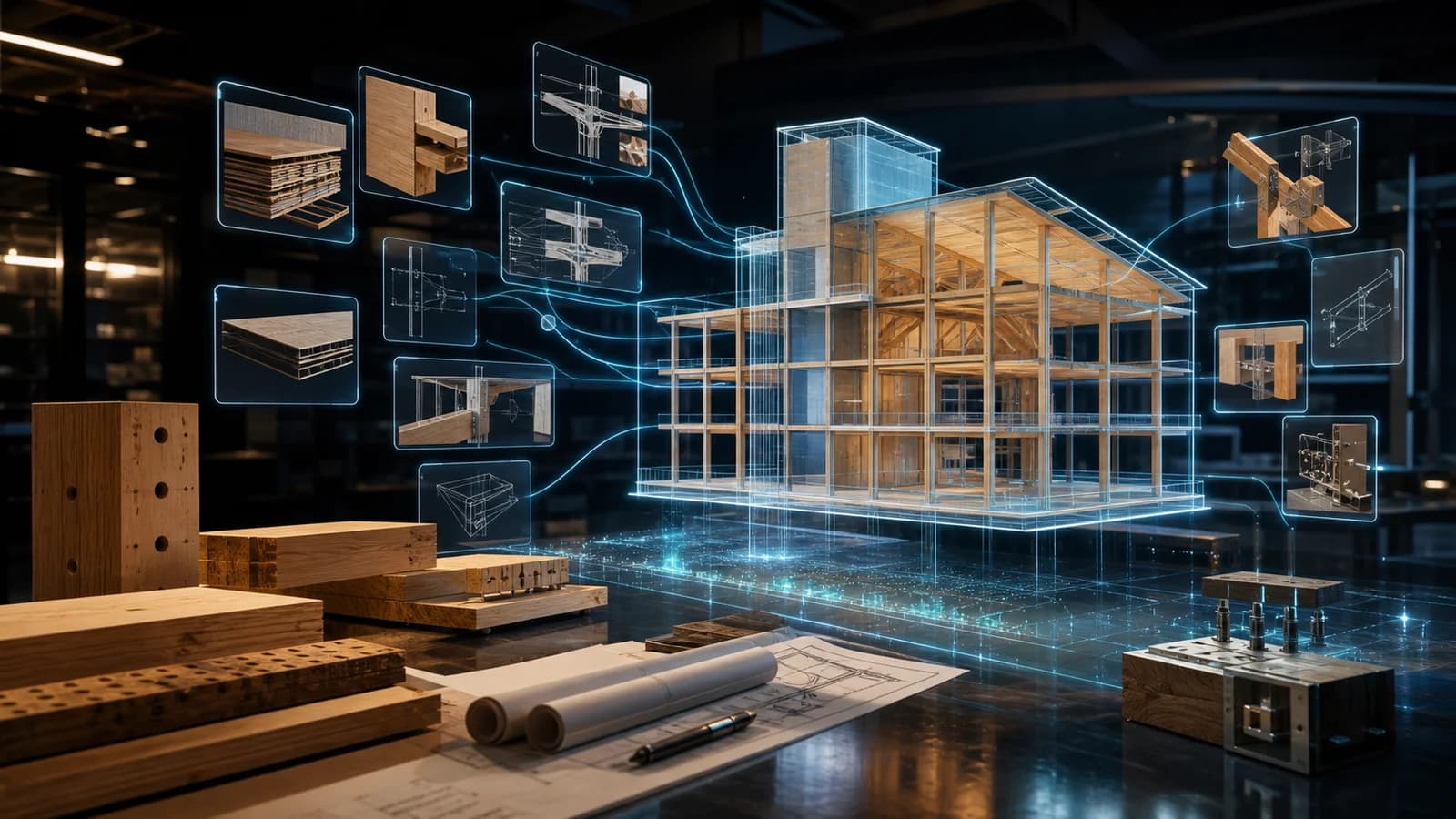
Most timber design applications stop before robot motion. They produce geometry, drawings and perhaps machine files. LASER shows the next layer of information: tasks have duration, dependencies, deadlines, tools, spatial envelopes and collision relationships.
A fabrication-ready component may therefore need more than a list of holes. It needs an executable assembly plan.
For a platform such as FrameVerk, the relevant lesson is not to add two animated robot icons to the interface. It is to preserve manufacturing semantics from the model onward. A screw has a position, type and purpose. An adhesive operation has an area and time window. A panel has an assembly sequence and verified state.
That information can support automated checks even before a factory owns multiple robots. It can improve work instructions, takt planning and quality records for human-led production.
The limits of the demonstration
LASER is research, not a claim that every timber factory should immediately install a pair of robots. The demonstrated process concerns a specific slab system and controlled manufacturing environment. Real factories also manage material variation, maintenance, operator safety, supply interruptions and product certification.
The schedule is only as trustworthy as its geometry, timing data and constraints. Unexpected obstructions, tool wear or a misplaced workpiece can require sensing and recovery strategies beyond an offline plan.
Economic value also depends on production volume and variation. A highly automated cell can be powerful for repeatable components, but a smaller shop may gain more from simpler CNC equipment and better digital coordination.
From robot choreography to building delivery
The importance of LASER lies in making multi-robot fabrication tractable under construction-specific constraints. It does not treat robots as isolated machines. It treats them as participants in a timed material process.
The full-scale slab gives the research a memorable statistic: 352 screws. The deeper achievement is coordinating 108 subroutines without collision while adhesive deadlines kept running.
Timber construction is often described as suitable for automation because components are lightweight and machinable. LASER demonstrates that suitability is not enough. Production needs scheduling logic that understands space, time and the building system simultaneously.
When those layers connect, a digital model can become more than a drawing. It can become a manufacturing plan precise enough for two robots to share—and, ideally, precise enough that neither robot needs to blame the architect.
Sources: Huang et al., “LASER: Level-Based Asynchronous Scheduling and Execution Regime for Spatiotemporally Constrained Multi-Robot Timber Manufacturing,” 21 March 2026: https://arxiv.org/abs/2603.20577
Construction Robotics, “Constraint to capability: a multi-robot screw-press gluing micro-factory for scalable and efficient multi-story timber slab assembly,” 2026: https://link.springer.com/article/10.1007/s41693-026-00190-4
University of Stuttgart IntCDC, “Multi-Storey Wood Building System”: https://www.intcdc.uni-stuttgart.de/research/research-projects/rp-3/